You scroll through Pinterest at midnight. You see that kitchen — white shiplap walls, a big wooden table, a farmhouse sink, and string lights softly glowing. Something inside you says, “I want that.”
But then you think — is this even possible for a regular person? Doesn’t it cost a fortune? Won’t it look outdated in two years?
Here’s the truth: modern farmhouse interior design is not just a trend. It’s a lifestyle. And the best part? It doesn’t have to break the bank.
Let’s dive into everything you need to know — room by room, tip by tip — so you can actually create this look in your own home.
What Exactly Is Modern Farmhouse Interior Design?
Before we get into the fun stuff, let’s get clear on what we’re talking about.
Modern farmhouse design is basically the love child of two styles — rustic farmhouse charm and clean, contemporary minimalism. Think of it like this: your grandmother’s cozy farmhouse had warmth and soul, but maybe it was a little too cluttered and dated. Modern design cleaned it up, added some sophistication, and the result is magic.
The key elements that make it work:
- Neutral color palettes (white, cream, gray, warm beige)
- Natural materials like wood, linen, and stone
- Black metal accents (light fixtures, faucets, cabinet handles)
- Shiplap walls or exposed brick
- Vintage or antique-inspired pieces mixed with modern furniture
- Open, airy floor plans with tons of natural light
The trick is balance. Too much rustic? It feels like a log cabin. Too much modern? It loses its soul. The sweet spot is where warmth meets simplicity.
Why Modern Farmhouse Style Is Still Dominating in 2025
“Isn’t the farmhouse trend over?” I get this question a lot. And honestly? No. Here’s why.
Modern farmhouse interior design has stuck around because it’s not really about following a trend — it’s about creating a home that feels genuinely lived-in and loved. In a world of sterile, cold interiors, people are craving warmth. They want a home that feels like a hug.
Plus, the style is incredibly adaptable. Whether you’re in a New York apartment, a Texas ranch, or a suburban home in Ohio, you can make farmhouse elements work. The bones of the style are flexible.
Joanna Gaines didn’t accidentally build an empire around this aesthetic. She understood that people don’t just want a beautiful home — they want a meaningful one.
The Living Room: Where the Magic Starts
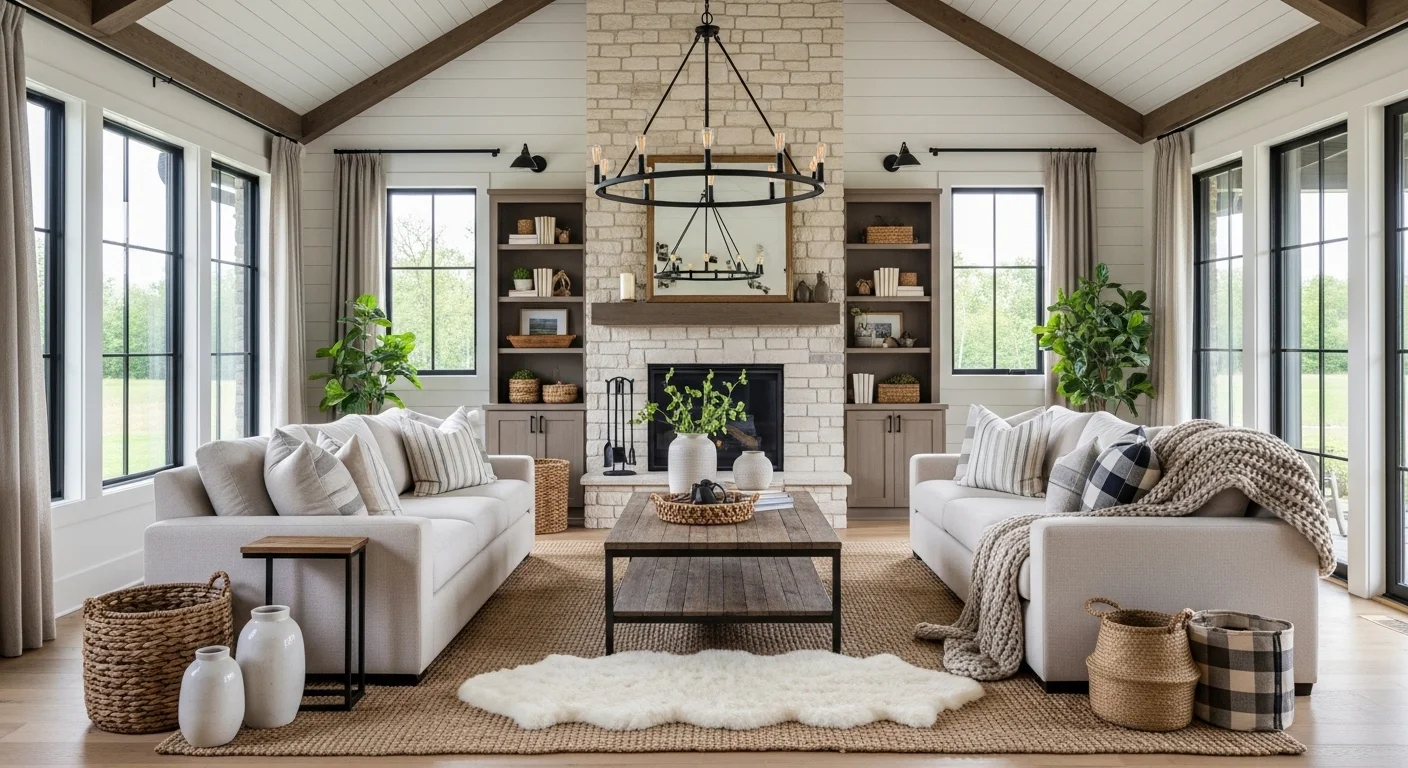
Your living room is the heart of your home. It’s where everyone gathers, so it should feel both welcoming and beautiful. Here’s how to nail the modern farmhouse look in this space.
Start With a Neutral Base
Paint your walls in a warm white or soft greige (that gray-beige combo everyone loves). Something like Sherwin-Williams “Alabaster” or Benjamin Moore’s “White Dove” works like a dream.
Don’t go stark white. It’s too cold. You want warmth — like the color of fresh cream in morning coffee.
Layer Your Textures
This is the secret weapon of modern farmhouse interior design that most people miss. It’s not just about what you put in the room — it’s about how different materials interact with each other.
Layer these textures:
- A chunky knit throw on the sofa
- A jute or sisal area rug on wood floors
- Linen or cotton curtains that pool slightly on the floor
- A reclaimed wood coffee table
- Metal (black or brushed bronze) lamp bases
When all these textures come together, your room starts to feel rich, layered, and alive — without a single piece of expensive furniture.
The Shiplap Moment
You can’t talk about modern farmhouse design without talking about shiplap. That iconic horizontal wood paneling changed everything.
Here’s the thing though — you don’t need to shiplap every wall. Pick one. Make it an accent wall behind your sofa or fireplace. Paint it white and let it breathe. That’s enough to completely transform the room.
If shiplap isn’t in your budget, wallpaper with a shiplap print works surprisingly well. Nobody will know the difference at a dinner party.
Don’t Forget the Fireplace
A farmhouse living room without a fireplace? It still works. But if you have one — celebrate it.
Surround it with white painted brick or a simple wooden mantel. Style the mantel with a mix of organic elements (a little plant, some candles, maybe a old clock or lantern) and keep it simple. Resist the urge to overcrowd it.
The Farmhouse Kitchen: The Star of the Show
If you ask anyone what their favorite part of a farmhouse home is, nine times out of ten they’ll say the kitchen. And that makes total sense.
The kitchen is where the real character shows up.
The Farmhouse Sink — Non-Negotiable?
Okay, it’s not literally non-negotiable. But if you can swing it, a farmhouse sink (also called an apron-front sink) is one of the single biggest visual upgrades you can make.
That deep, wide basin just looks so right in a farmhouse kitchen. In white fireclay? Even better.
If it’s not in the budget, no worries. A white undermount sink with black hardware achieves a similar vibe for a fraction of the cost.
Open Shelving — Brave But Beautiful
Here’s a controversial farmhouse kitchen move: open shelving instead of upper cabinets.
Yes, it means your dishes are always visible. Yes, it requires some organization. But when done right, open shelving with neatly stacked white dishes, a few wooden cutting boards leaning against the back wall, and a little potted herb — it looks like a magazine cover.
If you’re not ready for full commitment, try removing just two upper cabinet doors and see how you feel about it.
The Cabinet Color Game
White cabinets are the farmhouse classic. But honestly? Navy blue, forest green, or even charcoal lower cabinets with white uppers is a move that takes your farmhouse kitchen from basic to breathtaking.
The two-tone cabinet look is big right now, and it works beautifully with farmhouse aesthetics.
Hardware Matters More Than You Think
Swap out those generic silver cabinet handles. Replace them with matte black hardware or antique brass pulls. This single change costs less than $100 total and completely modernizes the space.
It sounds small. It is not small.
The Farmhouse Bedroom: A Retreat You’ll Actually Rest In
Your bedroom should feel like a soft landing after a long day. Modern farmhouse bedroom design does this better than almost any other style.
The Bed Is Everything
Go big with the bed. In modern farmhouse design, an upholstered linen headboard or a wooden platform bed anchors the entire room. Either works beautifully.
If you can find an antique iron bed frame at a flea market or thrift store — grab it. Sand it down, paint it matte black, and you’ve got a statement piece for almost nothing.
All-White Bedding (And Why It Works)
Stack up all-white bedding — layers of white linen, a white quilt, white shams — and then break it up with a single textured throw blanket in a warm neutral. Maybe a soft camel or dusty sage.
White bedding photographs beautifully, washes easily, and never goes out of style. It’s the farmhouse bedroom secret hiding in plain sight.
Shiplap in the Bedroom? Yes, Please.
If you didn’t do shiplap in the living room, consider it for the bedroom. A shiplap accent wall behind the headboard is stunning and creates that instant farmhouse atmosphere without overwhelming the space.
Paint it white or leave it in a warm natural wood tone for contrast.
Lighting Sets the Mood
Swap out a boring ceiling light for a woven rattan pendant or an exposed bulb fixture. These two options give you completely different vibes — rattan is soft and organic, exposed bulb is more industrial-farmhouse — but both work beautifully.
Add bedside lamps on matching nightstands. Symmetry matters in the bedroom.
The Farmhouse Bathroom: Small Space, Big Impact
You don’t need a massive bathroom to pull off this look. Some of the most stunning farmhouse bathrooms I’ve seen were the size of a closet.
The Vanity Switch
If your bathroom has a builder-grade vanity — that generic honey oak or white laminate thing — it’s time for an upgrade. You have two options:
- Buy a new vanity with shaker-style cabinet doors in white or a muted color
- Paint your existing vanity with a good quality cabinet paint (Rust-Oleum Cabinet Transformations works great)
Then add black or brass hardware and you’re most of the way there.
Subway Tile — The Classic That Never Gets Old
White subway tile in the shower or as a backsplash behind the sink is practically the uniform of farmhouse bathroom design. It’s clean, timeless, and affordable.
Pro tip: Use a dark or black grout instead of white. It creates definition, hides mildew better, and gives the tile a much more intentional, designed look.
Mason Jar Accessories and Woven Baskets
This is where the small details shine. A mason jar holding cotton balls, a woven basket holding rolled towels, a little plant on the windowsill — these tiny touches do more for your bathroom than a $500 fixture change.
Seriously. The accessories in a farmhouse bathroom are doing a lot of heavy lifting.
The Color Palette: What Actually Works
Let’s talk color because people overthink this all the time.
The modern farmhouse palette in a nutshell:
- Whites and off-whites — the foundation of everything
- Warm grays and greiges — for depth without coldness
- Warm beige and tan — for earthiness
- Black accents — the contrast that makes it modern
- Natural wood tones — warmth and texture
- Soft sage green or muted navy — for pops of color that don’t scream
What you’re not doing: bright colors, cool grays (they read too contemporary), anything trendy that you’ll hate in five years.
The palette is deliberately restrained so that the textures, materials, and shapes carry the visual interest. That’s the sophistication of it.
Budget-Friendly Farmhouse Hacks That Actually Work
Real talk — you don’t need to spend Joanna Gaines money to get this look. Here are some genuinely effective budget moves:
Under $50:
- Swap cabinet hardware to matte black pulls
- Add a faux shiplap wall with peel-and-stick panels
- Replace light switch covers with matte white ones
- Layer a jute rug over existing flooring
- Add woven baskets everywhere for storage and texture
$50–$200:
- Paint an accent wall or your entire space in a warm white
- Get a farmhouse-style mirror for the bathroom or entryway
- Add a new pendant light (IKEA and Amazon both have good options)
- Hang simple linen curtains from ceiling to floor
$200–$500:
- Refinish or paint your kitchen cabinets
- Add open shelving in the kitchen
- Get a new farmhouse-style light fixture for the dining area
- Thrift an antique piece of furniture and refurbish it
The honest truth? A $200 weekend project — new cabinet hardware, a fresh coat of paint, some new textiles — can transform a room completely if you’re making the right choices.
Common Mistakes to Avoid in Modern Farmhouse Design
Learning what NOT to do is just as valuable as learning what to do.
Mistake 1: Going overboard with the “rustic” elements. One or two reclaimed wood pieces? Gorgeous. Every surface in reclaimed wood with mason jars on every shelf and a barn door on every room? Overwhelming. Breathe. Edit.
Mistake 2: Forgetting about lighting. Farmhouse design lives or dies by its lighting. Harsh, cool fluorescent lights will kill the vibe instantly. Go warm (2700K–3000K bulbs), layer your light sources, and never underestimate the power of a good lamp.
Mistake 3: Making it too “perfect.” Farmhouse design should feel slightly imperfect and lived-in. Don’t arrange everything too symmetrically. Let some things be a little off. That’s what gives it its soul.
Mistake 4: Ignoring the floors. Wide-plank wood floors (real or LVP) are a game changer. If you have carpet in your main living areas, it’s worth looking into your options. Even a large area rug over existing flooring can shift the entire feel.
Mistake 5: Buying everything new. Some of the most beautiful farmhouse homes are full of old, thrifted, or family-heirloom pieces. That worn wooden chest your grandmother left you? It belongs in a farmhouse home. Don’t overlook what you already have.
How to Start Right Now (Even If You’re Overwhelmed)
If this all feels like a lot, here’s your simple starting point:
- Pick one room. Just one. Don’t try to redo your entire home at once.
- Start with paint. A warm white on the walls is the single most impactful first step.
- Change the hardware. Kitchen and bathroom. Takes two hours. Costs almost nothing.
- Add one textural element. A jute rug, a linen throw, a woven basket.
- Take one picture. Notice how different it already looks.
Then build from there. Modern farmhouse interior design is not a one-weekend project — it’s a process. And that’s actually the fun part.
A Closing Thought
The reason modern farmhouse design resonates with so many people isn’t really about shiplap or farmhouse sinks or mason jars. It’s about the feeling those things create.
It’s about walking into your home and feeling like you can finally exhale.
It’s about a home that says “come in, sit down, you belong here.”
That’s what you’re really building when you pursue this style. And that — that’s worth every bit of the effort.
Start small, stay consistent, and trust your instincts. Your dream home is closer than you think.
Frequently Asked Questions
Q1: What is the difference between farmhouse and modern farmhouse interior design?
Traditional farmhouse design leans heavily into rustic, antique, and vintage elements — think country quilts, lots of wood, and an older, more dated aesthetic. Modern farmhouse keeps that warmth and character but strips away the clutter. It introduces clean lines, contemporary furniture shapes, and a more restrained, curated approach. The result feels fresh and timeless rather than nostalgic and dated.
Q2: What colors are used in modern farmhouse interior design?
The palette is built around neutrals — warm whites, soft creams, warm grays, and beige tones. Black is used as an accent through hardware and fixtures to add contrast and modernity. Natural wood tones provide warmth. Occasional muted greens, blues, or sage tones add color without disrupting the overall calm and cohesive feel.
Q3: How do I add modern farmhouse style to a small home or apartment?
Small spaces actually work beautifully for this style. Focus on lighter colors to keep things airy, use mirrors strategically to expand the space visually, choose furniture with clean lines to avoid visual clutter, and add texture through soft furnishings rather than large pieces. A few well-chosen farmhouse-style accessories — a woven basket, a wood-framed mirror, a linen throw — can introduce the aesthetic without overwhelming a small space.
Q4: Is modern farmhouse interior design expensive?
It doesn’t have to be. Many of the most impactful farmhouse elements — paint, cabinet hardware swaps, textile choices, DIY shiplap panels — are genuinely affordable. Thrift stores and flea markets are gold mines for the antique or vintage-inspired pieces the style loves. Set a budget, prioritize the changes with the biggest visual impact, and build the rest over time.
Q5: What flooring is best for a modern farmhouse home?
Wide-plank hardwood floors in warm, natural tones are the gold standard for modern farmhouse design. If hardwood is out of budget, luxury vinyl plank (LVP) flooring has become incredibly convincing and is both durable and affordable. Lighter wood tones or a medium honey oak both work well. For areas like bathrooms, large-format white or light gray tile keeps the aesthetic consistent while being practical.