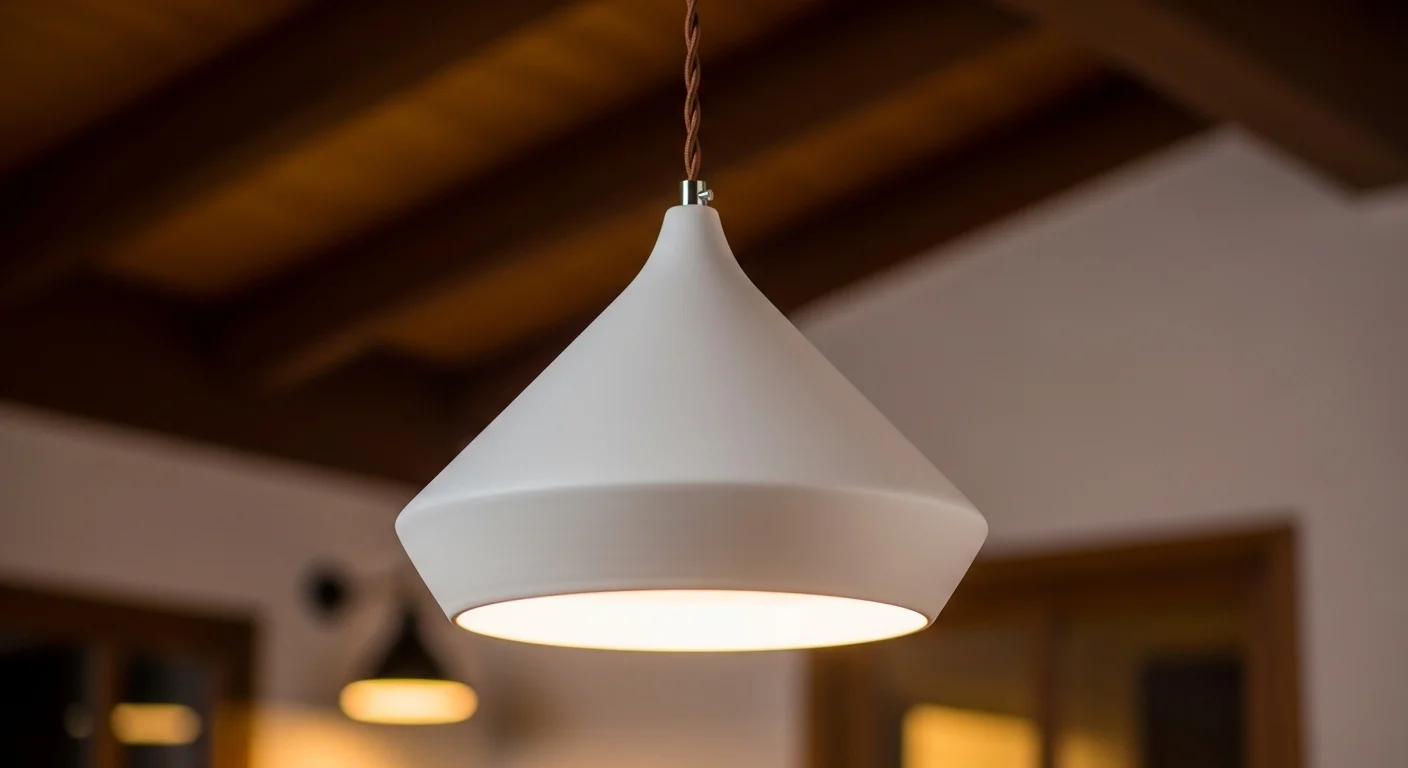
Nine times out of ten, it’s the lighting.
Not the walls. Not the furniture. The light hanging from the ceiling.
And if that light happens to be a ceramic pendant light? Game over. The room just wins.
I’ve helped dozens of people transform their living rooms, kitchens, and dining spaces — and every single time, swapping out a boring fixture for a handcrafted ceramic pendant changed everything. It’s not magic. It’s just good design doing its job quietly.
So let’s talk about it. What makes ceramic pendant lights so special, how do you pick the right one, and what should you absolutely avoid? Let’s get into it.
What Exactly Is a Ceramic Pendant Light?
Before anything else, let’s get on the same page.
A pendant light is any light fixture that hangs down from the ceiling — usually on a cord, cable, or rod. Simple enough, right?
Now, a ceramic pendant light takes that concept and wraps the shade or body in hand-thrown or molded ceramic — think the same earthy, textured material your favorite coffee mug might be made from.
That material changes everything.
Ceramic doesn’t just look beautiful. It diffuses light in a way that feels warm and organic, not harsh or clinical. When light passes through or around a ceramic shade, it casts gentle patterns on your walls and ceiling — little pools of warmth that make a room feel lived-in and intentional.
It’s the difference between fluorescent office lighting and candlelight at a good restaurant. Same purpose, completely different feeling.
Why Ceramic? Why Not Just Any Pendant Light?
Fair question. There are pendant lights made from glass, metal, rattan, fabric, wood, concrete — basically everything. So why ceramic specifically?
Here’s the honest answer: ceramic has a texture and depth that almost nothing else can replicate.
When a potter throws a piece on a wheel or presses clay into a mold, tiny imperfections are baked in. Little ridges. Subtle variations in glaze. A slight unevenness in the rim. Those “flaws” are actually what makes it beautiful — they’re proof that a human being made it.
Compare that to a mass-produced glass globe. Perfectly smooth. Perfectly symmetrical. And kind of… forgettable.
Ceramic pendant lights also age beautifully. The glaze develops a slight patina over time. The earthy tones deepen. It looks better five years from now than it does on day one.
That’s a rare quality in home décor.
The Different Types You Need to Know About
Not all ceramic pendant lights are the same — not even close. The style you pick should match your space, your ceiling height, and honestly, your personality.
1. Single Drum or Cylinder Shades
This is the classic shape. A cylindrical or drum-shaped ceramic shade hangs on a cord, usually centered over a dining table or kitchen island.
Best for: Minimalist or Japandi-style interiors, low ceilings, small kitchens.
The clean lines don’t compete with anything. They just sit there looking quietly confident.
2. Globe or Teardrop Ceramic Pendants
Rounder, fuller, more sculptural. These look like something you’d find in a boutique hotel lobby — in the best possible way.
Best for: Living rooms, entryways, spaces where you want a statement piece without going overboard.
Pair two or three of these at staggered heights over a kitchen island and you’ll never stop getting compliments.
3. Open-Bottom Bowls
Shaped like a wide ceramic bowl facing downward, these direct light straight down — perfect for task lighting over a workspace or dining table.
Best for: Anywhere you need focused light. Reading nooks. Home offices. Long dining tables.
The open bottom also means the bulb is partially visible, which creates a nice vintage or industrial effect depending on the bulb you choose.
4. Sculptural or Irregular Forms
This is where ceramics really gets exciting. Some artisan makers throw pendants that look less like lights and more like art installations. Asymmetrical. Textured. Cracked glaze finishes. Raw, unglazed patches.
Best for: Bohemian or eclectic spaces. Artists’ studios. Anywhere you want people to stop and ask “where did you get that?”
If you’re the kind of person who buys handmade pottery at a farmers market, this is your vibe.
5. Cluster or Multi-Pendant Arrangements
Not a single pendant, but a group of three, five, or seven ceramic pendants hung at different heights from a single canopy. The result looks like a floating constellation of small ceramic orbs.
Best for: High ceilings. Entryways with double-height ceilings. Open-plan living spaces where you need the light to fill vertical space.
Glaze Finishes: This Is Where the Magic Happens
The shape matters. But the glaze? The glaze is where a ceramic pendant light goes from “nice” to “I need that immediately.”
Here’s a quick breakdown of the most common finishes and what they do for a room:
- Matte White or Off-White — Clean, airy, Scandinavian. Blends into bright rooms. Reflects light softly without glare.
- Reactive Glaze — This is where things get interesting. Reactive glazes shift color depending on firing temperature and angle of light. One piece might show blue, green, grey, and brown all at once. Every piece is one-of-a-kind.
- Terracotta or Raw Clay — Unglazed or lightly glazed, showing the natural red-brown of the clay. Earthy. Warm. Goes beautifully with wood and linen.
- Midnight Blue or Forest Green — Deep, saturated tones that make ceramic pendants look almost jewel-like. Stunning against white walls or natural wood ceilings.
- Speckled or Mottled — Think the glaze on a rustic espresso cup. Tiny flecks of color scattered across the surface. Casual, relaxed, timeless.
- Crackle Glaze — Fine hairline cracks in the glaze surface, usually filled with a darker color during firing. Looks ancient. Looks intentional. Looks expensive.
Don’t just pick a shape. Pick a glaze that makes you feel something.
Room by Room: Where to Put a Ceramic Pendant Light
Kitchen
The kitchen is the most popular spot — specifically over an island or peninsula. A ceramic pendant light here does two jobs at once: it provides task lighting for food prep and acts as a design focal point.
Go for an open-bottom style if you need strong downward light. Go for a drum or globe if you want more ambient warmth.
Pro tip: If your island is long (more than 4 feet), use two or three pendants spaced evenly rather than one large one. It looks more intentional and provides better light coverage.
Dining Room
Over the dining table is prime pendant territory. This is where you want drama. A large globe in a reactive glaze. A cluster of smaller pendants at different heights. Something that makes dinner feel like an event, not just a meal.
Hang the bottom of the pendant 28 to 34 inches above the table surface. Too high and it looks disconnected. Too low and your guests are eating in a cave.
Bedroom
A ceramic pendant as a bedside light — hung from the ceiling instead of placed on a table — is one of the smartest space-saving tricks in interior design.
It frees up your nightstand completely. And if you choose a small ceramic pendant with a warm-toned bulb, the light it casts is genuinely romantic. Not in a cheesy way. Just… soft and beautiful.
Entryway or Hallway
First impressions matter. A single sculptural ceramic pendant in the entryway tells guests immediately that this home has taste.
Keep it simple here. One good piece. Let it breathe.
Reading Nook or Home Office
An adjustable pendant — one you can raise or lower — over a reading chair or desk puts the light exactly where you need it. Ceramic diffuses the light so it’s never harsh on the eyes, even during long work sessions.
How to Choose the Right Ceramic Pendant Light: 5 Things to Actually Check
Buying a pendant light isn’t complicated, but there are a few things that trip people up. Here’s what to look for:
1. Ceiling Height
Standard ceiling height is around 8 to 9 feet. At that height, a pendant with a 6-to-8-inch shade works well. Higher ceilings can handle larger, more dramatic pieces.
Rule of thumb: The pendant should never hang so low that anyone can accidentally bump their head. And it should never hang so high that it looks like it’s floating disconnected from the room.
2. Light Output
Ceramic is dense. Depending on the thickness and glaze, it may block a lot of light. If you need bright task lighting, choose an open-bottom design or a pendant with a glaze that allows some light to pass through.
If you want ambient warmth, a fully enclosed ceramic shade with a warm-white (2700K-3000K) bulb is perfect.
3. Wiring and Installation
Most ceramic pendant lights come with a fixed cord length that you can adjust at installation. Make sure your ceiling has the correct junction box before buying — a standard round box works for most pendant lights under 50 lbs.
Ceramic can be heavy. Always check the weight rating of your ceiling box, especially for sculptural pieces.
4. Cord vs. Rod Suspension
Cord suspension is more flexible — you can adjust the height easily. Rod suspension looks cleaner and more architectural but is fixed at a specific length. For kitchen islands and dining tables, rod suspension often looks more intentional. For bedrooms and reading nooks, cord gives you more flexibility.
5. Artisan vs. Mass-Produced
There’s nothing wrong with a well-made mass-produced ceramic pendant. But if you want something truly unique — a piece that no one else on your street has — look for makers on Etsy, at local craft fairs, or through small-batch ceramics studios.
Prices range widely: you can find a decent ceramic pendant for $40-80, and artisan pieces can run $200-600. The handmade ones are worth it if you can swing it. They just have a presence that factory pieces can’t replicate.
Bulb Choice: Don’t Ruin a Beautiful Light With the Wrong Bulb
This sounds minor. It’s not.
The wrong bulb can make even the most beautiful ceramic pendant look terrible.
Here’s what works:
- Edison-style filament bulbs (warm white, 2200K-2700K) — Perfect for exposed-bottom pendants. The visible filament adds to the vintage, handcrafted feel.
- Warm white LED (2700K-3000K) — Best for enclosed shades. Efficient, long-lasting, and the color temperature mimics incandescent warmth beautifully.
- Avoid cool white (4000K+) or daylight (5000K+) bulbs — They make ceramic glazes look flat and washed out. The earthy tones you fell in love with will disappear under cold light.
Also: use a dimmer switch if possible. Being able to dial the light up or down transforms how the room feels at different times of day.
Caring for Your Ceramic Pendant Light
Good news: ceramic is incredibly low-maintenance.
- Dust it with a soft, dry cloth every few weeks. That’s mostly it.
- For smudges or grease (common in kitchens), use a damp cloth with a tiny bit of mild dish soap. Wipe gently, then dry immediately.
- Never use abrasive cleaners. They’ll scratch the glaze.
- Check the wiring once a year — just a quick visual inspection of the cord and canopy for any fraying or discoloration.
That’s genuinely all there is to it. Ceramic doesn’t rust, doesn’t fade, doesn’t warp. It just sits there looking beautiful.
Common Mistakes People Make (And How to Avoid Them)
Hanging it too high. The single most common mistake. People get nervous about it being “in the way” and hang it too high. Then it looks like it’s disconnected from the room. Trust the measurements: 28-34 inches above a table, 7 feet above the floor for general spaces.
Choosing a pendant that’s too small. A small pendant over a large dining table looks lost and timid. Scale up. If you think you need a 10-inch shade, try a 14-inch one. It’ll look right.
Ignoring the cord color. Black cord on a white ceiling looks jarring. White cord on a black ceiling looks wrong. Match the cord to the ceiling or canopy, not to the pendant shade itself.
Buying without checking the weight limit. Ceramic is heavy. A large sculptural pendant can weigh 8-12 lbs. Standard junction boxes are rated for 35-50 lbs, but always verify before installing.
Using the wrong color temperature bulb. Already covered this, but it’s worth repeating. Warm white. Always warm white.
A Quick Story: The Dining Room That Finally Came Together
A friend of mine spent three years trying to figure out why her dining room felt wrong. New paint colors. New chairs. A rug. Nothing helped.
Then she replaced the cheap brushed-nickel pendant (you know the type — looks like it came free with the house) with a hand-thrown ceramic pendant in a deep reactive glaze — blues and greens and a little brown all swimming together.
She paired it with a 2400K Edison bulb and a dimmer switch.
The room looked completely different that same evening. Same table. Same chairs. Same walls. But suddenly it felt like a place where you’d want to linger over dinner for hours.
That’s what a ceramic pendant light actually does. It doesn’t just provide light. It changes how a space feels.
Final Thoughts: Is a Ceramic Pendant Light Worth It?
Short answer: yes. Almost always, yes.
It’s one of the highest-impact, relatively low-cost upgrades you can make to any room. A good ceramic pendant — even an entry-level one — will outlast trends, outlast most furniture, and keep looking beautiful as long as you own the house.
If you’re standing in a room right now thinking it needs something but you can’t figure out what — look up. The answer is probably hanging from your ceiling. Or rather, the beautiful ceramic pendant that should be.
Start with one room. One pendant. See what happens.
You won’t go back to boring.
Frequently Asked Questions (FAQ)
Q1: What room is best suited for a ceramic pendant light?
A: Any room works, but kitchens, dining rooms, and bedrooms are the most popular. Over a kitchen island or dining table, ceramic pendants act as both task lighting and a design focal point. In bedrooms, a small ceramic pendant as a bedside light is a beautiful and space-saving alternative to a table lamp.
Q2: How low should I hang my ceramic pendant light?
A: Over a dining table or kitchen island, hang the bottom of the pendant 28 to 34 inches above the surface. For general room lighting (not over a table), the bottom of the pendant should be at least 7 feet from the floor to avoid head bumps. For entryways with high ceilings, you have more flexibility — just make sure it feels anchored to the space, not floating up near the ceiling.
Q3: Are ceramic pendant lights heavy? Will my ceiling handle it?
A: Ceramic is heavier than glass or fabric, yes. A small pendant might weigh 2-4 lbs, while a large sculptural piece can reach 10-15 lbs. Standard residential ceiling junction boxes are rated for 35-50 lbs, so most ceramics are fine. Always check the weight rating on your specific junction box before installing anything, just to be safe.
Q4: What type of bulb should I use in a ceramic pendant light?
A: Warm white is the rule. For enclosed ceramic shades, use a warm white LED bulb at 2700K-3000K. For open-bottom pendants where the bulb is visible, an Edison-style filament bulb (2200K-2400K) looks stunning and complements the handcrafted feel of the ceramic. Avoid cool white or daylight bulbs — they make ceramic glazes look flat and kill the warmth you’re paying for.
Q5: How do I clean a ceramic pendant light?
A: It’s very easy. Dust regularly with a soft dry cloth. For grease or smudges (especially in kitchens), use a damp cloth with a small amount of mild dish soap, then dry immediately. Never use abrasive cleaners, scouring pads, or harsh chemicals — they’ll damage the glaze. That’s genuinely all the maintenance required. Ceramic is one of the most durable and low-maintenance materials used in lighting.