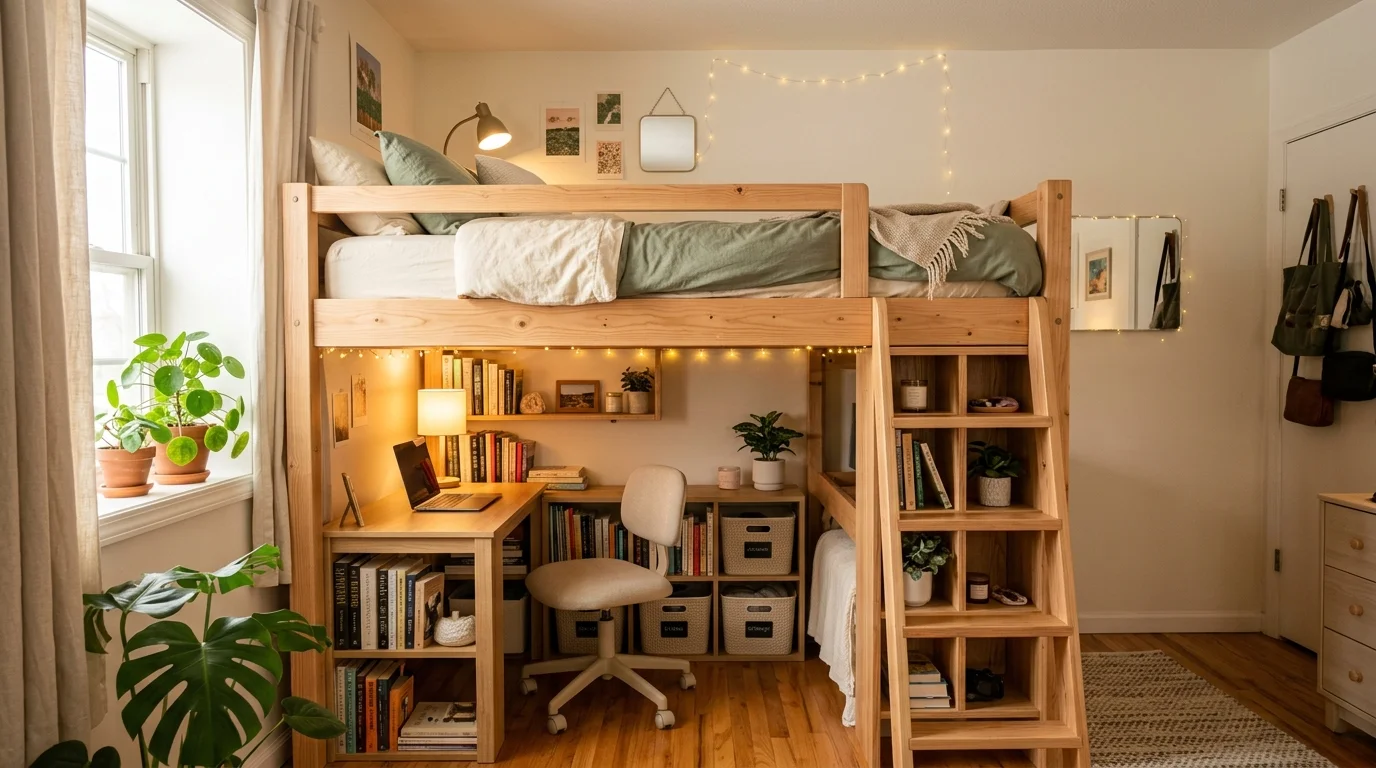
You wake up every morning and the first thing you see is… wall. Right there. Two feet from your face.
Sound familiar? Small rooms can feel like a trap — especially when your bed eats up more than half the floor space. But here’s the thing: the problem isn’t your room. It’s how you’re using the vertical space you already have.
That’s exactly where loft bed ideas for small rooms come in. They’re not just trendy Pinterest content. They’re legitimate, life-changing solutions that people — from college students to city apartment dwellers — have been quietly using to double their usable space.
Let’s dig into what actually works.
Why Loft Beds Are a Game-Changer for Small Spaces
Think about it. The average small bedroom has maybe 100–150 square feet. Your bed probably takes up 40 of those. Now raise that bed 5 feet off the ground. What do you have underneath? A whole new world.
That’s the core logic of loft beds. You stop using floor space for sleeping and start using it for living.
A well-designed loft setup can give you:
- A dedicated study or work-from-home desk
- A cozy reading nook
- A mini wardrobe or closet system
- Extra storage drawers or shelves
- Even a play area for kids
The key is choosing the right loft bed style for your specific situation. Not every loft design fits every room, and that’s what we’re going to get into right now.
1. The Classic Full-Height Loft Bed With Desk Underneath
This is the one everyone thinks of first — and for good reason. It works.
A full-height loft bed (usually 5–6 feet off the ground) frees up the entire floor space underneath. Slide in a long desk, add a monitor, a lamp, some shelves, and suddenly your small bedroom also has a home office.
Best for: Students, remote workers, anyone who needs a dedicated workspace but can’t afford a separate room.
Pro tip: Go for a loft bed with a built-in ladder on the side rather than the end. It takes up less floor space and looks cleaner.
Real talk — a 22-year-old interior design student named Priya turned her 90-square-foot dorm room into something that looked straight out of a design magazine just by switching to a loft bed with a mounted desk underneath. She told me it felt like getting a whole new apartment without moving out.
2. Low Loft Bed for Rooms With Low Ceilings
Not every room has 9-foot ceilings. If yours is more like 7–8 feet, a standard full-height loft might leave you ducking every morning.
Enter the low loft bed — typically raised 3–4 feet. You won’t get a full standing workspace underneath, but you can easily fit:
- A comfortable reading chair
- A small chest of drawers
- A clothing rail with hanging space
- Open shelves for books or baskets
Best for: Apartments with standard ceiling heights, older homes, or anyone who gets a little claustrophobic sleeping too close to the ceiling.
The nice thing about low lofts is they also feel less intimidating. Kids and adults who are nervous about heights tend to adapt much more easily.
3. Loft Bed With Built-In Wardrobe
This is one of the smartest loft bed ideas for small rooms you’ll find — because it tackles two problems at once.
The structure of the loft bed itself becomes the wardrobe frame. One side has the ladder, the other side has hanging rails and shelves built directly into the support structure.
You get your sleeping space and your storage space in a single footprint.
What to look for when buying:
- Adjustable shelving (your storage needs will change)
- Solid wood or powder-coated steel for durability
- At least one long hanging rail for coats and dresses
- Optional door panels if you want a cleaner look
IKEA’s KURA and STUVA systems are famous for this kind of modular approach. But honestly, plenty of custom carpenters can build something even better for a similar budget if you have specific dimensions in mind.
4. Loft Bed With Sofa Underneath (The Living Room Hack)
This one is brilliant for studio apartments and tiny spaces where your bedroom IS your living room.
Here’s the setup: a raised loft bed sits above a compact sofa or loveseat. Add a small coffee table, a TV mount on the wall, and you’ve created a genuine living area under your bed.
It sounds unusual. It looks incredible. Think of it as vertical zoning — sleeping zone on top, relaxing zone below.
Some designs even include a pull-out sofa bed underneath, which means you can accommodate guests without a dedicated guest room. Pretty clever for a 200-square-foot studio, right?
Best for: Studio apartments, city rentals, young professionals
5. Loft Bed With Slide — Because Why Not?
Okay, this one is primarily for kids’ rooms. But hear me out — it’s also just genuinely fun.
A loft bed with a slide attached to the side makes the whole “going to bed” experience something kids actually look forward to. Less bedtime drama. More smiling. That alone might be worth the price.
Beyond the fun factor, these setups usually include:
- Underbed play space or tent area
- Built-in bookshelf rails
- Guardrails on all sides for safety
- Themed designs (castles, treehouses, rocket ships)
If you have a child in a small bedroom, a loft bed with a play zone underneath is arguably the single best furniture investment you can make.
6. Corner Loft Beds — Maximum Space Efficiency
Here’s a lesser-known option that works incredibly well in square rooms: the corner loft bed.
Instead of pushing the bed against one wall, it’s positioned in a corner, with the support structure running along two walls. This means you get L-shaped desk space underneath, which feels massive compared to a single straight desk.
You can fit:
- A wide study desk in the corner
- Shelves running up both walls
- A monitor on one side, notes/books on the other
This is the setup serious productivity people swear by. If you work or study from home and your bedroom doubles as your office, this configuration is worth serious consideration.
7. Murphy Bed + Loft Combo — The Shape-Shifter
A Murphy bed (wall bed) that transforms into a loft is the ultimate space-saving move. During the day, the bed folds flat against the wall and the desk or shelving underneath is fully accessible. At night, the bed folds down for sleeping.
These are more expensive than standard loft beds, but for certain situations — especially very small studio apartments or rooms that double as offices — they’re genuinely transformative.
Typical cost range: $1,500–$5,000+ depending on custom features
Best for: Rooms under 150 sq ft, home offices that need to convert to bedrooms
8. Loft Beds for Two Kids — Bunk vs. Loft
If you have two children sharing one small room, you’re probably already thinking about bunk beds. But there’s another option worth considering: two separate loft beds on opposite walls.
Each child gets their own loft bed with their own private space underneath. One might have a desk, the other a play area. You preserve a central floor space for them to actually play together without tripping over beds.
This setup also solves the classic bunk bed problem — the child on the bottom always complains about the ceiling being too close, and the child on top has trouble climbing down at night.
With two separate lofts, both kids get a full sleeping experience AND their own dedicated under-bed zone.
9. Loft Beds With Hidden Storage Steps
Most loft beds use either a vertical ladder or an angled staircase for access. But staircases with built-in drawers in each step? That’s next-level.
Every step becomes a drawer. You can store clothes, shoes, books, toys — whatever’s taking up floor space — inside the actual staircase structure. It’s invisible storage that you’re literally standing on.
These are worth the extra cost if storage is your main pain point.
10. Industrial-Style Loft Beds for Adults
Loft beds aren’t just for kids and students. There’s a growing market for seriously stylish adult loft beds made from steel tubing with wood shelving — the kind you’d see in a Brooklyn loft or a Scandinavian design apartment.
These typically feature:
- Black powder-coated steel frames
- Solid oak or walnut wood accents
- Open shelving instead of enclosed storage
- Minimal design that looks intentional, not desperate
If you’re an adult who wants a loft bed but doesn’t want it to look like a college dorm, these industrial designs are your answer.
11. DIY Loft Bed Ideas on a Budget
Not everyone wants to spend $800+ on a brand-name loft bed. And honestly? You don’t have to.
Some of the most creative loft bed setups I’ve come across were built for under $200 using:
- Heavy-duty pipe fittings (plumbing pipe frames are incredibly strong)
- Reclaimed wood pallets (properly treated for safety)
- IKEA components modified with custom lumber
- Standard lumber from a hardware store with basic joinery
The most important thing with DIY loft beds: safety first, always. The frame needs to hold your weight + mattress weight + any movement during sleep. That typically means a load capacity of 300–500 lbs minimum. Use lag bolts, not just screws. Secure to wall studs where possible.
YouTube has excellent tutorials for this. Search for “DIY loft bed platform” or “floating loft bed frame” for step-by-step builds.
12. Loft Bed With Curtain Enclosure — For Privacy
This one’s especially clever for studio apartments or shared rooms. A loft bed with curtain rods running along the sides creates a private sleeping pod up top.
Draw the curtains and it’s like having your own little room. Block out light. Muffle sound. Create genuine privacy even when someone else is in the same space.
Some people add fairy lights, a small clip-on fan, and a phone charging station inside to make it feel genuinely cozy — like a modern take on a ship cabin or a bunk in a Japanese capsule hotel.
Best for: Studio apartments, shared living situations, people who love cozy enclosed sleeping spaces (known as “cave sleepers”)**
13. Floating Loft Beds (Wall-Mounted)
Traditional loft beds have four legs touching the floor. Floating loft beds attach directly to wall studs with no visible floor supports.
The visual effect is dramatic. The bed appears to hover in mid-air. The floor underneath is completely clear — no legs to clean around, no visual clutter.
Technically it’s not magic — the wall is doing the structural work. But it creates the most open, airy feel of any loft setup.
These require wall-mounting to studs and are not always renter-friendly, but if you own your space or have landlord approval, they create genuinely stunning rooms.
14. Loft Beds With Integrated Lighting
Lighting is one of the most overlooked parts of a loft bed setup. Here’s how to do it right:
- Under-bed task lighting: LED strip lights mounted under the frame illuminate the desk or workspace below without glare
- Reading light: A small adjustable LED lamp clipped to the headboard side of the loft keeps night reading easy
- Ambient glow: Warm LED strips along the rails create a soft atmospheric effect for evenings
- Motion sensor night lights: For kids’ lofts, a gentle motion-activated light at the base of the ladder is a safety essential
Getting the lighting right makes a loft setup feel professionally designed rather than improvised.
15. Choosing the Right Mattress for a Loft Bed
This doesn’t get talked about enough. A regular thick mattress can be a problem on a loft bed for two reasons:
- It reduces headroom even further
- It’s hard to make the bed up there neatly
The sweet spot for loft bed mattresses is 6–8 inches thick. Memory foam or latex options work better than traditional spring mattresses because they don’t require box springs and are lighter to maneuver up there.
Some loft bed brands sell bundled slim-profile mattresses. If yours doesn’t, look at options labeled “bunk bed mattress” or “RV mattress” — these are designed exactly for tight-clearance situations.
Things to Check Before You Buy Any Loft Bed
Before you click “add to cart,” run through this quick checklist:
- Ceiling height: Measure from floor to ceiling. Subtract mattress thickness + 24–30 inches for comfortable sitting clearance on top. What’s left is your max loft bed height.
- Weight capacity: Check the manufacturer’s stated limit. Don’t assume; verify.
- Room dimensions: Make sure you can actually fit the footprint without blocking doors or windows.
- Assembly complexity: Some loft beds require two people and 4+ hours. Know what you’re getting into.
- Safety rails: Non-negotiable if children will use it. Rails should be at least 5 inches above the mattress surface.
- Warranty: Reputable brands offer at least 1-year structural warranties. Budget options often don’t.
A Final Word on Making Small Rooms Work
Here’s what nobody tells you about small rooms: the constraint is actually a gift.
When you have limited space, you’re forced to think creatively. You’re pushed toward better design. You end up with a room that’s more intentional, more personal, and often more visually interesting than a sprawling space that gets cluttered with random stuff.
A great loft bed isn’t just furniture. It’s a spatial philosophy. It says: I’m going to use every inch of what I have, and make it look good doing it.
Whether you go with a simple full-height loft with a desk, a corner setup for maximum productivity, or a dreamy curtained sleeping pod — the move you’re making is the right one.
Pick the loft bed idea that matches your lifestyle. Then make it yours.
FAQ — Loft Bed Ideas for Small Rooms
Q1. What’s the minimum ceiling height needed for a loft bed? Most full-height loft beds require at least 9 feet of ceiling clearance for comfortable use. For lower ceilings (7–8 feet), look for low-profile loft beds that sit 3–4 feet off the floor instead.
Q2. Are loft beds safe for adults? Yes, absolutely — as long as the bed has adequate weight capacity (typically 250–500 lbs for adult-grade models), proper safety rails, and secure construction. Adult-specific loft beds are designed for heavier loads and more durable use patterns than children’s versions.
Q3. Can I put a loft bed in a rental apartment? In most cases, yes — especially freestanding loft beds that don’t require wall mounting. Wall-mounted floating loft beds may require landlord permission since they involve drilling into studs. Always check your lease.
Q4. What goes well under a loft bed besides a desk? Plenty of great options: a sofa or loveseat, a wardrobe or dresser, a reading chair, a mini-fridge and coffee setup, a gaming station, open shelving, a treadmill, or even a pet area. The key is measuring the space carefully before committing.
Q5. How do I make a loft bed look stylish rather than dorm-like? Choose a metal or solid wood frame over cheap MDF. Add coordinating bedding in neutral or sophisticated tones. Include thoughtful lighting (warm LED strips work great). Use the space underneath for an intentional purpose — not just random clutter. Match the loft’s color to your existing room palette. Small details make a massive difference.
Small room, big ideas. The space you have is enough — you just need to see it differently.