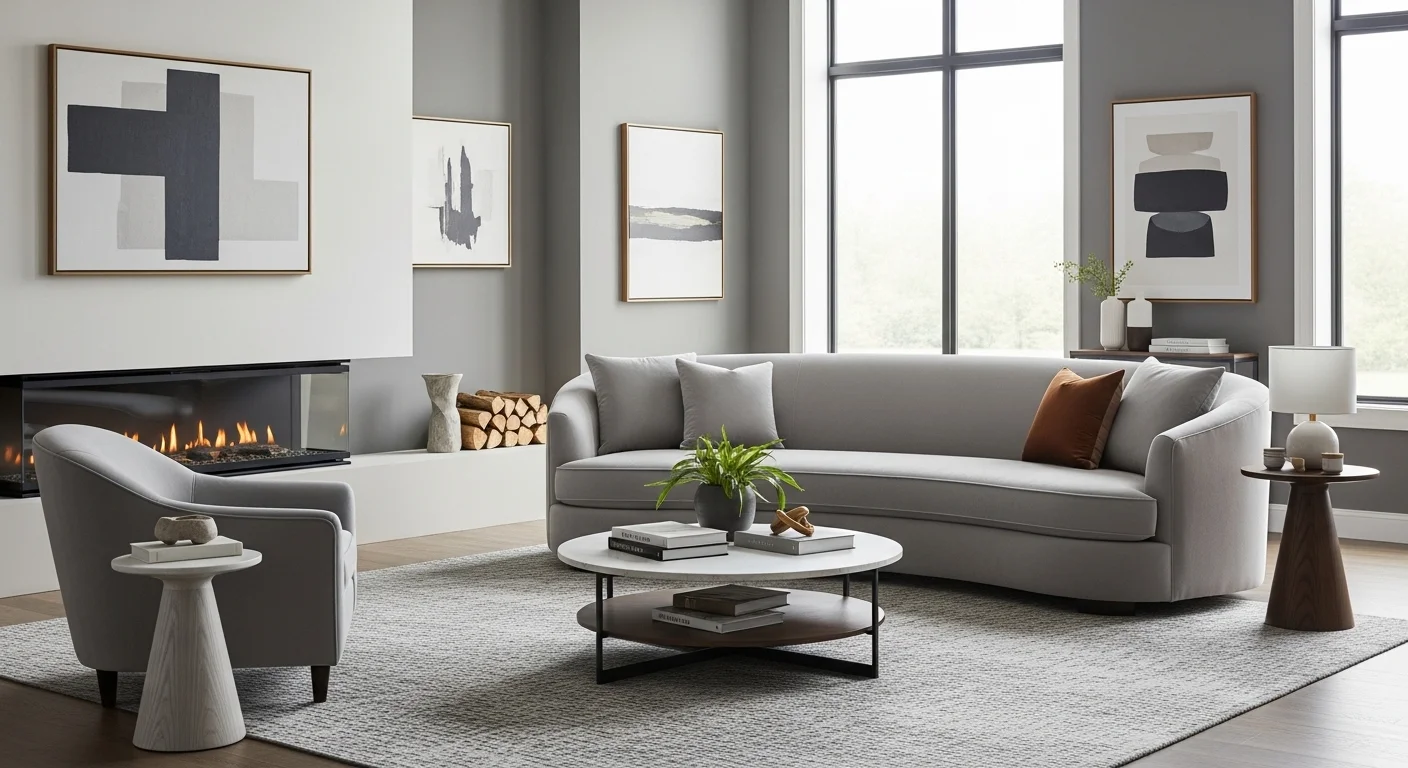
You’ve scrolled through Pinterest. You’ve saved about 47 living room photos. And every single one of the rooms you love? There’s a curved sofa sitting right in the middle of it.
It’s not a coincidence.
The curved sofa has quietly become the single most transformative piece of furniture you can put in a living room. Not the TV. Not the rug. The sofa. And if you’ve been on the fence about whether it’ll work in your space — this is the article that’s going to settle it for you.
Let’s get into it.
What Even Is a Curved Sofa? (And Why Is Everyone Obsessed?)
A curved sofa is exactly what it sounds like — a sofa with a curved, arc-shaped silhouette instead of the typical straight-line design. But calling it “just a sofa with a curve” is like calling the Eiffel Tower “just a tall thing.”
The shape does something magical to a room.
It softens everything. Most living rooms are full of hard angles — square TV units, rectangular coffee tables, flat walls. A curved sofa breaks that rigidity. The moment you bring one in, the room exhales. It becomes warmer. More inviting.
And here’s the thing nobody really tells you: a curved sofa doesn’t just look different. It functions differently too. The inward curve naturally pulls people toward each other. Conversations happen more easily. It’s basically furniture that’s been engineered for connection.
That’s why you’ll find curved sofas in the living rooms of people who actually use their living rooms — not just as a showpiece, but as a real gathering space.
The Different Types of Curved Sofas (So You Know What You’re Actually Looking At)
Before you start shopping, you need to know there are a few distinct styles under the “curved sofa” umbrella.
1. The Classic Arc Sofa
This is the most common type. It’s a single sofa unit where the back and/or the overall shape forms a gentle arc or bow. Think of it as your standard three-seater, just curved. Great for medium-sized living rooms.
2. The Semicircle (or Half-Moon) Sofa
This one goes big. The sofa forms nearly half a circle, wrapping around a central point — usually a coffee table or a fire pit if you’re outdoors. This is the kind you see in luxury hotel lobbies and those insane living rooms in architectural digest.
It seats a lot of people and creates an incredibly intimate, enclosed feeling.
3. The Modular Curved Sofa
This is the smart choice for people who like flexibility. Modular sofas are made of individual sections (called modules) that you can arrange however you want. You can curve them, straighten them, make an L-shape, or even split them up across the room.
If you move houses a lot, or if you’re the kind of person who rearranges furniture every six months (no judgment), modular is the way to go.
4. The Curved Sectional Sofa
Similar to modular but usually sold as one complete piece. A curved sectional typically has a longer chaise or lounger on one end and sweeps into a curved body. Incredibly cozy. Perfect for living rooms that double as movie night headquarters.
How Does a Curved Sofa Actually Change a Living Room?
Okay, let’s get specific. Because “it looks amazing” is fine, but you want to know how it changes things.
It Creates a Natural Focal Point
In most living rooms, the TV is the focal point. Everything points toward it. The curved sofa flips that — it becomes the center of gravity. The room organizes itself around the sofa, not the screen. That shift is subtle, but it makes the room feel intentionally designed rather than just assembled.
It Makes Small Rooms Feel Bigger
Counter-intuitive, right? A bigger, curved sofa in a small room making it feel larger? Here’s why it works.
Straight sofas pushed against walls emphasize the boxy, confined shape of a room. A curved sofa placed slightly away from the wall (even just a few inches) creates a sense of depth. The eye follows the curve and perceives more dimension. Add a round coffee table in front and a circular rug underneath, and suddenly your small apartment living room feels designed.
It Instantly Elevates the Aesthetic
There’s a reason interior designers charge a lot of money, and there’s also a reason one of their favorite tricks is adding a curved sofa. The curved line is associated with luxury, art, and thoughtful design. It signals that the person living there made a choice, not just grabbed the first couch they saw on sale.
Your living room goes from looking assembled to looking curated. That’s the difference.
The Best Curved Sofa Styles for Every Living Room Type
Not every curved sofa works in every room. Here’s how to match the sofa style to your space.
For Modern and Minimalist Living Rooms
Go for clean lines, tight upholstery, and low profiles. A curved sofa in a solid neutral — cream, sand, charcoal, or slate — with thin, tapered legs looks incredible in a minimalist space. Avoid heavy, tufted designs here. Simple and sculptural is the goal.
For Maximalist or Eclectic Living Rooms
This is where you can go wild. Velvet curved sofas in deep jewel tones — emerald green, sapphire blue, burnt sienna — look stunning against patterned walls or bold artwork. Layer textures: a velvet sofa, a boucle throw, a shaggy rug. The curved silhouette actually anchors all the visual chaos.
For Traditional or Classic Living Rooms
Look for curved sofas with rolled arms, button tufting, or camelback silhouettes. A curved sofa in a warm ivory linen or a classic striped fabric with wooden legs fits right into a traditional living room without looking out of place.
For Open-Plan Living Spaces
This is where a curved sofa genuinely shines. Open-plan spaces struggle with definition — it can feel like you’re just floating in a big room. A curved sectional or a large semicircle sofa can define the living area, creating a “room within a room” effect even without walls. It’s one of the most effective space-defining tools in interior design.
What Size Curved Sofa Do You Actually Need?
Here’s where people make the most mistakes. They fall in love with a sofa online, buy it, and then it arrives and either drowns the room or looks like a toy in it.
So here’s a simple way to think about sizing:
- Measure your room first. Not after you fall in love with a sofa. Before.
- Leave at least 36 inches (about 90 cm) between the sofa and other furniture for comfortable walking space.
- For a room under 12 feet wide, stick to a simple arc sofa or a smaller curved two-seater.
- For rooms 15 feet and above, a curved sectional or semicircle sofa will look proportionate.
- The sofa should take up roughly two-thirds of the wall or the visual space it occupies. Too small and it looks lost. Too big and it looks crammed.
Also — and this is important — think about your doorways. Curved sofas are harder to maneuver into a space than straight ones. Measure your hallways, stairwells, and doorframes before ordering. Some modular sofas are specifically designed to break apart for easy delivery, which is worth paying attention to.
The Colors That Work Best for a Curved Sofa Living Room
Color choice can make or break the look. Here are the combinations that actually work.
Cream or Off-White Curved Sofa
The most versatile option. Works in virtually any living room style. Looks effortlessly elegant. Pairs beautifully with warm wood tones, brass accents, and earthy wall colors. The only catch: it requires regular cleaning.
Sage Green or Olive Curved Sofa
Honestly, this might be the best color choice going right now. Sage green curved sofas feel fresh, sophisticated, and connected to nature. They work with both warm and cool toned rooms. Pair with terracotta accents for a warm Mediterranean feel or with light grey and silver for something more modern.
Caramel or Cognac Leather Curved Sofa
If you want warmth and longevity, a leather curved sofa in a caramel or cognac tone is unbeatable. It ages beautifully, it’s easy to clean, and it brings a rich, lived-in quality to a living room that fabric sofas can’t quite replicate.
Charcoal or Dark Grey Curved Sofa
Moody, dramatic, and incredibly versatile. A charcoal curved sofa can anchor a light, bright living room or add depth to a darker, more dramatic space. Layer with warm-toned pillows — mustard, rust, dusty pink — to stop it from feeling cold.
What to Put With a Curved Sofa (The Styling Part Everyone Skips)
Buying the sofa is step one. Styling it is what actually makes the room sing.
The Coffee Table
Forget rectangular coffee tables with a curved sofa. Go round. Every time. A round coffee table echoes the curve of the sofa and creates visual harmony. Go low profile and leave breathing room — you don’t want the table fighting for attention.
The Rug
A circular or oval rug under a curved sofa looks intentional and pulled-together. If you want to use a rectangular rug, it still works, but make sure it’s large enough that the front legs of the sofa sit on it.
The Cushions
Don’t match them. Mixing textures and shapes — a velvet cushion, a knitted one, a flat printed one — adds visual interest without looking chaotic. Stick to a consistent color palette (3 max) and vary the texture instead.
The Lighting
A curved sofa deserves dramatic lighting. A sculptural floor lamp behind or beside the sofa, or a statement pendant overhead if you’re in an open-plan space. Avoid harsh overhead lighting — it flattens everything. Soft, directional light makes the curves of the sofa look even more beautiful.
Common Mistakes People Make With Curved Sofas
Let’s talk about what not to do, because these mistakes are extremely common.
Pushing it against the wall. A curved sofa was not made to hug a wall. It’s meant to float in the room. Pull it away from the wall and place it in relation to other furniture, not the architecture.
Buying the wrong scale. A tiny curved loveseat in a large room looks sad. A massive semicircle in a small room looks like it swallowed the space. Scale matters more with curved sofas than with any other furniture type.
Pairing it with all straight-edged furniture. The whole point of a curved sofa is to introduce organic, flowing shapes. If everything else in the room is hard angles, the sofa looks out of place. Soften other elements too — round side tables, arch mirrors, curved lamps.
Choosing the wrong fabric for your lifestyle. If you have kids or pets, a cream bouclé sofa is going to give you anxiety every single day. Performance fabrics, leather, or darker textured materials are far more practical.
Real Talk: Is a Curved Sofa Worth the Money?
Curved sofas typically cost more than their straight-line equivalents. Sometimes significantly more. So is it actually worth it?
Here’s the honest answer: yes, if you’re buying quality.
A well-made curved sofa in a solid frame, with good cushioning and quality upholstery, will last 10-15 years easily. And for those 10-15 years, it will be the thing every single guest comments on when they walk into your living room.
The design impact-to-cost ratio of a curved sofa is genuinely hard to beat. You could spend twice as much on artwork and it wouldn’t change the feeling of the room as dramatically.
If budget is a concern, look for modular options — they tend to be better value because you can start small and add sections over time. And keep an eye on sales from mid-range furniture brands, which often discount curved sofas because they’re slower sellers (which means you get a deal and you get a less common piece of furniture).
Conclusion: Should You Get a Curved Sofa for Your Living Room?
Here’s where it stands.
If you want a living room that feels designed — not just furnished — a curved sofa is one of the most effective moves you can make. It changes the energy of a room. It starts conversations. It makes people want to sit down and stay awhile.
Yes, it takes a bit more thought to style correctly. Yes, you need to measure carefully. And yes, you might have to rethink some of the other furniture in the room to let it shine properly.
But when it’s right? When the curve of the sofa sweeps across your living room, catching the light, anchoring the space — there’s nothing quite like it.
Get the measurements right. Choose the material that suits your life. And don’t push it against the wall.
FAQ: Curved Sofa Living Room
Q1: Can a curved sofa work in a small living room?
Yes — but scale is everything. In a small room, go for a simple arc sofa or curved two-seater rather than a full semicircle. Pull it away from the wall slightly and pair with a round coffee table. The curves will actually make the room feel more spacious by breaking up the boxy shape.
Q2: What is the best fabric for a curved sofa?
It depends on your lifestyle. For longevity and ease of cleaning, leather or performance velvet is best. For a softer, more luxurious look, bouclé or linen works beautifully — just be aware these require more care. If you have pets or kids, avoid light-colored bouclé and opt for a performance fabric in a mid-tone color.
Q3: How do I style a curved sofa in an open-plan living room?
Use the curved sofa to define the living zone within the open space. A large area rug under the sofa and coffee table creates a visual “room.” Position the sofa with its back facing the kitchen or dining area — this signals the boundary between spaces without needing walls. A curved sectional works especially well for this.
Q4: Can I mix a curved sofa with existing straight-edged furniture?
You can, but you’ll get the best results if you introduce at least one or two other curved or rounded elements — a round coffee table, an oval rug, an arch mirror. A completely straight-edged room with a single curved sofa can feel like the sofa doesn’t belong. A few other curved accents tie it all together.
Q5: How much space should I leave around a curved sofa?
Leave at least 36 inches (about 90 cm) between the sofa and any adjacent furniture or walls to allow comfortable movement. The sofa itself should ideally float in the room rather than being pushed against a wall — even a gap of 4-6 inches behind the sofa makes a noticeable visual difference and helps the curved silhouette read properly from all angles.