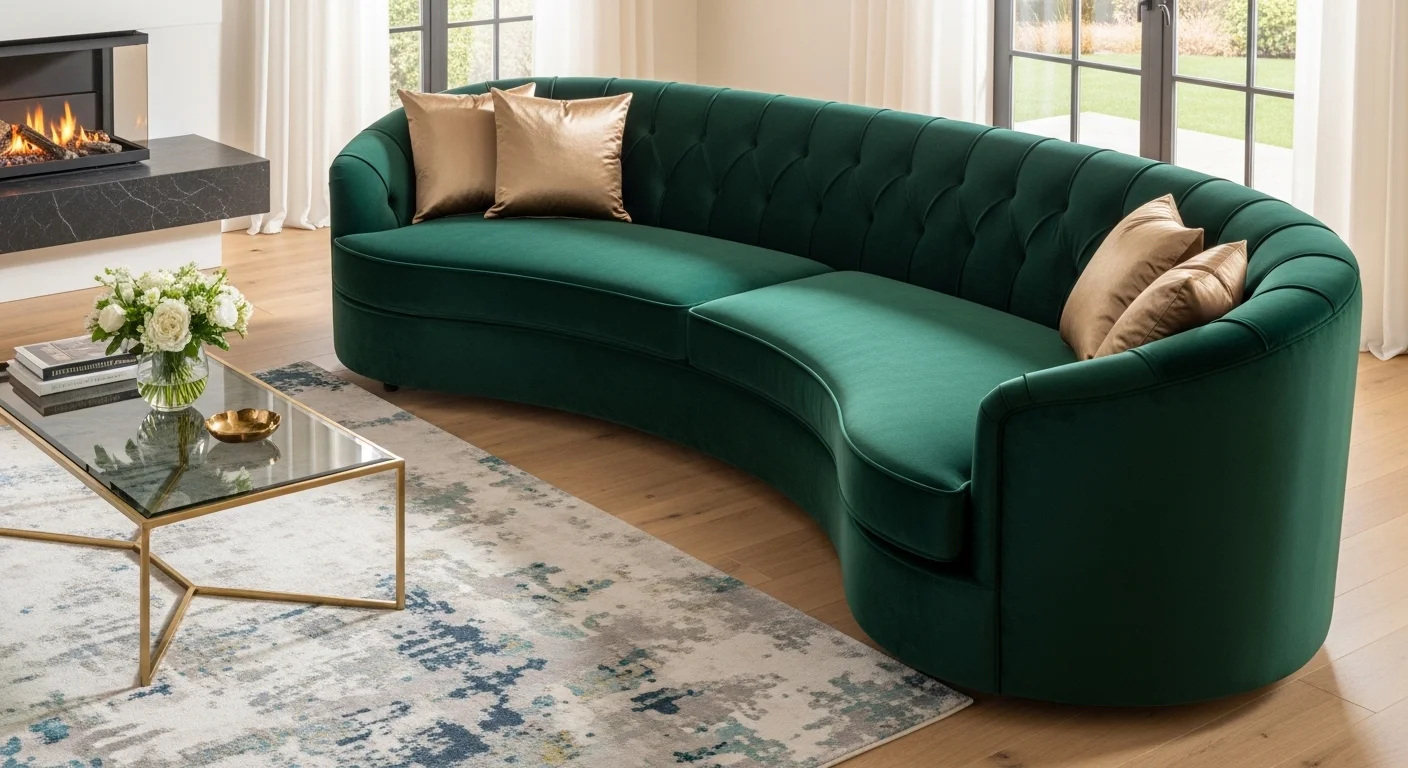
You walk into someone’s living room and something just stops you. Not the TV. Not the rug. It’s this gorgeous, sweeping sofa sitting in the middle of the room like it owns the place. That’s what a curved sofa does — it commands attention without even trying.
But here’s the thing. Most people hesitate. “Is it too bold? Will it fit? What do I even pair it with?”
If that sounds like you, this guide is going to answer every single one of those questions. And by the end of it, you’ll either be ready to buy one — or know exactly why you should.
What Even IS a Curved Sofa? (Let’s Get This Straight)
A curved sofa is exactly what it sounds like — a sofa with a rounded or arched silhouette instead of the usual straight, boxy shape. The backrest sweeps in a gentle arc. Some versions have curved arms. Others form a complete half-circle or crescent shape.
Think of it as the sofa that went to design school.
Unlike traditional sofas, a curved sofa doesn’t just sit against the wall and behave itself. It becomes the centerpiece. It creates a sense of warmth and flow in a room that straight furniture simply can’t replicate.
And no — it’s not a new idea. These designs have roots in mid-century modern interiors from the 1950s and 60s, when designers like Vladimir Kagan were making furniture that looked like it belonged in a spaceship or a jazz lounge. Today, that aesthetic is back — and stronger than ever.
Why Is Everyone Suddenly Obsessed With Curved Sofas?
Scroll through Pinterest or Instagram for five minutes and you’ll see them everywhere. There’s a real reason this trend has exploded.
Straight lines are everywhere. Your walls are straight. Your doors are straight. Your TV stand is straight. After a while, all that geometry feels cold. A curved sofa softens the whole room. It introduces an organic shape that your eye naturally loves.
There’s also science behind it. Research in environmental psychology suggests that curved shapes feel more welcoming and less threatening than sharp angles. You literally feel more relaxed around rounded furniture. That’s not interior design fluff — that’s how human brains work.
And then there’s the social side of it. A curved or semi-circular sofa naturally orients everyone sitting on it toward the center. It creates a conversation pit vibe. People face each other more naturally. You’re not all staring at the wall — you’re actually engaging.
That’s a big deal in a world where we spend all our time staring at separate screens.
The Different Styles of Curved Sofas (Pick Your Vibe)
Not all curved sofas are created equal. Here’s a breakdown of the main styles you’ll encounter:
1. The Crescent or Banana Sofa
This is the classic curved sofa shape — a gentle arc, like a crescent moon laid flat. It usually seats three to four people comfortably. The backrest curves, the arms might curve slightly, and the whole thing has this elegant, flowing quality.
Best for: Living rooms with open floor plans where the sofa can float in the middle of the space rather than being pushed against a wall.
2. The Semi-Circular or Conversation Sofa
This one is more dramatic — it forms a wide U or half-circle. It’s essentially a sectional that curves around a central coffee table. You’ve probably seen this in upscale hotel lobbies or in those gorgeous penthouse interiors on design shows.
Best for: Large rooms, open-plan spaces, or anyone who loves to entertain. It seats a lot of people and makes every gathering feel intentional.
3. The Modular Curved Sectional
Modern furniture brands have gotten clever. Instead of one fixed curved piece, they sell curved sofas in modular sections you can rearrange. Want a gentle arc today and a full circle tomorrow? Done.
Best for: People who like flexibility, renters, or anyone who’s not 100% sure of their long-term floor plan.
4. The Curved Chaise Sectional
This is a hybrid — a mostly straight sectional with one curved end that sweeps outward. It gives you that curved aesthetic without committing to a fully rounded form.
Best for: Smaller spaces or people who want a hint of curves without the full drama.
5. The Round Sofa (Yes, That’s a Thing)
Fully circular. A complete 360-degree seating arrangement. This is the most dramatic version — think 1970s Italian design at its most theatrical.
Best for: Very large rooms, statement pieces, or design lovers who want to go all in.
How to Choose the Right Curved Sofa for YOUR Space
Here’s where most people get stuck. The sofa looks amazing in the showroom or on the website — but will it actually work in your home?
Let’s walk through it.
Step 1: Measure Like Your Life Depends on It
Curved sofas have a different footprint than straight ones. Even a sofa that’s 90 inches wide might push out 45-50 inches into the room because of the arc. That’s almost four feet of depth at the center.
Measure your room. Then measure the path from your front door to the room — because you need to get the thing in first.
Pro tip: Use painter’s tape on the floor to mock up the sofa’s shape before you buy. It takes ten minutes and saves enormous heartache.
Step 2: Think About Traffic Flow
Curved sofas work beautifully when they float in the center of a room. But if your room requires walking around furniture constantly, the arc can create awkward traffic patterns.
Ask yourself: Where do people naturally walk through this room? Then place your tape mock-up and walk around it. Does it feel natural or annoying?
Step 3: Match the Scale to the Room
A tiny curved loveseat in a massive open-plan living room looks lost. A giant semi-circular sectional in a small apartment looks suffocating.
Curved sofas tend to work best in medium to large rooms — roughly 12×15 feet or bigger. That said, a well-proportioned crescent sofa can absolutely work in a smaller space if it’s the right size.
Step 4: Consider What You’ll Pair It With
Curved sofas have strong opinions about their surroundings.
- Coffee table: Go round or oval. A rectangular coffee table in front of a curved sofa creates visual tension that doesn’t feel intentional.
- Rug: A large circular or oval rug anchors the whole setup beautifully.
- Other furniture: Keep additional seating simple and low-profile so the curved sofa stays the star.
The Best Fabrics and Materials for a Curved Sofa
This matters more than people realize. Because of the curved shape, certain upholstery materials look and wear better than others.
Bouclé: This loopy, textured fabric has become the signature look for curved sofas in 2024-2025. It’s cozy, warm-looking, and has a handmade quality that plays perfectly against the sofa’s architectural shape. The slight texture also hides minor wear well.
Velvet: Rich, lustrous, and deeply satisfying to look at. Velvet on a curved sofa looks genuinely luxurious. The downside? It requires more maintenance and can show marks from pets or kids.
Performance Fabric: If you have kids, dogs, or a general talent for spilling things (no judgment), performance fabrics like Sunbrella or Crypton are engineered to resist stains without looking clinical. Several furniture brands now offer curved sofas in performance velvet — the best of both worlds.
Leather: Bold choice. A curved leather sofa looks incredibly sleek and modern. It’s durable and easy to wipe clean. But it can feel cold (literally and aesthetically) in the wrong room, so pair it with warm textiles and soft lighting.
Linen: Casual, breathable, and beautiful. Linen on a curved sofa has a relaxed European quality. It wrinkles and marks more easily than synthetics, but many people love that lived-in look.
Styling Your Curved Sofa: Real Room Ideas
Let’s get specific.
The Minimalist Approach
Cream or white bouclé curved sofa. Pale oak flooring. A single large round marble coffee table. One dramatic floor lamp arching over the sofa. Nothing else. Let the sofa breathe.
This is the “less is more” play and it absolutely works.
The Moody, Dramatic Version
Deep teal or forest green velvet curved sofa. Dark walls — navy, charcoal, or deep green. Brass accents everywhere: lamp bases, coffee table legs, decorative objects. Layered rugs in warm tones.
This is the room that makes guests go quiet when they walk in.
The Warm, Lived-In Look
Terracotta or camel-toned curved sofa in bouclé or textured fabric. Natural wood coffee table. Lots of plants. Woven baskets. Warm, ambient lighting. A stack of books that you actually read.
This feels like a home rather than a showroom — and that’s a compliment.
The Maximalist Fantasy
A curved sectional in a bold color — emerald, cobalt, or dusty pink. Mixed patterns in the throw pillows. An eclectic gallery wall. A sculptural floor lamp. Multiple textures fighting for attention — and somehow all getting along.
This takes confidence to pull off. But when it works, it really works.
Common Mistakes People Make With Curved Sofas
Learn from other people’s errors before they become yours.
Mistake #1: Pushing it against the wall. A curved sofa against a flat wall looks strange and wastes the sofa’s best quality — its shape. Float it in the room whenever possible.
Mistake #2: Pairing it with a rectangular coffee table. As mentioned earlier — round sofa, round table. The geometry should flow, not clash.
Mistake #3: Buying too large for the space. The arc takes up more visual and physical space than a straight sofa of the same seat length. Always measure, always mock up.
Mistake #4: Ignoring the back of the sofa. Because curved sofas often float in the middle of rooms, the back is visible. Make sure it’s finished nicely — not just raw fabric or exposed wood meant to face a wall.
Mistake #5: Choosing a style that fights the rest of the room. A curved sofa in ultra-modern chrome and glass leather doesn’t belong in a room full of rustic wood and vintage textiles. Your sofa should feel like it grew up with everything else in the room.
The Best Curved Sofas Worth Knowing About in 2025
Without naming specific prices (they fluctuate), here are the categories worth exploring:
Investment Pieces (High-End): Brands like Roche Bobois, B&B Italia, and Minotti make curved sofas that are genuinely extraordinary. Built to last decades. Customizable. Worth saving up for if furniture is your priority.
Mid-Range Sweet Spot: West Elm, CB2, and Article offer curved sofas that hit the quality-to-price balance well. Decent construction, good fabric options, and they actually look great in real homes, not just staged ones.
Budget-Friendly Options: IKEA doesn’t have a ton of curved options yet, but brands like Wayfair and Amazon carry affordable curved sofas from various manufacturers. Quality varies, so read reviews carefully and check return policies.
Vintage and Secondhand: This is actually a fantastic route. The curved sofa aesthetic has roots in the 1970s and 80s, which means good vintage finds are out there on Facebook Marketplace, Craigslist, or at estate sales. A bit of reupholstering can turn a $200 find into something spectacular.
Is a Curved Sofa Right for You? (Honest Assessment)
Let’s be real with each other for a second.
A curved sofa is not for everyone. If your living room is small, narrow, or has an awkward layout, a curved sofa might fight the space rather than enhance it. If you change your furniture constantly and need versatility, the very specific geometry of a curved sofa can feel limiting.
But if you have the space, if you’re willing to build a room around one anchor piece, and if you want your living room to feel genuinely different from every other living room on the block?
A curved sofa is one of the single best investments you can make in your home.
It changes how the room feels. Not just how it looks — how it actually feels to be in it. More inviting. More intentional. More you.
The Final Word: Your Living Room Deserves Better Than Boring
Here’s the thing nobody tells you when you’re furniture shopping. Most living rooms are completely forgettable. Safe sofa, safe colors, safe layout. You walk out and can’t remember what you saw.
A curved sofa refuses to be forgettable. It’s a choice that says you thought about it. That you wanted something more than functional. That your home is a space you actually care about.
And you know what? That matters. Your home is where you decompress after a brutal week. Where you host people you love. Where you build the small moments that actually make up a life.
It’s worth getting the sofa right.
FAQ: Curved Sofas — Everything You Were Wondering
Q1: Can a curved sofa work in a small living room?
Yes, but it requires careful planning. A smaller crescent-shaped curved sofa (around 80-85 inches wide) can work beautifully in rooms as small as 12×12 feet, provided you float it away from the wall and keep other furniture minimal. Avoid semi-circular sectionals in small spaces — they’ll overwhelm everything.
Q2: Are curved sofas comfortable to sit on?
Generally, yes — often more comfortable than people expect. The curved backrest wraps slightly around you, which many people find more supportive than a flat back. That said, comfort varies greatly by brand and construction. Always test in person if you can, or make sure you’re buying from somewhere with a solid return policy.
Q3: How do I clean and maintain a curved sofa?
Maintenance depends entirely on the fabric. Bouclé and textured fabrics can be vacuumed gently with an upholstery attachment. Velvet should be brushed with a soft brush to restore the nap. Performance fabrics can handle spot cleaning with mild soap and water. Leather should be wiped down regularly and conditioned every few months. Whatever you choose, read the care instructions from the manufacturer — they vary significantly.
Q4: Do curved sofas go out of style quickly?
This is a fair concern. Furniture trends come and go. But here’s the honest answer: the curved sofa aesthetic has roots in the 1950s, came back in the 70s, and is having its third major moment right now. The fundamental design principle — organic curves softening a space — is timeless. A well-made curved sofa in a neutral tone will outlast any trend cycle. A neon curved sofa in a novelty shape? Maybe give it a few years before deciding.
Q5: What’s the best way to arrange a curved sofa in an open-plan living space?
The golden rule: float it. Pull the curved sofa away from the wall and place it facing the room’s main focal point (fireplace, TV, large window). Position a round coffee table directly in front of it. Add an area rug that extends at least 18 inches beyond the sofa on all sides to anchor the seating zone. This creates a defined “room within a room” that feels intentional and designed — exactly what open-plan spaces need.