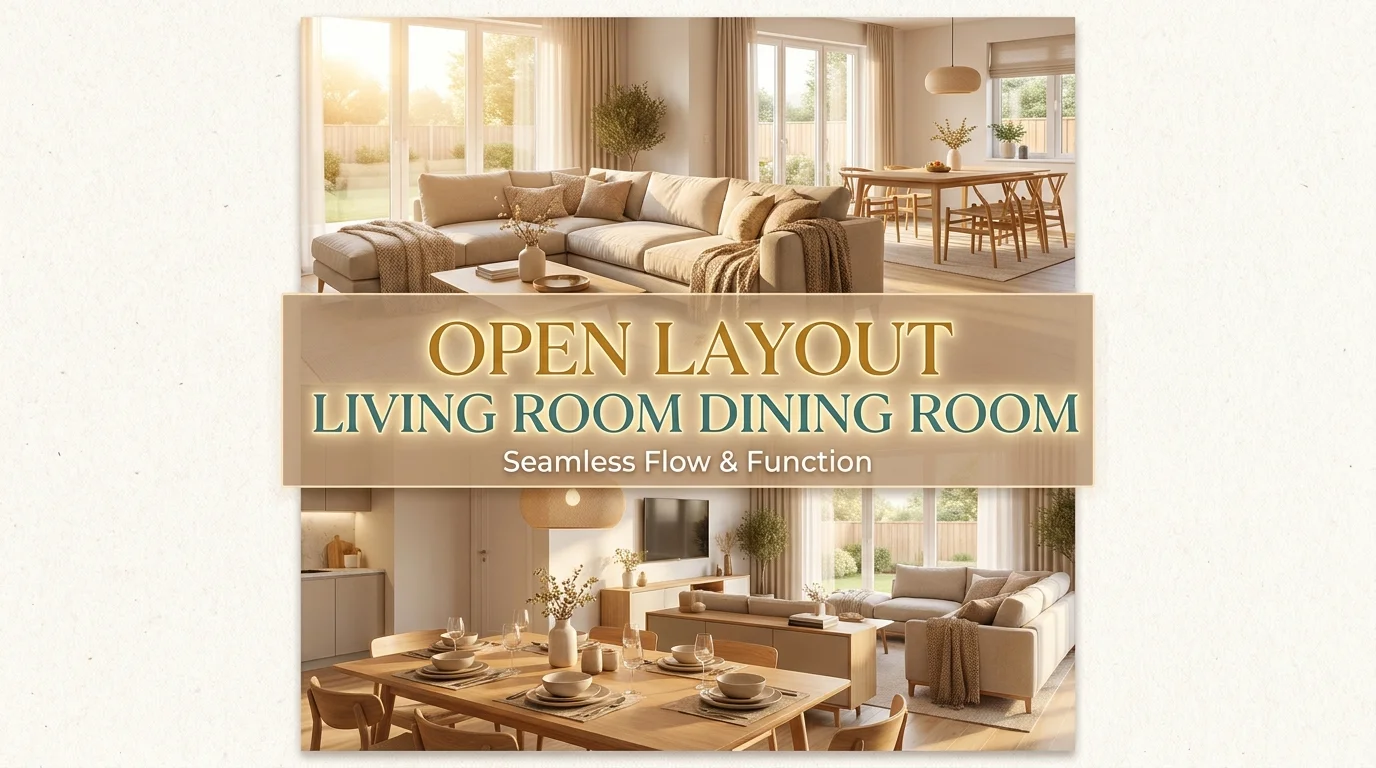
You know that feeling when you walk into someone’s home and it just breathes?
No walls choking the space. No dark corners. Just this open, flowing vibe where the living room and dining room flow into each other like best friends who never fight. That feeling? That’s what an open layout living room dining room gives you.
And if you’re sitting in your cramped apartment or old-style house right now thinking, “I wish my place felt like that” — this article is for you.
Let’s talk about everything. What it actually is, how to design one, common mistakes people make, and how to pull it all together even if you’re on a budget.
What Is an Open Layout Living Room Dining Room, Anyway?
Simply put, it’s when your living area and dining area share one big open space — no wall separating them.
Instead of two separate rooms with a door or a wall between them, you get one connected zone. The couch, the coffee table, the TV area — all living side by side with your dining table and chairs.
It sounds simple. But done right, it can completely transform how your home feels.
In older homes, rooms were usually closed off. Cooking smells stayed in the kitchen, conversations stayed in one room, and guests sat awkwardly in a “formal” dining room that nobody actually used every day.
Open layouts changed all of that. And today, it’s one of the most popular home design choices — whether you’re renovating an older house or decorating a brand new apartment.
Why People Are Obsessed With Open Concept Living
Here’s the honest truth: open layout homes feel bigger than they actually are.
Even a 600 square foot apartment can feel surprisingly spacious when there are no walls cutting it into tiny boxes. Light travels further. Your eyes can rest on a longer sightline. And suddenly, even a modest home feels airy and relaxed.
But it’s not just about size. Here are the real reasons people love open layout living room dining room setups:
- Natural light doubles. Windows in one zone light up the entire open space. No dark dining room hiding in a corner.
- Social connection. When you’re cooking or setting the table, you’re still part of the conversation happening on the sofa. Nobody gets left out.
- Perfect for families with kids. You can watch the kids playing in the living area while you eat dinner or prep food. One eye on them, one on your plate.
- It just looks better. Let’s be real — open spaces photograph beautifully. Every Instagram home you’ve ever saved probably has an open layout.
- Hosting becomes effortless. Guests flow naturally between sitting and eating. No awkward transitions.
The Challenges Nobody Talks About (Honestly)
Now, I’m not going to pretend it’s all perfect. Because it’s not.
Open layouts come with a few real challenges, and knowing them ahead of time saves you from regret later.
Noise travels. If the TV is on loud during dinner, everyone hears it. If someone’s on a call, the whole room knows.
Cooking smells spread everywhere. Fried fish at 7pm? Your guests on the sofa will know. Good ventilation is non-negotiable in open layout homes.
Clutter becomes everyone’s problem. In a closed room, you can shut the door on a mess. In an open layout? That stack of mail on the dining table is visible from the sofa.
Heating and cooling costs can be higher. One big space means your AC or heater is working overtime.
None of these are dealbreakers. They’re just things to plan for. And honestly, most people who make the switch say they’d never go back.
How to Design an Open Layout Living Room Dining Room That Actually Works
Okay, here’s where things get exciting. Let’s talk design.
1. Define Your Zones Without Walls
The magic of an open layout is that it feels open but still has structure. You don’t want the living area and dining area bleeding into each other confusingly.
Use rugs to define zones. A large area rug under the sofa and coffee table visually anchors the living space. A smaller rug under the dining table defines that zone. Two rugs, two zones, zero walls.
You can also use:
- Different ceiling treatments (a pendant light over the dining table vs. recessed lights over the living area)
- Furniture placement that faces different directions
- A low bookshelf or open shelving unit as a soft divider
The goal is clear zones that still breathe into each other.
2. Pick a Consistent Color Palette
This is where many people go wrong. They think “open layout” means every piece of furniture can be a different color. Wrong.
In an open layout, cohesion is king.
Pick 2-3 core colors and stick to them across both zones. If your sofa is in warm gray, your dining chairs should nod to that — maybe in a warm wood tone that complements it. If your rug is navy, bring a hint of blue into the dining area too — a centerpiece, some placemats, or an accent wall.
When the colors flow, the eye moves smoothly from one area to the next. When they clash, the space feels chaotic — even if it’s technically “open.”
3. Get Your Furniture Scale Right
Big mistake: buying furniture that’s the wrong size for an open space.
In a regular closed room, a big sofa might feel cozy. In an open layout, it can accidentally block sightlines and make the space feel weird. On the flip side, tiny furniture in a large open space looks sad and unanchored.
The rule of thumb: Your furniture should be proportional to the space, not to individual “rooms.”
Before buying anything, tape out the dimensions on the floor. Seriously. It sounds extra, but it saves so much money and heartache.
4. Lighting — The Secret Weapon
Lighting is what makes or breaks an open layout living room dining room design.
Think of your space as having two distinct moods:
- The dining area needs warm, focused light — a pendant or chandelier that hangs low over the table creates intimacy even in a big open space.
- The living area needs layered lighting — a mix of ceiling lights, floor lamps, and table lamps so you can adjust the vibe depending on the time of day.
Avoid relying on one overhead light for the whole space. That’s the fastest way to make an open layout feel like a waiting room.
Dimmer switches are a game changer. Install them and thank yourself later.
5. Create a Visual “Bridge” Between the Two Areas
Here’s a designer trick that most people overlook: use one recurring element that appears in both zones to tie the whole space together.
It could be:
- The same metal finish on your light fixtures and dining chair legs
- A similar wood tone in the coffee table and dining table
- A throw pillow in the living area that uses the same color as your dining chair cushions
These subtle repetitions tell your brain “this is one intentional space” rather than two rooms awkwardly sharing square footage.
Open Layout Living Room Dining Room Ideas for Every Home Size
Small Apartments (Under 600 sq ft)
Less is more. Seriously.
- Use a round dining table — no sharp corners, flows better in tight spaces
- Choose a sofa with legs (not one that sits flat on the floor) — legs make the space feel lighter
- Mirrors are your best friend — place a large mirror near the dining zone to reflect light and double the visual space
- Go vertical with storage — floating shelves on the walls keep the floor clear
The biggest mistake in small open layouts: Buying too much furniture and then cramming it all in. Edit ruthlessly.
Medium Homes (600–1200 sq ft)
You have room to breathe here. Use it well.
- An L-shaped sofa works great — it defines the living zone strongly without needing walls
- A proper 6-seater dining table is doable — don’t undersize it because you’re scared of the space
- Add a statement piece — a bold chandelier over the dining table, a large piece of artwork on the main wall, or a dramatic floor lamp in the living corner
Larger Homes (1200+ sq ft)
Now you’re dealing with a different problem: the space might feel too open, too cold, too echo-y.
- Use bigger rugs to really anchor each zone
- Add texture — woven baskets, linen curtains, wood accents — to make a big space feel warm and lived-in
- Consider a partial room divider: a half-wall, a decorative screen, or tall plants to create visual breaks without closing the space off
The Furniture Layout Mistake That Ruins Everything
Ready for the most common open layout mistake?
People push all their furniture against the walls.
It seems logical — more floor space in the middle, right? But it actually makes the room feel hollow and disconnected. Guests end up sitting across from each other at weird distances, shouting to have a conversation.
Instead, float your furniture. Pull the sofa away from the wall. Arrange chairs so they face each other at a comfortable angle. Create a conversational cluster in the living zone, and a separate functional cluster around the dining table.
When furniture floats, the space immediately feels more intentional and more human.
Styling the Open Layout: Small Details That Make a Huge Difference
You’ve got the layout sorted, the furniture in place, the lights hanging right. Now let’s talk about the stuff that makes guests go “wow.”
Plants. Not one tiny cactus on a shelf. We’re talking a big fiddle leaf fig in the corner of the living area, maybe some trailing pothos on a shelf near the dining zone. Plants add life — literally — to an open space and soften all the hard edges.
Table styling. Your dining table doesn’t need to be set for dinner every day. But it should never look completely bare either. A simple centrepiece — a bowl of fruit, a vase with stems, a cluster of candles — keeps it looking intentional.
Throw blankets and cushions. The living area needs texture. Throws and cushions do double duty: they add colour and cosiness. Just don’t overdo it — three or four well-chosen cushions beat twelve mismatched ones.
Art on the walls. In an open layout, you usually have one or two dominant walls. Use them wisely. One large piece of art is almost always more impactful than a mismatched gallery wall in a first attempt.
Real Talk: Is an Open Layout Right for Your Family?
Here’s a question worth sitting with for a second.
Open layouts are incredible for certain lifestyles. If you love hosting, if you have young kids you need to keep an eye on, if natural light and airy spaces make you happy — yes, absolutely, go for it.
But if you need quiet zones, if someone in your home works from home and needs separation, if cooking smells genuinely bother your family — think carefully.
The best home design isn’t the trendiest one. It’s the one that actually fits how you live.
Some families do a hybrid: open layout between kitchen and dining, but keep the living room separated with a set of open shelves or glass partition panels. You still get flow and light without total openness.
Budget Tips: Getting the Open Layout Look Without Spending a Fortune
Let me be honest — you don’t need to spend lakhs to nail an open layout living room dining room aesthetic.
Here’s what actually moves the needle on a budget:
- Paint. A fresh coat of a well-chosen colour does more for a space than almost anything else. Light, warm neutrals work best in open layouts.
- Lighting upgrades. Swap out that boring ceiling light for a pendant over the dining table. Affordable options exist at every price point.
- A good rug. Even one decent rug anchors the living zone beautifully. Look for sales, secondhand markets, or even online deals.
- Rearrange before you buy. Seriously — try floating your existing furniture first. You might be shocked by how different the room feels before you spend a single rupee.
- Declutter. Open layouts punish clutter hard. A cleared-out, well-organised space always looks better than a stuffed one.
A Quick Story
A friend of mine renovated her 2BHK apartment a couple of years back. She was convinced she needed to expand the space — maybe knock down a wall, add square footage somehow.
Her contractor convinced her to just remove the partial wall between the dining and living area, add a pendant light over the dining table, and put down two coordinated rugs.
Total cost? Less than she expected.
The result? Her apartment felt like a completely different home. Bigger, brighter, more social. She told me later, “I can’t believe I lived with those walls for so long.”
That’s the power of an open layout done right.
Conclusion: Your Next Step
An open layout living room dining room isn’t just a design trend. It’s a lifestyle upgrade.
It makes your home feel bigger. It makes everyday moments — meals, conversations, just being with your family — feel more connected. And when done thoughtfully, it looks genuinely beautiful.
Start small if you’re nervous: move your furniture, define zones with rugs, add better lighting. You don’t have to knock down walls tomorrow.
But once you feel that open, flowing, breathing quality that a well-designed open layout brings — you’ll wonder why you waited this long.
FAQ: Open Layout Living Room Dining Room
Q1. Can I create an open layout without knocking down walls? Yes, absolutely. Use furniture arrangement, rugs, and lighting to visually define zones in an existing open space. If you have a partial wall or a doorway you don’t love, consult a structural expert about options — but many people achieve the open layout feel purely through styling.
Q2. How do I keep an open layout from looking messy? Consistency is key. Stick to a limited colour palette, keep surfaces reasonably clear, and make sure each zone has a clear purpose. Storage solutions that hide clutter — baskets, closed cabinets, ottomans with storage — are your best friends.
Q3. What size rug do I need for an open layout living area? In most living zones, a rug that fits all front legs of your sofa and chairs on it is the minimum. Bigger is usually better — an undersized rug makes the whole space feel unanchored. When in doubt, go one size up from what you think you need.
Q4. How do I handle noise in an open layout home? Soft furnishings absorb sound — rugs, curtains, cushions, and upholstered furniture all help. If TV noise during dinner is a concern, position your seating so the TV faces away from the dining area, or invest in a good soundbar with directional audio.
Q5. Is an open layout dining room good for small homes? Yes, often it’s ideal for small homes. Removing visual barriers makes a small space feel significantly larger. The key is keeping furniture scaled appropriately and not overcrowding the space.