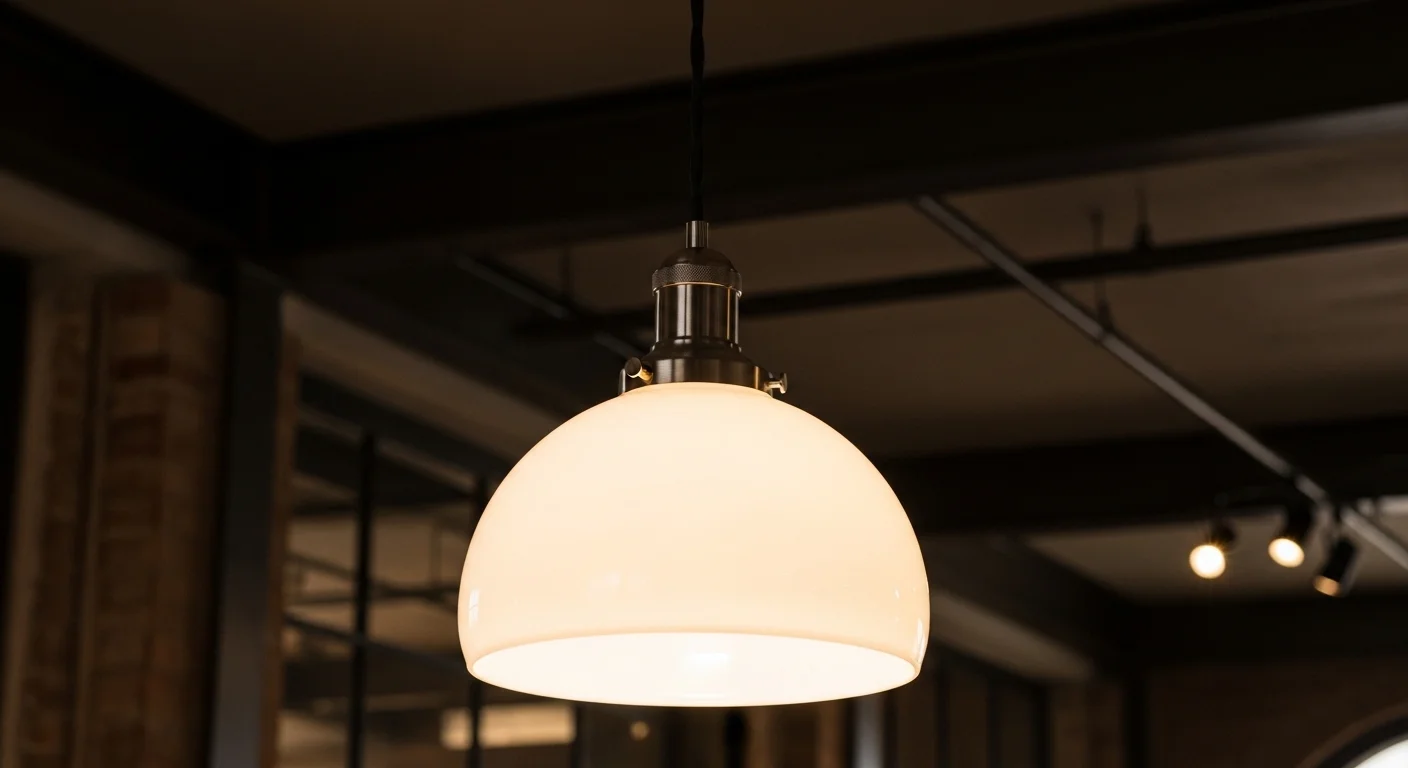
You walk into a room and something just feels right. The light is warm. The vibe is cozy. Everything looks pulled together — not too modern, not too old-fashioned. You look up, and there it is: a soft, creamy white globe hanging from the ceiling, glowing like it swallowed a piece of the moon.
That’s a milk glass pendant light. And yeah, it’s probably responsible for half the magic in that room.
I’ve been obsessing over lighting design for years, and I’ll tell you this straight — no fixture has the same universal appeal as milk glass. It works in farmhouse kitchens. It works in modern lofts. It works in tiny bathrooms and sprawling dining rooms. It’s the lighting equivalent of a white t-shirt: simple, clean, and somehow always right.
But if you’re here, you probably already sense that. You just want to know — which one do I buy? Where do I hang it? Is it worth it?
Let’s get into it.
What Exactly Is Milk Glass?
Before we get into pendant lights specifically, let me give you a quick rundown on the material itself.
Milk glass is an opaque or semi-translucent glass that’s white or off-white in color. It gets its name from its appearance — it literally looks like milk that somehow froze into glass form. It was hugely popular in the mid-20th century, especially in the 1950s and 60s, when you’d see it on everything from vases to dinnerware to lamp shades.
The magic of milk glass is in how it diffuses light. Instead of projecting a sharp beam, it scatters light softly in all directions. That means no harsh shadows. No glare. Just a warm, even glow that makes a room feel comfortable and inviting.
When you put that material into a pendant light shade, something special happens. The fixture becomes a glowing object in its own right — beautiful even when it’s switched off, and even more beautiful when it’s on.
Why Milk Glass Pendant Lights Are Having Such a Massive Comeback
Look, trends come and go. Everyone was doing Edison bulbs for a while. Then matte black fixtures. Then brass everything. But milk glass pendant lights have been quietly popular for decades, and right now they’re absolutely everywhere.
Why?
The “cozy aesthetic” trend is in full swing. People are tired of cold, clinical spaces. They want warmth. They want texture. They want a home that feels like a hug. Milk glass delivers exactly that.
There’s also the sustainability angle. Buying a vintage-style milk glass pendant light or an actual antique one means less waste, and people are really into that right now.
And honestly? Social media has a lot to do with it. Search “kitchen lighting” on Pinterest or Instagram and within 30 seconds you’ll see a milk glass globe pendant hanging over a kitchen island, absolutely nailing the look. It photographs beautifully. The soft glow is camera-friendly in a way that harsh LED fixtures just aren’t.
The Different Styles of Milk Glass Pendant Lights
Not all milk glass pendant lights are the same. There are several distinct styles, and picking the right one for your space matters a lot.
1. The Classic Globe
This is the one you’ve seen a hundred times. A round, smooth, opaque white glass globe hanging from a simple cord or rod. It’s timeless. It’s versatile. If you’re not sure which style to go with, start here.
Best for: Kitchen islands, bedroom ceilings, entryways, bathroom vanities.
2. The Schoolhouse Style
This one has a more structured shape — like a globe that got slightly flattened at the bottom and fitted with a metal rim. It has a vintage, industrial-meets-classic look. Very popular in farmhouse and transitional-style homes.
Best for: Kitchen islands, mudrooms, laundry rooms, covered porches.
3. The Fluted or Ribbed Globe
Same general shape as the classic globe, but with vertical ridges running around the glass. The ribbing catches light in interesting ways and adds visual texture to the fixture even when it’s off.
Best for: Bathrooms, bedrooms, accent lighting in living rooms.
4. The Elongated or Teardrop Shape
Not a perfect sphere — more like an elongated oval or teardrop. Feels slightly more modern while still maintaining that warm milk glass character.
Best for: Dining rooms, entryways with high ceilings, modern farmhouse kitchens.
5. The Bell Shape
Wider at the top, narrowing toward an open bottom. This shape is more directional — it pushes more light downward. Good if you need task lighting but still want the aesthetic.
Best for: Over kitchen sinks, reading nooks, workshop areas.
How to Choose the Right Size
This is where a lot of people mess up. They fall in love with a fixture online, buy it, hang it up, and then realize it looks tiny and sad or overwhelmingly huge.
Here’s a simple sizing rule that actually works:
For a single pendant over a table or island: The shade diameter should be roughly half the width of whatever it’s hanging over. So if your kitchen island is 4 feet wide, go for a shade that’s about 18–24 inches in diameter.
For multiple pendants in a row: Smaller globes work better — usually 8 to 12 inches — because you’re relying on the group effect, not a single statement piece.
For ceiling height: The bottom of your pendant should hang about 7 feet from the floor in most living spaces. Over a kitchen island or dining table, you want it lower — usually around 30 to 36 inches above the surface.
Don’t eyeball it. Measure. And if you’re not sure, cut a circle of paper in the size of the shade you’re considering and hold it up. It sounds ridiculous, but it works.
Room-by-Room Guide: Where to Use Milk Glass Pendant Lights
Kitchen
This is the sweet spot. A row of milk glass pendant lights over a kitchen island is one of the most classic, satisfying looks in home design.
Why it works: Kitchens need good task lighting, but they also need to feel warm and inviting — especially if they’re open to a dining or living area. Milk glass splits that difference perfectly. The diffused light is bright enough to work under, soft enough to look beautiful.
Go with two or three schoolhouse-style or globe pendants in a consistent size, spaced evenly. Hang them 32–36 inches above the island countertop.
Dining Room
Over a dining table, a milk glass pendant light (or a cluster of them) creates an intimate atmosphere that feels like candlelight — but way more practical.
A single large globe, 18 inches or bigger, can be a real statement piece here. Or go for a chandelier-style fitting with multiple smaller milk glass shades if you want something more dramatic.
Bathroom
Here’s where milk glass pendant lights are genuinely underused. Most people slap whatever comes in the bathroom vanity kit and call it a day.
But a single milk glass globe over a freestanding bathtub? Or two flanking a bathroom mirror? That’s spa territory. That’s intentional. And it’s genuinely not that hard to pull off.
Just make sure whatever fixture you choose is rated for damp locations if it’s near the shower or tub.
Bedroom
Pendant lights in bedrooms replace bedside lamps, and they’re honestly better. No more knocking things off your nightstand reaching for the switch.
A small milk glass globe on a long cord on each side of the bed looks elegant, saves surface space, and creates the kind of soft, diffused light that’s perfect for winding down before sleep.
Entryway or Foyer
The entryway sets the tone for your whole home. A single beautiful milk glass pendant light in an entryway tells your guests: this person has taste. It doesn’t have to be big — a medium globe with a nice cord and canopy can make a powerful first impression.
Pairing Milk Glass with Different Design Styles
This is where people get confused. “Is milk glass too traditional for my modern space?” Nope. Here’s how it plays with different styles:
Modern/Minimalist: Go with a clean, simple globe shape and a matte black or brushed nickel hardware. The contrast between the soft white glass and sharp dark metal is stunning.
Farmhouse/Rustic: Pair with warm wood tones, shiplap walls, and oil-rubbed bronze or brass hardware. Schoolhouse style is your best friend here.
Mid-Century Modern: Milk glass is native to mid-century design. Pair with walnut furniture, angled legs, and warm amber bulbs for a vintage look that feels current.
Coastal/Bohemian: Woven rattan, natural linen, and a milk glass globe creates the most effortlessly chic coastal vibe. No beach house props needed.
Industrial: This one might surprise you, but milk glass against exposed brick, concrete, and black pipe fixtures works really well. The softness of the glass balances the rawness of the industrial materials.
What Bulb Should You Use Inside a Milk Glass Pendant Light?
The glass diffuses light, so the bulb itself is less visible — but your bulb choice still matters a lot.
Color Temperature: Go warm. 2700K–3000K range. This is what gives you that golden, cozy glow. Anything above 3500K starts to look harsh and cool — not what you want from a milk glass fixture.
Bulb Type: LED bulbs are the obvious choice for efficiency, but make sure they’re dimmable if your fixture is on a dimmer switch. Many cheap LEDs don’t dim smoothly and will flicker annoyingly.
Bulb Shape: The globe (G-shape) or Edison (ST or A-shape) bulbs look great in milk glass shades because even though they’re partially hidden, they add to the warmth. Avoid bright white tubular bulbs — they’ll fight against the soft aesthetic.
Wattage Equivalent: For a bedroom or living room pendant, 40–60W equivalent LED is usually plenty. For a kitchen island where you need actual task lighting, go up to 75–100W equivalent.
New vs. Vintage: Which Should You Buy?
This is a real question worth thinking about. Vintage milk glass pendant lights from the 1950s–70s have a character and quality that’s genuinely hard to replicate. The glass is thicker. The patina on the hardware tells a story. You can find them at estate sales, antique shops, and online marketplaces like Etsy or eBay for sometimes surprisingly affordable prices.
The downside? They may need rewiring. The socket might be old and not compatible with modern bulbs. You’ll need to factor in potential restoration costs.
New reproductions are much more convenient. You get modern wiring, standard socket fittings, UL listings (meaning they’ve passed safety standards), and usually a warranty. The quality varies widely though — some are excellent, some are obviously cheap.
My honest take: If budget is a concern, go new. If you love the hunt and don’t mind a little DIY, vintage can be incredibly rewarding and often produces a more unique result.
How to Install a Milk Glass Pendant Light (Quick Overview)
I’m not going to walk you through a full electrical tutorial here — that’s what licensed electricians are for, and if you’re not comfortable with electrical work, please hire one. But here’s the general process so you know what you’re getting into:
- Turn off the circuit breaker for the room you’re working in. Don’t skip this.
- Remove the old fixture and disconnect the wires.
- Install the mounting bracket for your new pendant.
- Connect the wires — black to black (hot), white to white (neutral), green/bare copper to ground.
- Thread the cord or rod through the canopy and secure it.
- Attach the shade and install your chosen bulb.
- Restore power and test.
If your ceiling doesn’t already have a junction box, you’ll need to add one — that’s definitely a job for a professional.
The Best Places to Shop for Milk Glass Pendant Lights
You’ve got options. Lots of them.
- Etsy — Best for vintage and handmade options. Huge variety, often with real character. Read seller reviews carefully.
- Rejuvenation — A Pacific Northwest brand that specializes in historically accurate reproductions. Pricier, but the quality is genuinely excellent.
- Schoolhouse — Similar to Rejuvenation, American-made, high quality, and customizable.
- Wayfair / Amazon — Wide range of price points. Read reviews carefully and look for UL-listed fixtures.
- Local antique stores and estate sales — You might find something truly special. Plus you get to touch it before buying.
- Home Depot / Lowe’s — Surprisingly decent options at accessible price points, especially if you need something quick.
Common Mistakes to Avoid
Let’s save you some headaches.
Buying the wrong size. Measure twice, order once. Use the guidelines above.
Forgetting to check the ceiling height. Low ceilings need shorter pendants or flush-mounted alternatives. A pendant that works in a room with 10-foot ceilings might be a head-hazard in a room with 8-foot ceilings.
Ignoring the hardware finish. The glass gets all the attention, but the canopy, cord, and socket housing need to match your other hardware (cabinet pulls, faucets, door knobs). Mixing brass and chrome randomly looks unintentional.
Using the wrong bulb. A cool, bright white LED in a warm milk glass shade defeats the whole purpose. Go warm.
Not dimming it. Almost every pendant light looks better on a dimmer. It’s a cheap upgrade (dimmer switches cost $15–40) that pays off every single day.
A Quick Note on Price
Milk glass pendant lights range from about $30 for basic mass-market options to $400+ for artisan or vintage pieces. The sweet spot for quality-and-value tends to be in the $80–$200 range for new fixtures.
Don’t automatically buy the cheapest option — poorly made glass shades can look plasticky and the hardware can corrode quickly. But you also don’t need to spend $500 on a single pendant for a kitchen island. There’s a massive middle ground of well-made, attractive fixtures that hit that $100–$150 mark.
Conclusion: This Fixture Earns Its Place in Every Home
There’s a reason designers keep coming back to the milk glass pendant light. It’s not trendy in the way that makes it look dated in five years. It’s classic in the way that makes it look intentional and sophisticated in any space, any decade.
Whether you’re renovating a farmhouse kitchen, upgrading a bathroom, or just trying to make your bedroom feel less like a college dorm, a milk glass pendant light is one of the highest-impact, most accessible changes you can make.
Pick the right size. Match the hardware to your existing finishes. Put in a warm LED bulb. Add a dimmer. And then just enjoy the glow.
That soft, creamy light? That’s not just a lamp. That’s atmosphere. And atmosphere is what makes a house feel like a home.
FAQ: Milk Glass Pendant Lights
Q1: Are milk glass pendant lights suitable for outdoor use?
Most standard milk glass pendant lights are designed for indoor use only. If you want to use one in a covered porch or outdoor space, specifically look for fixtures rated for “damp locations” or “wet locations” depending on your exposure to moisture. Standard indoor fixtures will deteriorate quickly in outdoor conditions.
Q2: Can I use a smart bulb in a milk glass pendant light?
Yes! Smart bulbs (like Philips Hue or LIFX) work fine in most milk glass pendant fixtures as long as the socket is a standard size (usually E26 in the US). The milk glass shade actually enhances smart bulbs — the diffused glow looks especially beautiful when you adjust the color temperature through an app.
Q3: How do I clean a milk glass pendant light shade?
Turn off and cool the fixture first. Remove the glass shade if it detaches. Wash with warm water and a small amount of dish soap — milk glass is surprisingly durable. Avoid abrasive scrubbers that can scratch the surface. Dry thoroughly before reattaching. For shades that don’t detach, wipe gently with a damp microfiber cloth.
Q4: Will a single milk glass pendant light be enough to light a whole room?
Generally, no — a pendant light is usually accent or task lighting, not the sole light source for a large room. In a bedroom or small dining area, a single pendant with a bright enough bulb (75–100W equivalent LED) can do the job. For kitchens or living rooms, plan on supplementing with recessed lighting, floor lamps, or additional pendants.
Q5: Is milk glass the same as frosted glass?
Similar effect, but different material. Frosted glass is clear glass that has been etched or sandblasted to create a matte, translucent surface. Milk glass is made with added minerals during manufacturing that make it opaque and white throughout. Milk glass tends to be more opaque and casts a warmer, softer glow. Frosted glass is slightly more translucent and shows the silhouette of the bulb more clearly.