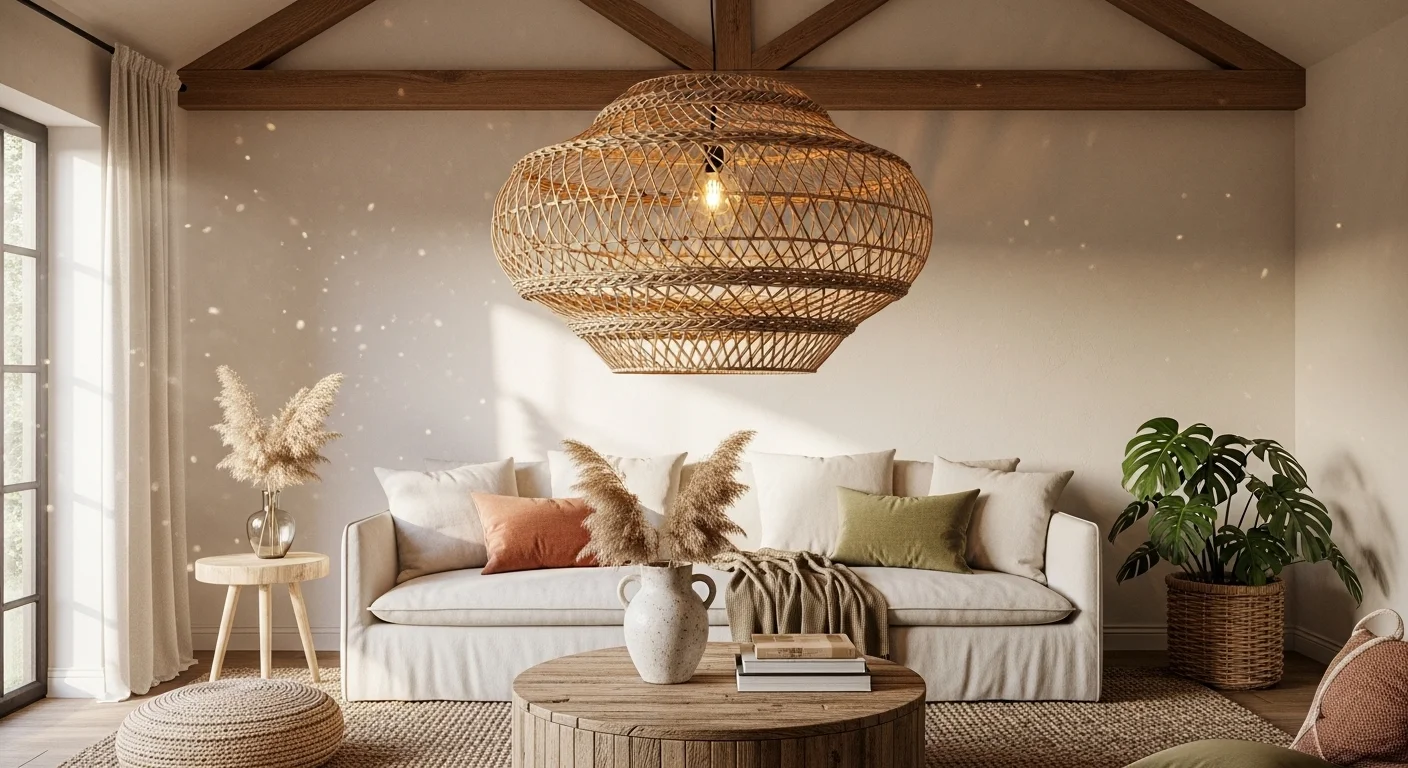
Everything feels warm. Cozy. Like the room is actually alive. And then you look up — and there it is. Hanging from the ceiling like a little piece of art, casting the most gorgeous, honeycomb-like shadows across the wall. A rattan pendant light.
It’s not fancy. It’s not complicated. But somehow, it changes everything.
If you’ve been trying to figure out why your living room, bedroom, or dining area feels a bit flat, a bit “meh” — I’d bet good money that your lighting is the culprit. And specifically, that you don’t have one of these beauties yet.
Let’s fix that.
What Exactly Is a Rattan Pendant Light?
Okay, real quick — for anyone who’s not sure what rattan even is. Rattan is a naturally growing vine plant, mostly found in tropical regions like Southeast Asia, Africa, and Australia. It’s lightweight, incredibly flexible, and seriously durable. People have been weaving it into furniture and home décor for centuries.
A rattan pendant light is simply a hanging light fixture where the shade — the part that covers the bulb — is made from woven rattan. Sometimes it’s raw rattan, sometimes it’s been painted white or black, sometimes it’s mixed with bamboo or seagrass. But the idea is the same: natural, woven material, hanging from your ceiling, looking impossibly good.
The magic? When the light turns on, those little gaps in the weave create the most stunning shadow patterns. It’s like having a living piece of art on your walls every single evening.
Why Is Everyone Suddenly Obsessed With Rattan Pendant Lights?
Here’s the thing — rattan isn’t “suddenly” popular. It’s had moments before (hello, 1970s). But right now? It’s everywhere. And there are really good reasons for that.
First, the whole world has gone crazy for natural textures. After years of everything being glass, metal, and cold minimalism, people are craving warmth. Wood. Stone. Linen. And rattan fits right in the middle of that movement.
Second, it works with literally every style. That’s rare. Most décor pieces are polarizing — you either love the look or it doesn’t fit your home. Rattan pendant lights are different. They slot into:
- Bohemian and eclectic spaces
- Coastal and beach-house vibes
- Scandinavian minimalist rooms
- Mid-century modern setups
- Even contemporary urban apartments
If your room has any natural element in it — a wooden table, a linen sofa, a plant — a rattan pendant light will feel like it belongs.
Third, they’re genuinely affordable. You can find beautiful rattan pendant lights starting from around $30–$40 and going up to a few hundred for handmade, artisan pieces. For the visual impact they deliver, the price-to-wow ratio is almost unfair.
The Different Styles of Rattan Pendant Lights (And Which One Is Right for You)
Not all rattan pendants are the same, and this is where it gets fun. Let me walk you through the main styles:
1. The Classic Ball or Globe Shape
This is probably what comes to mind first. A round, woven rattan globe hanging from a cord. It’s timeless. It works everywhere. If you’re totally new to rattan lighting and just want something beautiful without overthinking it — start here.
Great for: Living rooms, bedrooms, entryways.
2. The Drum or Cylinder Shape
Flatter and wider, these give off more of a deliberate, intentional look. They’re great over a dining table because they spread light across a larger surface while still looking elegant.
Great for: Dining rooms, kitchen islands.
3. The Bell or Dome Shape
These have a more defined silhouette — wider at the top, narrowing toward the bottom. They feel slightly more formal without losing the natural, relaxed quality of rattan.
Great for: Bedrooms, reading nooks, corners where you want a little drama.
4. The Cluster or Multi-Drop Style
Instead of one big shade, this style hangs multiple smaller rattan shades at different heights from a single ceiling mount. The effect is absolutely stunning — it feels like a curated installation rather than just a light fixture.
Great for: High ceilings, open-plan living areas, statement dining rooms.
5. Painted or Bleached Rattan
If natural brown rattan feels too warm or earthy for your space, many designs come in white or bleached finishes. These look absolutely incredible in minimal, Scandi-style rooms where you want the texture without the warmth of the natural color.
Great for: White and neutral color palettes, coastal/Hamptons-style homes.
Room by Room: How to Use a Rattan Pendant Light in Your Home
Let me get specific here because “it looks good everywhere” is great, but you probably want to know exactly how to make it work in your specific room.
In the Living Room
The living room is where rattan pendant lights really shine (pun intended). The key is hanging it at the right height — not too high that it feels disconnected, not so low that it’s in your face.
If you have a coffee table situation in the center of the room, consider a single statement pendant hung roughly 5.5 to 6 feet from the floor. If you have a reading corner, a smaller pendant hung lower creates the coziest little alcove.
Pro tip: Pair it with a warm Edison bulb (2700K color temperature) to amplify that golden, honeycomb glow.
In the Dining Room
This is the single most impactful change you can make in a dining room — full stop.
Hang your rattan pendant light 28 to 32 inches above the tabletop. Any higher and it loses intimacy; any lower and someone’s going to hit their head. For a long table, two or three smaller pendants spaced evenly along the length looks infinitely better than one giant shade.
The shadows that rattan throws across a dinner table at night? Honestly, your food will look better. Your guests will feel something without knowing why. It’s just atmosphere.
In the Bedroom
A rattan pendant light in the bedroom is a game changer, especially if you hang one (or two) on either side of the bed as bedside lighting. Instead of table lamps eating up your nightstand space, you get floating, sculptural light that actually becomes part of the room’s design.
Use a dimmable bulb. Trust me on this. Being able to go from bright-enough-to-read to soft-amber-for-sleep with a single switch is worth every penny.
In the Kitchen
Over a kitchen island, a rattan pendant (or a row of them) adds an organic counterpoint to all that tile and metal and hard edges. It’s the textile of the room — the softness that makes everything else feel less clinical.
Just make sure you’re choosing a style that’s not too open-weave if you’re hanging it near a stove. You don’t want steam and grease getting into the fibers.
In Kids’ Rooms and Nurseries
Here’s one people don’t always think about — rattan pendant lights are perfect for children’s spaces. They’re non-toxic, they create the softest, warmest light imaginable, and they have a playful, natural quality that fits beautifully in a room full of wooden toys and linen curtains.
Choose a small globe shape in a natural finish and hang it from a colorful cord. Adorable.
How to Style Around Your Rattan Pendant Light
Getting the light itself is only half the battle. Here’s how to make it look like it was styled by someone who actually knows what they’re doing.
Match it with natural textures. Rattan loves company. Jute rugs, linen cushions, wooden furniture, wicker baskets — any of these amplify the organic, earthy quality of your pendant.
Don’t go overboard. This is where people sometimes mess up. If you have a rattan pendant, a rattan chair, a rattan side table, AND a rattan fruit bowl — it starts to feel like a furniture showroom rather than a home. Let the pendant be the star and use rattan accents sparingly elsewhere.
Think about cord length. The hanging cord matters more than people realize. A long, exposed cord in a beautiful hemp or fabric-wrapped style can be part of the visual design. Many rattan pendants come with adjustable cord lengths — always check this before buying.
Consider your bulb. A rattan pendant with a bare Edison bulb looks incredible. A rattan pendant with a standard white LED bulb looks… fine, but you’re leaving so much on the table. Go warm white (2700K–3000K) and choose a decorative bulb that you don’t mind being visible.
What to Look for When Buying a Rattan Pendant Light
Okay, so you’re ready to buy. Here’s what actually matters:
1. Check the weave quality. Good rattan should be tightly and evenly woven with no loose ends or fraying. If it looks a little rough and uneven in the product photos, it’ll look worse in person.
2. Look at the ceiling canopy. That’s the little disc-shaped piece that mounts to your ceiling. Cheap ones look flimsy and small. A good quality pendant will have a solid, properly sized canopy.
3. Check the maximum wattage. Most rattan pendants work with bulbs up to 40–60 watts. If you need a brighter light, check before you buy.
4. Make sure it’s dimmable (if you want that feature). Not all pendants are compatible with dimmer switches. Look for “dimmable compatible” in the listing.
5. Read the reviews. Specifically, look for reviews with photos. You want to see what the light actually looks like installed in a real home, not just in a studio shot against a white background.
6. Measure your ceiling height. Standard ceiling heights are around 8–9 feet. If yours are higher, you may need an extension cord or a longer drop. Many sellers offer customization — just ask.
The Real Reason Rattan Pendant Lights Feel So Good
I want to take a second to talk about why this type of lighting feels so different from a regular shade or a recessed light.
It comes down to something designers call diffused light. Most artificial lights throw light in a harsh, direct way — a cone of brightness that creates sharp contrasts. Rattan weave scatters that light in all directions through dozens of tiny gaps. The result is soft, ambient, glowing light that fills a room rather than spotting it.
And then there are the shadows. Those intricate, lace-like shadows that rattan throws on your walls and ceiling — they create what’s called visual texture in a room. The room suddenly has depth and movement even when nothing is moving. It feels more alive.
That feeling people get when they walk into your home and just stop? That’s it. That’s what you’re buying.
Rattan Pendant Light Maintenance: Keeping It Looking Fresh
Good news — rattan is one of the easiest materials to maintain.
- Dust regularly with a soft brush or a compressed air can. Don’t let dust accumulate in the weave.
- Never wet-clean rattan unless the seller specifically says it’s okay. Water can cause rattan to warp or crack over time.
- Keep it away from direct sunlight for extended periods. UV light will bleach the natural color over time.
- Check the wiring annually — especially where the cord meets the canopy. If you see any fraying, call an electrician before using it.
That’s genuinely it. Rattan is durable, low-maintenance, and built to last years if you treat it right.
Common Mistakes People Make (And How to Avoid Them)
Let me save you from the errors I’ve seen people make:
- Hanging it too high. Your pendant should feel connected to the room, not floating near the ceiling like a lost balloon.
- Choosing the wrong size. A tiny pendant in a large room gets lost. A huge pendant in a small room feels overwhelming. As a general rule, the diameter of your shade (in inches) should roughly equal the width and length of the room (in feet) added together.
- Using the wrong bulb. Cool white LED bulbs turn your cozy rattan pendant into something that looks clinical and harsh. Always warm white.
- Forgetting about scale. One large pendant looks intentional. Three mismatched sizes of rattan shades in the same room looks chaotic.
Final Thoughts: Just Do It Already
Look — I’ve given you a lot of information here. But here’s the simple truth: a rattan pendant light is one of the lowest-risk, highest-reward things you can do for your home.
It’s affordable. It’s beautiful. It works in almost every room and almost every style. And the moment you flip that switch for the first time in the evening, watching those golden shadows spread across your walls — you’ll wonder why you waited so long.
Your room has been waiting for this. Go find your light.
FAQ: Rattan Pendant Light Questions Answered
Q1: Are rattan pendant lights safe to use? Yes, absolutely — as long as you use them within the manufacturer’s wattage guidelines and make sure the electrical installation is done properly. Rattan itself is a natural material and is not a fire hazard at normal bulb temperatures. Stick to the recommended wattage (usually 40–60W) and you’re completely fine.
Q2: Can rattan pendant lights be used outdoors? Standard rattan pendant lights are generally not suitable for outdoor use because rattan absorbs moisture and can warp, crack, or develop mold when exposed to rain or high humidity. If you want a similar look for a covered patio or outdoor area, look for lights specifically rated for “damp locations” or those made from synthetic rattan, which is weather-resistant.
Q3: How do I clean a rattan pendant light? The easiest method is to use a soft-bristle brush (like a clean paintbrush) or a can of compressed air to blow dust out of the weave. For any stubborn spots, slightly dampen a cloth and dab gently — don’t soak the rattan. Always let it dry completely before turning the light back on.
Q4: What size rattan pendant light do I need for my room? A simple rule of thumb: add the length and width of your room in feet, and that number in inches gives you a good starting shade diameter. For a 10×12 foot room, look for a shade around 20–22 inches. For a kitchen island, one pendant per 2 feet of island length works well. For a dining table, your shade should be roughly half the width of the table.
Q5: Can I use an LED bulb in a rattan pendant light? Yes — and you should! LED bulbs generate far less heat than incandescent bulbs, which is actually better for the rattan and safer overall. Just make sure you choose a warm white LED (2700K–3000K color temperature) to get that beautiful golden glow, rather than a cool white or daylight bulb which will look harsh and unflattering through the weave.