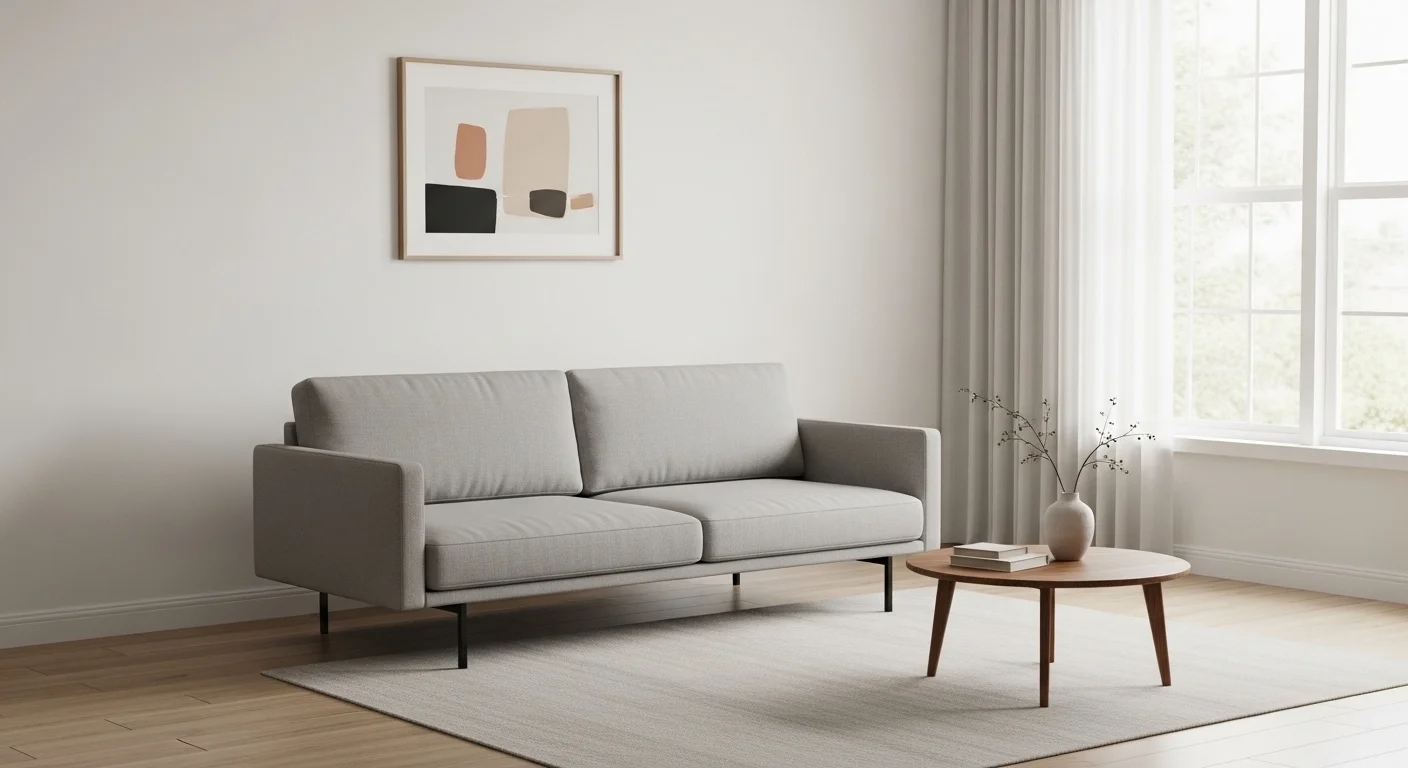
You walk into your living room. There’s too much going on. The sofa is big, the colors are everywhere, the space feels… heavy. Like it’s pressing down on you.
Sound familiar?
Most people don’t realize it, but the sofa is the heartbeat of your living room. Get it wrong, and the whole room feels off. Get it right? Everything just clicks. And that’s exactly where a minimalist sofa comes in.
This isn’t just a design trend. It’s a lifestyle shift. And by the end of this guide, you’ll know exactly what to look for, what to avoid, and how to pick the one that fits your life — not just your floor plan.
What Actually Is a Minimalist Sofa? (It’s Not What Most People Think)
Let’s clear something up right away.
A minimalist sofa is not just a plain-looking sofa. It’s not boring. It’s not uncomfortable. And it’s definitely not about spending less money to get less furniture.
Minimalist design is about removing everything that doesn’t need to be there.
Think clean lines. No fussy cushion frills. No carved wooden legs with curlicues. No overstuffed armrests that eat up half the seat space. Just honest, functional, beautiful design that says, “I know exactly what I am.”
The best minimalist sofas have:
- A low, streamlined silhouette
- Solid-color or subtle textured upholstery
- Legs that are simple — tapered wood, metal hairpin, or no legs at all (platform style)
- Cushions that hold their shape (no constant fluffing required)
- A size that fits the room instead of dominating it
If a sofa has tassels, it’s not minimalist. If it needs four throw pillows just to look good, it’s not minimalist. If it shows up and the room feels smaller, definitely not minimalist.
Why People Are Obsessed With Minimalist Sofas Right Now
Here’s a real thing that happened to my colleague Priya.
She had a huge sectional sofa — one of those U-shaped beasts that took up most of her apartment living room. Comfortable? Sure. But she felt like she was living inside the sofa, not in her home. Every time she had guests over, everyone got swallowed by cushions and the room felt like a furniture showroom.
She switched to a sleek, mid-century modern minimalist sofa — two-seater, olive green, simple tapered legs. Suddenly, her apartment looked twice the size. She could actually walk around. The room breathed.
That’s the magic.
And here’s why the trend is growing so fast:
1. City apartments are getting smaller. People need furniture that works with their space, not against it.
2. Mental health and clutter are connected. Research from Princeton University showed that visual clutter competes for your brain’s attention. A cleaner room = a calmer mind.
3. Social media aesthetics. Whether it’s the Japanese wabi-sabi influence, Scandinavian design principles, or Korean minimalism, clean interiors dominate platforms like Pinterest and Instagram.
4. Durability and quality over quantity. A minimalist sofa is usually built better because the design depends on structural honesty, not decorative tricks hiding poor construction.
The 6 Types of Minimalist Sofas (And Which One Is Right for You)
Not all minimalist sofas are the same. Let’s break them down.
1. Mid-Century Modern Sofa
This is probably the most popular style when people say “minimalist sofa.” Think Mad Men office vibes. Low back, wide seat, tapered wooden legs, clean angles.
Best for: People who want a classic, timeless look. Works in both modern and vintage-inspired rooms.
Common colors: Walnut brown, mustard yellow, forest green, dusty rose, camel.
2. Scandinavian (Scandi) Sofa
Scandinavian design is all about warmth through simplicity. These sofas often have soft, rounded edges — not as sharp as mid-century — with cozy fabrics like boucle or wool.
Best for: People who want minimalism but still want the room to feel warm and inviting.
Common colors: Off-white, light grey, sand, sage green.
3. Japanese-Inspired Floor Sofa
Low to the ground. Sometimes no legs at all. Wide seating. Often paired with tatami-style floors or rugs. This is serious minimalism — the kind that says “I’ve read Marie Kondo twice.”
Best for: Studio apartments, meditation spaces, or anyone who loves sitting on the floor anyway.
Common colors: Charcoal, natural linen, dark navy.
4. Platform Sofa
Similar to the floor sofa but with a solid base instead of legs. Very geometric. Very architectural. This is the sofa that interior designers put in big, open-plan living rooms with high ceilings.
Best for: Larger spaces where you want a statement piece that still feels clean and uncluttered.
Common colors: Dark grey, cream, terracotta, black.
5. Two-Seater / Loveseat Minimalist Sofa
Small space? This is your answer. A minimalist two-seater can make a tiny room feel perfectly curated instead of cramped.
Best for: Studio apartments, home offices, reading nooks, bedrooms with a sitting area.
Common colors: Almost anything works — this is where you can go bold because the scale is small.
6. Modular Minimalist Sofa
This is the grown-up version of a sectional. Modular sofas have individual pieces you can rearrange. Minimalist versions keep the lines clean and use neutral tones.
Best for: People who move frequently or want flexibility. Also great for families.
Common colors: Charcoal, oatmeal, dark teal, dusty blue.
How to Choose the Perfect Minimalist Sofa: A Step-by-Step Approach
Okay, let’s get practical. You’re shopping for a sofa. Here’s exactly how to think about it.
Step 1: Measure Your Space First (Seriously, Do This)
This sounds obvious but almost everyone skips it. Then they buy a sofa and it doesn’t fit through the door. Or it fits but now there’s no room to walk around it.
The golden rule: Leave at least 18 inches between your sofa and the coffee table. And at least 30 inches between the sofa and the wall (if the sofa isn’t against a wall).
Use painter’s tape on your floor to outline the sofa dimensions before you buy. This trick saves more marriages than couples therapy.
Step 2: Pick Your Fabric Based on Your Life
This is where people make the most expensive mistakes.
| Your Situation | Best Fabric Choice |
|---|---|
| Have kids or pets | Performance fabric, microfiber, leather |
| Live alone, like elegance | Linen, velvet, boucle |
| Hot climate | Linen, cotton, performance weave |
| Want easy cleaning | Leather or performance fabric |
| Want cozy warmth | Boucle, wool blend, velvet |
Pro tip: Boucle is having a massive moment right now. It’s that loopy, textured fabric that looks like a cloud. Absolutely beautiful on a minimalist sofa — but it snags easily. Not ideal if you have cats.
Step 3: Choose a Leg Style That Matches Your Floor
Legs matter more than you think. They affect how the sofa “floats” in the room.
- Tapered wood legs = warm, mid-century, classic
- Metal hairpin legs = industrial, edgy, modern
- No legs / platform base = ultra-modern, Japanese-inspired
- Short wood block legs = Scandinavian, cozy
If you have a dark wood floor, go for lighter legs. If your floor is light, darker legs give contrast. Simple math.
Step 4: Color — The Decision That Haunts People
Here’s the thing about color: neutrals never go wrong for a minimalist sofa, but that doesn’t mean you have to play it safe.
Safe neutrals: Cream, oatmeal, light grey, charcoal, white.
Brave but beautiful: Dusty sage green, clay/terracotta, navy blue, rust, forest green.
Colors to avoid for a minimalist vibe: Bright red, pattern-heavy prints, anything with tropical flowers on it.
One strong piece of advice — if your walls are white or very light, try a sofa with some color. Not neon. Not wild. But a muted sage or a soft dusty blue can make a minimalist room feel intentional rather than sterile.
Step 5: Test the Seat Depth Before You Buy
This is the most underrated factor in sofa comfort. Seat depth is the measurement from the front edge of the cushion to the back.
- Under 22 inches: Very upright, formal — good for people who don’t like sinking in
- 22–24 inches: The sweet spot for most people
- 25+ inches: You’ll need to add a pillow behind your back if you’re under 5’8″
Many minimalist sofas have shallower seat depths to keep that clean silhouette. Make sure it works for your body before you fall in love with how it looks.
The Biggest Mistakes People Make When Buying a Minimalist Sofa
Let’s be real. These mistakes happen constantly.
Mistake #1: Buying online without sitting in it. Photos lie. A sofa can look perfect online and feel like a park bench in real life. If you can, visit a showroom. If you can’t, at least read verified reviews that mention comfort.
Mistake #2: Thinking “minimalist” means “cheap.” The opposite is usually true. A well-made minimalist sofa uses quality materials that can stand on their own without decoration hiding bad construction. Budget for quality. A good sofa lasts 10–15 years.
Mistake #3: Matching everything perfectly. Interior designers actually cringe at this. Your sofa doesn’t need to match your rug which matches your curtains which matches your cushions. A minimalist room uses variety in texture and tone, not a single color story from the furniture catalog.
Mistake #4: Ignoring the cushion fill. The cushion fill determines how long your sofa stays comfortable and looks good.
- Foam only: Firm, keeps shape, but hardens over time
- Down blend (foam + feathers): Luxurious, soft, needs fluffing
- High-resilience foam: The best of both worlds — comfortable and durable
Mistake #5: Getting a sofa that’s too big because “more is better.” In minimalist design, scale is everything. A sofa that’s too large for the room destroys the whole effect. Smaller, right-sized furniture makes rooms look bigger and more intentional.
Minimalist Sofa Styling: How to Make It Look Like a Magazine Spread
You’ve got the sofa. Now what?
Keep your throw pillows to a maximum of 2–3. And make sure at least one of them has texture — a chunky knit, a linen, a velvet. Not five different prints fighting each other.
Add a simple throw blanket. Drape it casually over one armrest. Not folded perfectly — that looks staged. Let it look lived-in.
Choose a coffee table with visible legs. A glass-top table or a simple wood table with slender legs makes the space feel open. A big solid block of a coffee table closes the room in.
Let the sofa breathe. Don’t push it against the wall. Floating furniture — especially a minimalist sofa — in the center of a room makes the space look designed, not just furnished.
One good lamp, not five small ones. A floor lamp with a clean stem next to the sofa does more for the room’s atmosphere than a bunch of table lamps competing for attention.
Real Talk: What Does a Good Minimalist Sofa Cost?
Let’s talk money, because nobody else gives you a straight answer.
| Budget Range | What You’ll Get |
|---|---|
| Under $500 | Basic construction, foam cushions, limited fabric options — fine for a first apartment |
| $500–$1,200 | Better fabric choices, improved cushion fill, more style options |
| $1,200–$2,500 | Solid wood frames, quality upholstery, good durability — the sweet spot |
| $2,500–$5,000 | Designer pieces, premium materials, heirloom quality |
| $5,000+ | Custom, luxury, built-to-last-forever territory |
The honest advice? Spend as much as you can afford in the $1,200–$2,500 range. A sofa is not the place to go bargain-hunting. You sit on it every single day.
Top Brands Known for Minimalist Sofas
A few names worth knowing when you start shopping:
- Article — Affordable Scandinavian-inspired sofas, good quality for the price
- West Elm — Mid-range, wide variety of clean-lined styles
- Floyd — Modular, modern, very minimalist
- Muji — Japanese design philosophy, simple and functional
- Herman Miller / Design Within Reach — Premium, investment-level pieces
- IKEA (SÖDERHAMN, ÄPPLARYD) — Budget option with surprisingly good minimalist design
- Burrow — Great modular options, ships in boxes, easy assembly
The Environmental Angle: Minimalist Sofas and Sustainable Living
Here’s something worth thinking about.
Minimalism and sustainability go hand in hand. When you buy one high-quality minimalist sofa that lasts 15 years instead of three cheap ones that fall apart in five years each, you’re producing less waste.
Look for:
- OEKO-TEX certified fabrics — tested for harmful substances
- FSC-certified wood frames — sustainably sourced
- CertiPUR-US certified foam — made without harmful chemicals
- Brands with repair programs — some companies will replace cushions instead of making you buy a new sofa
A truly minimalist mindset isn’t just about how the sofa looks. It’s about buying consciously, buying well, and buying once.
Conclusion: Your Living Room Deserves Better
Here’s the simple truth.
Your home should feel like you — calm, considered, comfortable. Not like a showroom. Not like a storage unit. And not like a furniture catalog where everything matches too perfectly.
A minimalist sofa is more than just furniture. It’s a decision to stop filling space and start designing it. It’s choosing quality over quantity, clarity over chaos, and intention over impulse.
You don’t need a big budget. You don’t need to hire a designer. You just need to know what you want, measure your space, and pick something that fits your life — not just your living room.
Start there. The rest takes care of itself.
Frequently Asked Questions (FAQ)
1. What makes a sofa “minimalist”?
A minimalist sofa is defined by clean, simple lines with no unnecessary decorative elements. It typically features a low profile, solid or subtly textured upholstery, simple leg designs, and a neutral or muted color palette. The emphasis is on function and form working together without excess.
2. Are minimalist sofas comfortable?
Yes — but comfort depends on the specific sofa, not the style. A minimalist sofa can be extremely comfortable with the right cushion fill (high-resilience foam or a down blend), appropriate seat depth, and quality construction. Don’t assume “minimal” means “minimal comfort.”
3. What colors work best for a minimalist sofa?
Neutrals like cream, oatmeal, light grey, and charcoal are the safest choices. However, muted tones like dusty sage, clay, dusty blue, or forest green also work beautifully and add personality without cluttering the space visually.
4. How do I style a minimalist sofa without it looking boring?
Use texture instead of pattern. A boucle throw, a linen cushion, a chunky wool blanket — these add visual interest without noise. Keep accessories limited (2–3 cushions max), add a quality floor lamp, and let negative space do the heavy lifting.
5. How long should a quality minimalist sofa last?
A well-made minimalist sofa with a solid hardwood frame, quality foam, and durable upholstery should last 10–15 years with normal use. Avoid particleboard frames and always check for kiln-dried hardwood in the frame construction when making your purchase decision.