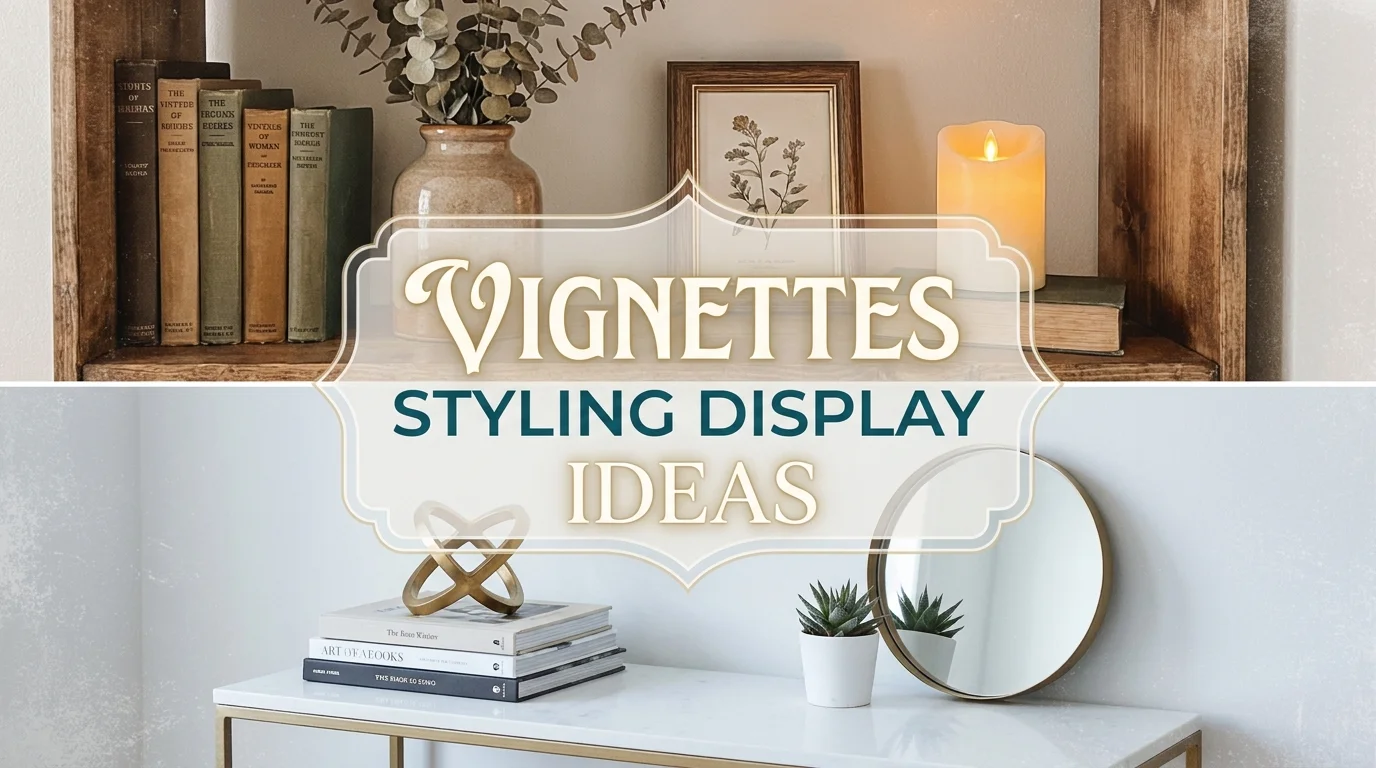
You know that feeling when you walk into someone’s home and one little corner just stops you in your tracks?
There’s a small tray on the shelf. A candle. Maybe a tiny plant and one beautiful book. And somehow it all just… works. You stand there thinking, “How did they do that?”
That, my friend, is the magic of a vignette. And the good news? You don’t need a fancy interior designer or a big budget to pull it off. You just need to know a few secrets — and that’s exactly what we’re diving into today.
What Even Is a Vignette? (And Why Should You Care?)
Let’s keep this super simple. A vignette is just a small, styled grouping of objects arranged together to tell a story or create a mood. It could be on a bookshelf, a side table, a windowsill, a fireplace mantel — literally anywhere.
Think of it like a little scene. Like a tiny movie set, but on your coffee table.
Why does this matter? Because random stuff thrown on a shelf looks like clutter. But the same stuff, arranged with a bit of intention? Suddenly it looks curated. Intentional. Beautiful.
The difference between a messy shelf and a styled one is often just knowing how to group things. That’s what vignettes styling display ideas are all about.
The “Rule of Three” — The Secret Backbone of Every Great Vignette
Here’s the first thing every decorator learns: things look best in odd numbers.
Three objects. Five objects. Seven. Never four, never six. Weird, right? But it works. Our brains find odd groupings more visually interesting because they’re slightly off-balance — and that tension is what keeps the eye moving and engaged.
So when you’re building your first vignette, start with three things:
- One tall item (like a lamp, a vase, or a candlestick)
- One medium item (a stack of books, a small sculpture, a fruit bowl)
- One small item (a crystal, a small plant, a pretty stone)
This creates visual hierarchy. Your eye travels from tall to medium to small, and it feels satisfying without you even knowing why.
Try it right now with stuff you already own. Seriously. Go grab three random things, arrange them in a triangle shape, and I promise you’ll be surprised.
Varying Heights: The Move Nobody Talks About Enough
This is the part where most people go wrong. They put five items on a shelf, all roughly the same height, and wonder why it looks boring.
Height variation is everything.
When objects are all at the same level, your eyes have nowhere to go. But when you mix tall, medium, and short? The eye bounces around. It explores. It enjoys itself.
A few easy ways to add height variation:
- Stack books under a small object to lift it up
- Use a cake stand or riser to elevate a plant or candle
- Lean a framed print or mirror behind shorter objects
- Use a tall branch or stem in a narrow vase to shoot upward
That last one is a personal favorite. I once turned a boring side table into a real conversation piece just by adding one tall dried pampas grass stem in a simple ceramic vase. People asked about it for months.
Texture, Texture, Texture — The Unsung Hero
Here’s what separates a good vignette from a great one: mixing textures.
When everything in your display is smooth and shiny, it reads as flat. But when you bring in rough next to smooth, matte next to glossy, organic next to structured? It suddenly feels rich and layered.
Some texture combinations that just work:
- Smooth ceramic vase + rough linen book cover + glossy marble coaster
- Woven basket + polished wooden bowl + soft-dried botanicals
- Metal candleholder + velvet ribbon + natural stone
You don’t need to spend money on new things. Just look at what you have and ask: “What’s the texture here?” Then find something that contrasts it.
Color Coordination: How to Pick a Palette Without Overthinking It
This trips people up more than anything else. They grab a bunch of pretty objects and then wonder why the group looks chaotic.
The answer is almost always: too many competing colors.
Here’s the easy fix. Pick two or three colors max for your vignette, and let one of them be neutral (white, cream, beige, natural wood, black).
For example:
- Soft green + cream + warm wood — feels earthy and calm
- Deep navy + brass gold + white — feels bold and sophisticated
- Blush pink + terracotta + off-white — feels warm and artistic
- Charcoal grey + forest green + natural linen — feels moody and editorial
You don’t have to match everything exactly — that would look too stiff. But keeping it within a loose color family ties the whole vignette together without any effort.
Vignettes Styling Display Ideas by Location
Different spots in your home call for different approaches. Let’s break it down.
Bookshelf Vignettes
Bookshelves are basically vignette playgrounds. The key here is breaking up the books with objects.
Don’t just line up books spine out. Pull some forward, stack some horizontally, and place objects in the gaps. A small plant here. A framed photo there. A little sculpture tucked between a stack.
Also — try removing some books entirely. Negative space is a design choice, not laziness.
Pro tip: Arrange books by color in one section of the shelf. It sounds obsessive but it looks incredible.
Coffee Table Vignettes
The coffee table vignette needs to be functional and beautiful. Because someone’s going to put their tea mug on it in approximately four minutes.
The classic formula:
- A tray (this contains everything and makes it feel intentional)
- A stack of coffee table books (2-3 max)
- A candle or small plant
- One sculptural or personal object — something that sparks conversation
The tray is the secret weapon here. It visually “frames” the vignette, so even if someone moves things around, the tray signals that this is a deliberate display.
Fireplace Mantel Vignettes
The mantel is prime real estate. It’s at eye level, centered on the wall — everyone looks at it.
Because it’s wide, you can use a symmetrical or asymmetrical layout. Symmetry feels formal and elegant. Asymmetry feels relaxed and modern.
For asymmetry: anchor one end with something tall (a tall vase, a leaning mirror, a large artwork), then trail off with decreasing heights toward the other end.
For symmetry: match objects on both sides of a central piece — matching candlesticks flanking a centerpiece, for instance.
Either way, layer things in front of each other. Don’t line everything up in a single row. Let a small object peek out from behind a larger one.
Windowsill Vignettes
Windowsills get natural light — use that. Plants thrive here. Glass objects catch the light beautifully.
Keep windowsill vignettes minimal. The window is already a focal point. You don’t want to compete with the view. Two or three objects max. A small succulent, a colored glass bottle, maybe a smooth stone.
Entryway Table Vignettes
Your entryway table is the first and last thing you and your guests see. It sets the tone for the whole home.
The essentials:
- A mirror above (reflects light, makes the space feel bigger)
- A lamp if there’s an outlet nearby
- A small tray for keys and everyday items (practical + pretty)
- One living thing — a plant, fresh flowers, or even a citrus fruit in a bowl
Don’t make your entryway vignette too precious. It lives in a high-traffic area. Make it beautiful but also livable.
The “Personal Object” Rule — Why Your Vignette Needs a Story
Here’s something the magazines won’t tell you. The most beautiful vignettes always have one thing that means something to the person who lives there.
A souvenir from a trip. A gift from someone you love. Something you made yourself.
This is the EEAT principle applied to home decor — authenticity. A perfectly styled vignette that has no soul feels like a showroom. The moment you add something personal, it becomes a home.
I have a small piece of driftwood on my bookshelf. It came from a beach trip with my family years ago. It’s not “decorative” in any conventional sense — it’s just a piece of wood. But it sits in my vignette next to a ceramic bowl and a stack of travel books, and people always ask about it. Because it has energy. It has a story.
Your vignette needs a story. What’s yours?
Seasonal Refreshing: Keeping Your Vignettes Alive
One of the best things about vignettes is that they’re not permanent. You’re not installing a new kitchen. You’re just arranging some objects on a shelf.
Change them with the seasons. This keeps your home feeling fresh without spending money.
Spring/Summer vibes:
- Fresh greenery, bright florals, light linens
- Shells, sea glass, woven rattan
- Pale, airy color palettes
Autumn/Winter vibes:
- Dried botanicals, pinecones, candles
- Warm earth tones — rust, amber, deep green
- Velvet, wool, heavy ceramic textures
A simple swap of a few objects can completely shift the mood of a room. That’s the real power of vignettes styling display ideas — flexibility.
Common Mistakes to Avoid (Learn From These So You Don’t Have To)
Let’s be real. I’ve made all of these mistakes personally.
Mistake 1: Overcrowding. More is not more. If you have 15 things in one vignette, cut it in half. Negative space isn’t empty — it’s breathing room.
Mistake 2: Ignoring scale. A tiny candle next to a massive vase looks lost. Make sure your objects relate to each other in size.
Mistake 3: All the same material. An all-ceramic vignette, an all-metal vignette — they feel one-dimensional. Mix materials.
Mistake 4: Forgetting the wall behind. The wall is part of your vignette. Lean something against it. Hang something above it. Connect your display to the vertical space.
Mistake 5: Never changing anything. A vignette you set up two years ago and never touched starts to become invisible. You stop seeing it. Refresh it. Move things around. Rotate objects in from storage.
Quick Styling Checklist Before You Call It Done
Before you step back and admire your work, run through this fast:
- [ ] Do I have varied heights?
- [ ] Is there texture contrast?
- [ ] Am I using a limited color palette (2-3 colors max)?
- [ ] Are there odd numbers of main groupings?
- [ ] Is there one personal or meaningful object?
- [ ] Does it have negative space — places where the eye can rest?
- [ ] Does it connect to the wall or surface behind/above it?
If you checked most of these, you’re golden.
Budget-Friendly Vignette Building: You Don’t Need to Spend a Cent
This part is important because people assume styled homes cost a fortune. They don’t.
Raid your own home first. Walk room to room and collect interesting objects: books, vases, candles, small plants, stones, trays. You probably have everything you need already.
Nature is free. Branches, leaves, pinecones, driftwood, dried seed pods — all of these make stunning vignette elements and cost nothing.
Thrift stores are gold mines. The best sculptural objects, interesting ceramics, and unique frames come from second-hand shops. You get character that you can’t buy new.
Repurpose ordinary objects. A simple glass jar becomes a vase. A cutting board becomes a tray. A stack of old books becomes a riser. Look at what you own with fresh eyes.
Wrapping Up: Your Home Is Waiting for Its Story
Here’s the thing about vignettes styling display ideas — there’s no wrong answer. There’s no grade you’re being given. No one’s judging you.
It’s just you, your home, and a few objects you love. Arrange them in a way that makes you smile when you walk past.
Start small. Pick one shelf or one table. Gather three to five things you love. Play with the arrangement. Step back, look at it. Adjust. Play some more.
You’ll know when it’s right — because it’ll feel like you.
That’s the whole point.
FAQ — Vignettes Styling Display Ideas
Q1: How many objects should a vignette have? There’s no strict rule, but aim for 3 to 7 objects. Odd numbers (3, 5, 7) tend to look more visually balanced and interesting. Start with 3 and add only if the space feels empty.
Q2: What’s the difference between a vignette and just decorating a shelf? Intent. A vignette is a deliberately curated grouping where every object is chosen for a reason — height, texture, color, meaning. Random objects on a shelf is decorating. A thoughtfully arranged scene with varied heights, textures, and a coherent color palette is a vignette.
Q3: Can I use artificial plants in vignettes? Absolutely. High-quality faux plants and dried botanicals work beautifully in vignettes, especially in low-light areas where real plants wouldn’t survive. The key is quality — cheap-looking fake plants will drag the whole display down.
Q4: How often should I change my vignettes? There’s no rule, but refreshing them seasonally (four times a year) keeps your home feeling alive and current. Even small swaps — a different candle, a fresh flower, rotating in a new book — can make a big difference.
Q5: My vignette looks cluttered even though I followed all the rules. What am I doing wrong? Usually it’s one of three things: too many colors, too many similarly sized objects, or not enough negative space. Try removing half the objects and see how it feels. Then add back only the pieces that earn their place. When in doubt, edit down rather than add more.