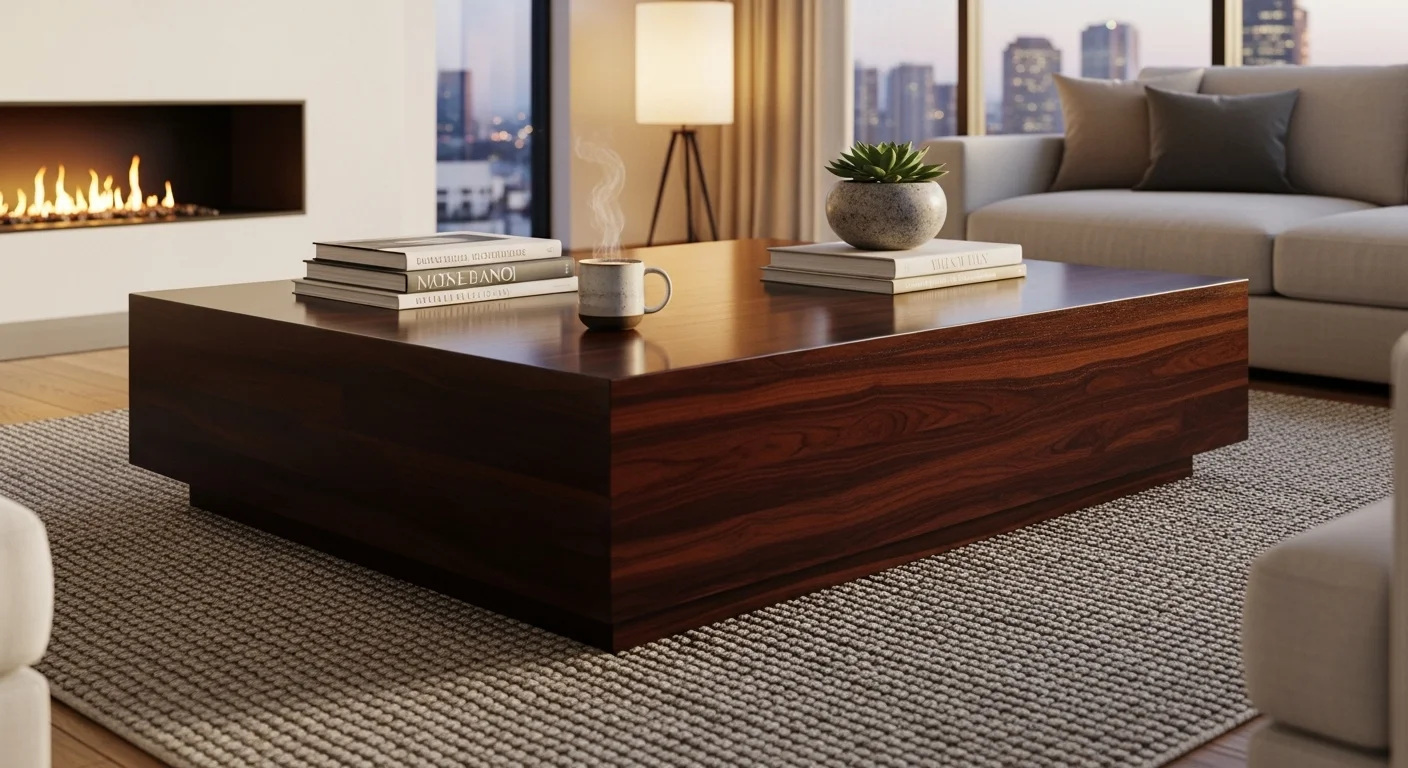
You know that feeling when you walk into someone’s living room and everything just clicks?
The sofa looks great. The rug ties the room together. But right in the middle of it all — there’s a coffee table that makes you go, “Wow, that’s perfect.”
That’s the power of a large coffee table done right.
But here’s the thing — most people mess this up. They either go too small (and the table looks lost in the room), too big (and now nobody can walk around), or they just pick whatever was on sale without thinking it through.
If you’ve been staring at your living room thinking something feels off, there’s a good chance your coffee table is the culprit. And this guide is going to fix that.
Why a Large Coffee Table Changes Everything
Let’s be real. A coffee table isn’t just a place to put your mug.
It’s the anchor of your entire living room setup. It defines the seating area. It tells guests whether your home feels cozy or cold, organized or chaotic. A large coffee table — when chosen right — pulls the whole room together like nothing else.
Think about it. You come home after a long day. You drop onto the couch, put your feet up on the table (don’t pretend you don’t do this), grab the TV remote, set down your snack, and maybe stack a couple of books. A small table can’t hold all that. But a large one? It’s got your back.
And for bigger living rooms or open-plan spaces? A small coffee table just looks sad. Like a tiny island floating in an ocean of nothing.
How Big Should a Large Coffee Table Actually Be?
Okay, so “large” is relative. What’s big in a studio apartment is tiny in a sprawling open-plan living room.
Here’s a simple rule to follow:
Your coffee table should be about ½ to ⅔ the length of your sofa.
So if your sofa is 90 inches long, your coffee table should be somewhere between 45 and 60 inches. That’s your sweet spot.
The Distance Rule (Super Important)
Leave 18 inches between your sofa and the coffee table. Not more, not less. This is the golden gap — enough to comfortably reach the table without leaning, but not so far that it feels disconnected.
Height Matters Too
The table height should match the height of your sofa cushions, give or take an inch or two. Typically that’s somewhere between 16 to 18 inches. Too low and it looks like a mistake. Too tall and it becomes weirdly formal.
Different Types of Large Coffee Tables (And Which One Is For You)
Not all large coffee tables are created equal. Let’s break down the most popular styles so you can figure out which one actually fits your life — not just your Pinterest board.
1. The Classic Wooden Coffee Table
Wood is timeless. And for good reason.
A solid wood coffee table brings warmth, durability, and a natural feel that’s hard to replicate. Whether it’s dark walnut, light oak, or painted white — wood fits into almost any style.
Best for: Traditional homes, farmhouse interiors, cozy family rooms.
If you’ve got kids or pets, go for wood with a good finish. It handles scratches way better than you’d think, and a few scuffs actually add character over time.
2. The Glass-Top Coffee Table
Want your living room to look bigger? Glass is your friend.
A glass-top table creates an illusion of open space — perfect for smaller rooms that need a large coffee table without feeling cramped. Plus, it looks incredibly sleek.
The downside? Fingerprints. So. Many. Fingerprints. If you’ve got kids or you’re just a normal human who touches things, be ready to wipe it down often.
Best for: Modern apartments, minimalist decor, rooms with bold rugs you want to show off.
3. The Upholstered Ottoman Coffee Table
Wait — can a coffee table be soft?
Yes. And it’s amazing.
An upholstered ottoman used as a coffee table is one of the smartest furniture decisions you can make. It’s comfortable, safe if you have little ones running around, and doubles as extra seating when you’ve got guests over.
Throw a large tray on top and suddenly you’ve got a stylish surface to hold your drinks and books.
Best for: Families with young kids, cozy living rooms, people who love versatility.
4. The Industrial Metal Coffee Table
Chunky. Bold. Unapologetically cool.
Metal coffee tables — especially those with raw steel or iron frames — bring an industrial edge that’s having a huge moment in interior design. Pair it with leather furniture and concrete or brick elements and you’ve got a seriously impressive setup.
They’re also incredibly sturdy. You could probably stand on one (please don’t).
Best for: Industrial-style homes, loft apartments, modern masculine aesthetics.
5. The Lift-Top Coffee Table
This one is a game changer for small spaces.
A lift-top coffee table has a surface that you can raise up to desk height — perfect for eating, working on your laptop, or doing homework without leaving the couch.
If you work from home and your living room doubles as your office, this might genuinely change your day-to-day life.
Best for: Studio apartments, people who eat on the couch (no judgment), remote workers.
6. The Storage Coffee Table
Because what even is storage in a living room?
A large coffee table with built-in storage — drawers, shelves, or hidden compartments — solves one of the most annoying problems in any living space: where to put all the stuff.
Remote controls. Magazines. Kids’ toys. Blankets. Board games. A storage coffee table quietly absorbs all of that without making your space look cluttered.
Best for: Families, people without much extra storage, organized minimalists.
Materials Breakdown: What to Actually Look For
Here’s a quick and honest breakdown of the most common coffee table materials:
| Material | Durability | Maintenance | Best For |
|---|---|---|---|
| Solid Wood | Very High | Low-Medium | Classic, farmhouse, rustic |
| MDF/Veneer | Medium | Low | Budget-friendly setups |
| Tempered Glass | High | High (cleaning) | Modern, minimalist |
| Marble | Very High | Medium | Luxury, statement pieces |
| Metal | Very High | Low | Industrial, modern |
| Rattan/Wicker | Medium | Low | Boho, coastal style |
Quick tip: Marble looks stunning but chips at the edges. If you’re clumsy or have kids, maybe go with marble-look ceramic instead. Same beautiful aesthetic, way more forgiving.
Large Coffee Table Styles for Every Kind of Home
Let’s match coffee tables to actual living room vibes, because “modern” means different things to different people.
For the Traditional Home
Think carved wood legs, deep finishes, and maybe a lower shelf for displaying books or baskets. A rectangular large coffee table in dark mahogany or cherry wood feels right at home next to traditional sofas and patterned rugs.
Look for details like turned legs or distressed finishes — they add that old-school charm.
For the Modern Minimalist
Clean lines. Low profile. No unnecessary details.
A large rectangular or square coffee table in matte black, concrete, or light oak with hidden legs is your best bet. Keep the top surface mostly clear — maybe one tray, one plant, one candle. That’s it.
For the Bohemian Room
Go rattan. Go wicker. Go round.
A large round coffee table in rattan or with a woven base feels completely at home in a boho space. It softens the room, adds texture, and looks like it came from a little shop in Bali (even if it came from a furniture warehouse).
For the Farmhouse Living Room
Distressed wood, white-painted finishes, chunky legs, and natural imperfections — that’s the farmhouse formula.
A large farmhouse-style coffee table with a lower shelf (great for baskets!) hits all the right notes without trying too hard.
For the Glam or Luxe Room
Marble tops. Brass or gold metal legs. Mirrored surfaces. Velvet seating nearby.
A large marble coffee table with gold accents is the kind of piece that makes guests stop mid-sentence to say, “Okay, where did you get that?”
How to Style a Large Coffee Table (Without It Looking Cluttered)
Okay so you’ve got the table. Now what do you put on it?
This is where most people either go too empty (sterile, cold) or too full (chaotic, stressful). The sweet spot is intentional layering.
Here’s a formula that always works:
The Rule of Three:
- One tray — This creates a visual boundary and groups smaller items together. It’s the coffee table’s version of a picture frame.
- One tall element — A vase with stems, a tall candle, or a small plant. Height creates dimension.
- One book stack — Stack 2-3 large coffee table books. They add color, personality, and tell guests a bit about who you are.
Then add one small unexpected element — a small sculpture, a decorative box, a crystal. That’s your personality piece.
The rule? Always leave some empty space. The tabletop isn’t a storage shelf. It’s a stage.
Seasonal Styling Trick
Switch up your coffee table styling by season. In winter, add a small candle holder and a cozy throw folded nearby. In summer, swap for fresh flowers and lighter tones. It keeps your living room feeling fresh without buying new furniture.
Common Mistakes People Make When Buying a Large Coffee Table
Let’s talk about the stuff nobody tells you before you buy.
Mistake #1: Not measuring the space first.
This is the big one. People fall in love with a table online, order it, and then it arrives and it’s way too big — or weirdly small. Measure your sofa length, the walking space around the table, and the height of your sofa cushions. Write it down. Keep that number with you when you shop.
Mistake #2: Ignoring the room’s traffic flow.
Your coffee table shouldn’t be an obstacle course. Make sure there’s enough space to walk around it naturally. The standard is at least 24-30 inches from the table to any other piece of furniture (TV unit, armchair, etc.).
Mistake #3: Matching everything too perfectly.
A coffee table that perfectly matches your sofa, your rug, and your curtains? It can look stiff and boring. A little contrast — in material, tone, or texture — makes the space feel more alive and intentional.
Mistake #4: Forgetting about the rug.
Your coffee table should sit mostly on your rug, not beside it. If the table legs are off the rug, the whole arrangement looks floating and unfinished. If your rug isn’t big enough to fit the table, consider going bigger on the rug.
Mistake #5: Buying for looks, ignoring practicality.
That razor-sharp corner marble table looks gorgeous in a showroom. But if you’ve got a toddler who runs full speed at everything in the house, you’re going to have a problem. Think about your actual daily life before committing.
Top Features to Look for When Shopping
When you’re browsing for a large coffee table, here’s your quick checklist:
- ✅ Size: Roughly ½ to ⅔ your sofa length
- ✅ Height: 16-18 inches (matching sofa cushion height)
- ✅ Clearance: 18 inches from sofa, 24-30 inches from other furniture
- ✅ Material suited to your lifestyle (kids, pets, heavy use?)
- ✅ Storage if you need it
- ✅ Style that complements (not copies) your existing furniture
- ✅ Weight capacity if you plan to prop feet up or put heavy items on it
- ✅ Finish that handles your light conditions (matte vs. glossy)
Budget Guide: What to Expect at Every Price Point
Let’s talk money, because that matters.
Under $200: You’re in MDF, particle board, and basic veneer territory. These can look nice and work fine for a year or two, but don’t expect them to last a decade. Great for renters or people who like to refresh their decor often.
$200-$600: This is the sweet spot for most buyers. You start getting solid wood options, real metal frames, and better construction. Many of the best-reviewed large coffee tables live in this range.
$600-$1500: Premium materials, better craftsmanship, and statement designs. Think real marble tops, solid hardwood, or designer-influenced looks. These are pieces you buy once.
$1500+: You’re in the luxury zone. Bespoke pieces, rare materials, designer brands. If you’re here, you probably already know what you want.
Quick tip: Don’t be afraid of second-hand. A solid wood coffee table from a vintage shop or online marketplace can be an absolute steal — and it already has the character that new furniture takes years to develop.
The Best Shapes for Large Coffee Tables
Shape matters more than people realize.
Rectangular: The most popular. Works with almost every sofa. Maximizes surface area. Easy to style. If you’re not sure, go rectangular.
Square: Great for sectional sofas or L-shaped arrangements. Creates a symmetrical, balanced look.
Round: Softer, friendlier, better for tight spaces because there are no sharp corners. The downside — less surface area.
Oval: The best of both worlds. Long like a rectangle, smooth like a circle. Elegant and practical.
Irregular/Organic shapes: Freeform wood slabs, asymmetrical designs. Beautiful, but harder to style and place.
For a large coffee table specifically, rectangular and square tend to work best because they fill the visual space more naturally in bigger rooms.
Large Coffee Tables for Small Spaces: Is It Even Possible?
Here’s a hot take — you can use a large coffee table even in a smaller room.
The trick is transparency or visual lightness.
A glass-top table with thin metal legs takes up the same physical space as any other table, but your eyes don’t register it the same way. The room still feels open because you can see through and under it.
Same goes for acrylic (clear plastic) tables — they’re practically invisible in a room, which means you get the surface area of a large table without the visual weight.
Also, light colors help. A white or light wood coffee table in a small room feels airy. A dark, chunky table in the same room would feel suffocating.
A Real-Life Story (Because Rules Are One Thing, Reality Is Another)
My friend Sadia completely redid her living room last year.
She had a medium-sized room with a big U-shaped sectional sofa and a tiny little coffee table right in the middle. It looked ridiculous — like a toy table dropped into an adult living room.
She was scared to go bigger. “What if it’s too much?” she kept saying.
She finally bought a large rectangular coffee table in light oak — about 55 inches long — with a small lower shelf for baskets.
The first time she sent me a photo of the finished room, my honest reaction was: “Why didn’t you do this sooner?”
The table filled the space properly. The room finally looked complete. All that anxiety about it being “too big” was completely unfounded. If anything, she could have gone a tiny bit bigger.
The moral? Trust the measurements. Trust the formula. Don’t let fear push you toward a table that’s too small for your space.
Where to Buy Large Coffee Tables
You’ve got more options than ever, honestly.
Online retailers like Wayfair, Amazon, and Overstock carry massive selections at every price point. Read the reviews carefully — especially the negative ones. People are honest about wobbly legs and difficult assembly.
Furniture stores like IKEA, West Elm, Crate & Barrel, and Pottery Barn let you see and touch before buying. Worth the trip if you’re spending more than a few hundred dollars.
Vintage and thrift stores are underrated goldmines. You can find solid wood pieces from decades ago for a fraction of their modern equivalent’s price.
Facebook Marketplace and Craigslist — If you’re comfortable picking up locally, you can find incredible deals. People upgrade their furniture all the time and sell pieces that are basically new.
Caring for Your Large Coffee Table
You’ve invested in a great table. Don’t let poor maintenance ruin it.
For wood: Wipe with a damp cloth, dry immediately. Use coasters religiously. Every few months, apply a wood conditioner or polish to keep the finish looking rich.
For glass: A simple glass cleaner and a microfiber cloth. Don’t use paper towels — they leave lint.
For marble: Marble is porous, so seal it once or twice a year. Wipe spills immediately — especially red wine or acidic liquids. They’ll stain if left sitting.
For metal: Dust regularly. For raw metal, apply a light coating of wax to prevent rust, especially in humid environments.
For upholstered ottomans: Spot clean with upholstery cleaner. Vacuum the surface regularly. If it has a removable cover — wash it. That thing collects more dust than you realize.
Conclusion: The Right Large Coffee Table Transforms Your Room
Here’s the bottom line.
A large coffee table is one of the most impactful purchases you can make for your living room. It’s not just furniture — it’s the functional and visual heart of the space where you live, relax, entertain, and recharge.
Get the size right. Match the style to your life — not just your mood board. Think about what you’ll actually do with it, not just what it’ll look like in photos. And don’t be afraid to go big.
When you find the right one? You’ll know. The room will finally feel finished.
FAQ: Large Coffee Tables
Q1: What size is considered a “large” coffee table?
Generally, a coffee table over 48 inches in length is considered large. For very spacious rooms or big sectional sofas, you might go up to 60-70 inches. The key is that it should be roughly half to two-thirds the length of your sofa.
Q2: Can a large coffee table work in a small living room?
Yes — if you choose the right style. Opt for glass tops, acrylic materials, or light-colored finishes. These create visual lightness so the table doesn’t overwhelm the space. Also, ensure you maintain at least 18 inches of clearance from the sofa.
Q3: What shape of large coffee table is best for a sectional sofa?
Square and round large coffee tables tend to work best with sectional or L-shaped sofas because they sit more naturally within the U or L shape. A large square coffee table centered in a sectional arrangement looks especially balanced and clean.
Q4: How do I keep a large coffee table from dominating the room?
Balance is key. If your coffee table is the statement piece, keep the surrounding furniture simple. Use rugs that are proportionate to the table and seating. Avoid over-styling the tabletop — leave breathing room. A table that’s sized correctly for the room should enhance it, not fight for attention.
Q5: Is it better to buy a coffee table with storage or without?
It depends on your lifestyle. If your living room doubles as a play area, a workspace, or a media room — storage is a huge win. Hidden compartments, drawers, and lower shelves help manage clutter without sacrificing style. If your space is well-organized and you value clean aesthetics above all, an open table with no storage looks sleeker. There’s no wrong answer — just honest self-assessment about how you actually use the space.