Let me be honest with you for a second.
You walk into your kitchen after a long day. There are dishes in the sink. The floor has some crumbs. The bathroom… let’s not even talk about the bathroom. And somewhere in the back of your head, this tiny voice says: “Why is this place always such a mess?”
Here’s the thing — it’s probably not because you’re lazy. It’s because you’re trying to clean everything at once, which is exhausting, overwhelming, and totally unsustainable. What you actually need is a house cleaning schedule printable free version that breaks all of this down into tiny, manageable chunks. One day at a time.
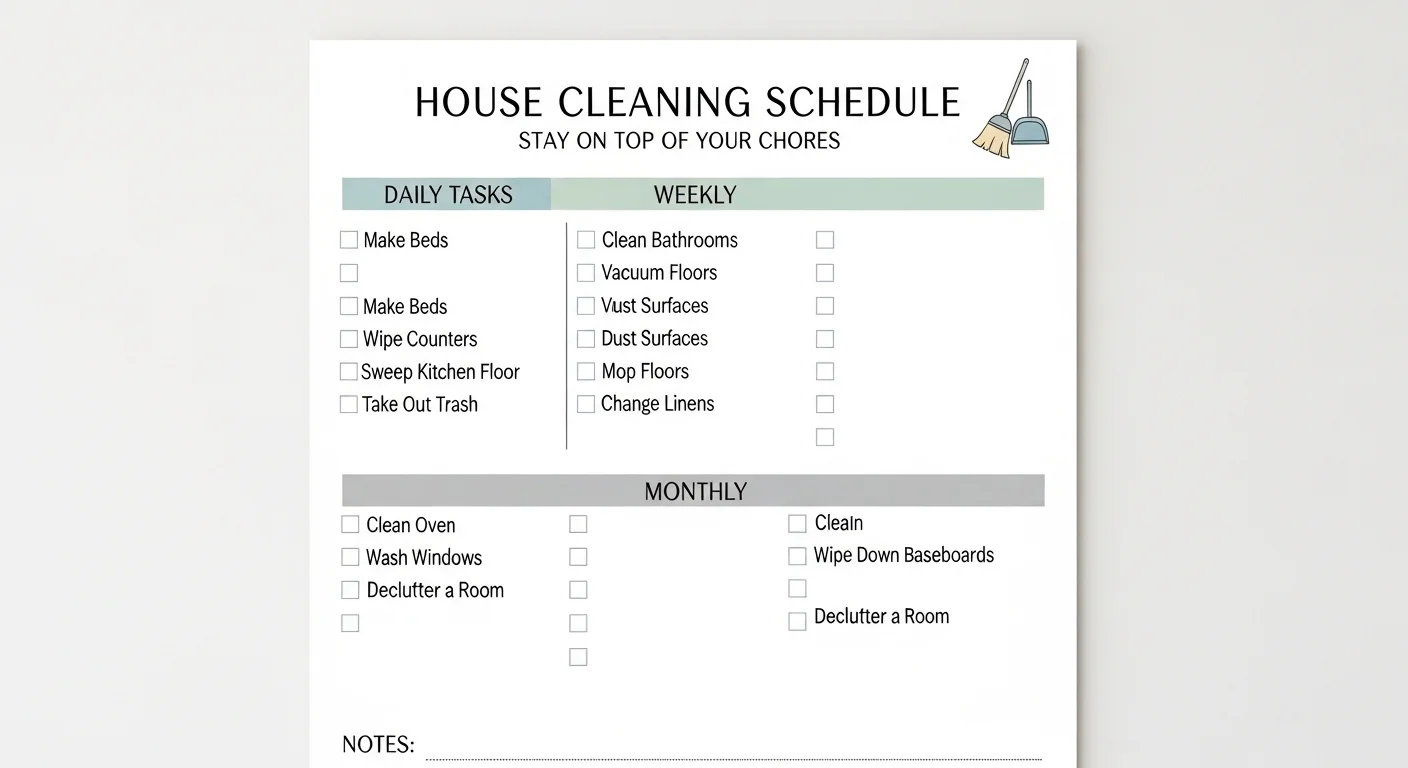
That’s exactly what you’ll find in this article. And yes, there’s an interactive printable checklist right up there at the top — use it, save it, or just print it and stick it on your fridge.
Why Random Cleaning Never Actually Works
You know that thing where you spend an entire Saturday cleaning, top to bottom, and by Wednesday the house looks exactly the same? Yeah. That’s the random cleaning trap.
When there’s no schedule, everything piles up until it becomes unbearable. Then you panic-clean for three hours. Then you feel burnt out. Then the pile starts again. It’s a horrible loop.
A solid cleaning routine breaks that cycle. Instead of one massive cleaning marathon, you do a little bit every day — and suddenly, the house just… stays clean. Almost like magic, but actually just math.
The 3-Layer Cleaning System That Actually Makes Sense
The checklist above is built around a three-layer system. Here’s how to think about it:
Layer 1: Daily Tasks (10–15 Minutes)
These are the tiny things that, if you skip them for three days in a row, turn your home into absolute chaos.
- Making the bed (takes 3 minutes, makes the whole room look put-together)
- Wiping kitchen counters after cooking
- Washing dishes before bed — or at least loading the dishwasher
- A quick sweep of the kitchen floor
- A fast bathroom wipe-down in the morning
The golden rule? Do the daily tasks every single day without negotiation. They’re fast. They’re easy. And they’re the glue that holds the whole system together.
Layer 2: Weekly Tasks (Split Across Days)
Here’s where most people go wrong — they dump ALL the weekly chores into Saturday morning and then wonder why they hate cleaning.
Don’t do that. Spread it out.
Monday and Tuesday? Vacuum and mop. Wednesday and Thursday? Change the sheets, do laundry, dust the shelves. Friday or the weekend? Deep clean the kitchen sink, wipe the microwave, empty the trash bins properly.
When you spread it like this, no single day feels heavy. You’re not dreading anything. You’re just doing one small thing, done in 20 minutes, and moving on with your life.
Layer 3: Monthly Deep Cleaning
This is the stuff nobody thinks about until it’s disgusting. The inside of the oven. The ceiling fan (trust me, check yours right now). The fridge seals. The bathroom rugs.
Pick one or two monthly tasks each week, and rotate through them. By the end of the month, everything’s been touched. Nothing gets forgotten for six months and then becomes a science experiment.
How to Use the Free Printable Cleaning Schedule
The interactive schedule at the top of this page has three tabs — Daily, Weekly, and Monthly. Here’s how to get the most out of it:
- Check off tasks as you complete them. The progress bar fills up as you go — it’s honestly more satisfying than it sounds.
- Use the Print button to get a clean paper version. Stick it on the fridge, inside a cabinet door, or wherever you’ll actually see it.
- Reset it every day (or week) depending on which tab you’re on.
If you want a more personalized version — like adding rooms, changing task names, or adjusting frequency — you can write those changes in by hand on the printed copy. No fancy apps needed.
A Real Story: How Sarah Went from Overwhelmed to Organized
Sarah is a teacher. Three kids, one dog, a husband who works long shifts. She told me her house felt “constantly out of control,” and she felt guilty about it all the time.
She started using a free printable house cleaning schedule — not a complicated one, just something similar to what you see above. Daily tasks got done before the kids woke up. Weekly tasks got split between her and her husband (she vacuumed, he mopped; she changed sheets, he did laundry).
Six weeks later? Not perfect. But manageable. She stopped feeling like she was drowning. The guilt went away. And she stopped spending her entire Saturday cleaning.
That’s the real value of a cleaning schedule. It’s not about having a spotless home. It’s about having a clear head because you know what needs to be done and when.
Room-by-Room Breakdown: What to Clean and When
Let’s get specific. Because “clean the bathroom” is vague. Here’s a more practical breakdown:
Kitchen
- Daily: Wipe counters, wash dishes, sweep floor, wipe stovetop
- Weekly: Deep clean sink, clean microwave inside, wipe fridge exterior, scrub trash bins
- Monthly: Clean inside oven and fridge, descale kettle and coffee maker, organize pantry
Bathroom
- Daily: Quick mirror wipe, put things back where they belong
- Weekly: Scrub toilet, clean sink and faucet, wipe shower walls, wash bath mat
- Monthly: Scrub grout, clean exhaust fan, wash shower curtain
Bedroom
- Daily: Make the bed, put clothes away (not on the chair)
- Weekly: Change bed sheets, dust surfaces, vacuum floor
- Monthly: Rotate mattress, vacuum under the bed, clean ceiling fan
Living Room
- Daily: Tidy cushions, put things back, quick straighten-up
- Weekly: Dust shelves and electronics, vacuum sofa and carpet, wipe remotes and light switches
- Monthly: Clean windows, vacuum behind sofa, wipe baseboards
Cleaning Tips That Actually Save You Time
Tip 1: Clean as you cook. While something’s in the oven, wipe the counter. Load the dishwasher while you wait. By the time dinner’s done, the kitchen is already half-clean.
Tip 2: Use a timer. Set 15 minutes. Go. You’ll be shocked what you can get done when you’re racing the clock. It turns cleaning into something almost game-like.
Tip 3: One in, one out rule. Every time something new enters your house, something old leaves. This applies to kids’ toys especially. Less stuff = less cleaning. Always.
Tip 4: Keep cleaning supplies in every room. A small spray bottle and a cloth under the bathroom sink means you’ll actually wipe it down when it needs it. Friction is the enemy of clean. Remove the friction.
Tip 5: Don’t aim for perfect. A home that’s 80% clean, consistently, is so much better than a home that’s 100% clean once a month and chaotic the rest of the time.
How to Make Kids (and Partners) Part of the Schedule
If you live with other people, this system only works if they’re part of it.
For kids: Give age-appropriate tasks with a visual checklist they can actually check off. Kids under 10 can make their bed, tidy their room, set the table, and wipe low surfaces. Older kids can vacuum, take out trash, and help with laundry.
For partners: Don’t assign tasks — negotiate them. Ask “which tasks are you okay owning?” Most people are more cooperative when they choose their tasks rather than being handed a list.
Make it visual. Put the house cleaning schedule printable free version on the fridge so everyone in the house sees it. When chores are visible and shared, resentment goes way down.
Choosing the Right Cleaning Schedule Format for Your Life
Not every schedule fits every household. Here are three common scenarios:
If you live alone: The daily tasks become very simple (you’re not making much mess). Focus your energy on weekly deep-cleaning and the monthly list.
If you have a family with young kids: Daily tasks are non-negotiable. You’ll need the weekly schedule to be split across all adults. Accept that some days will be messier than others — and that’s okay.
If you work long hours or irregular shifts: Compress your weekly tasks into two big sessions (like Sunday and Wednesday), and skip any daily tasks that aren’t truly essential. Protect your energy.
The beauty of a free printable cleaning schedule is that it’s just paper. You can cross things out, rearrange them, write in new tasks. It’s a framework, not a law.
The Mental Health Side of a Clean Home (This Part Matters)
This isn’t just about aesthetics. Research has consistently shown that cluttered, dirty environments increase cortisol levels — the stress hormone. A cleaner home genuinely helps you feel calmer, sleep better, and think more clearly.
When you walk into a tidy room, your brain isn’t constantly processing background noise (the pile of laundry, the dishes, the mess). It gets to relax. That’s not a luxury — that’s basic wellbeing.
A cleaning schedule is, in a strange way, an act of self-care. It protects your mental space.
Quick Guide: How Often to Replace or Deep Clean Things
People often wonder — how often is “often enough”? Here’s a rough guide:
- Bed sheets: Every 1–2 weeks
- Bath towels: Every 3–4 uses
- Kitchen sponges: Replace every 1–2 weeks (they’re disgusting after that)
- Toothbrush holder: Clean monthly (it’s one of the dirtiest spots in most homes)
- Pillows: Wash every 3–6 months
- Mattress: Vacuum and rotate every 3–6 months
- Shower curtain liner: Replace or wash every 1–3 months
Knowing this removes the guesswork. You’re not just cleaning when it looks dirty — you’re cleaning based on actual hygiene science.
The Bottom Line: Start Messy, Stay Consistent
Here’s the thing nobody tells you about cleaning schedules: the first week is the hardest. Your house might already be behind. You might miss a day or two. That’s completely fine.
The whole point of a house cleaning schedule printable free version is to give you a starting point — something to come back to. Even if you do 60% of it, that’s still 60% more than random cleaning. Over time, the habit builds. The house gets easier to maintain. And the cleaning starts to feel like background noise instead of an overwhelming project.
Print the schedule at the top of this page. Stick it somewhere visible. Start with just the daily tasks. And give yourself at least three weeks before you judge whether it’s working.
Your future self — the one who walks into a clean kitchen on a Tuesday night — will be very glad you did.
Frequently Asked Questions
Q1: How do I create a house cleaning schedule that I’ll actually stick to? Start smaller than you think you should. Pick three daily tasks and do only those for the first week. Once those feel automatic, add weekly tasks. Building habits gradually beats launching a perfect-but-overwhelming system that you quit after four days.
Q2: Can I use this free printable cleaning schedule for a small apartment? Absolutely. For smaller spaces, the weekly tasks will take less time, and you may only need the daily and monthly sections. You can cross out rooms or tasks that don’t apply to your space.
Q3: What’s the difference between a daily cleaning routine and a deep cleaning routine? Daily routines cover quick maintenance tasks — wiping, sweeping, tidying. Deep cleaning covers the things that don’t need daily attention but accumulate over time: inside appliances, grout, ceiling fans, upholstery. Both matter, but they serve different purposes.
Q4: How long should cleaning actually take each day? For daily maintenance tasks, 10–20 minutes is realistic for most homes. Weekly tasks broken down by day should take 20–30 minutes per session. If you’re spending hours cleaning daily, your system probably needs simplification — or a declutter session first.
Q5: Is a printable cleaning schedule better than a cleaning app? For most people, yes — at least to start. Paper is frictionless. You don’t need to open an app, log in, or charge anything. A paper schedule on the fridge is visible to everyone in the house, creates shared accountability, and doesn’t require any technology. Once the habit is built, you can switch to an app if you prefer — but the schedule itself is what matters, not the format.