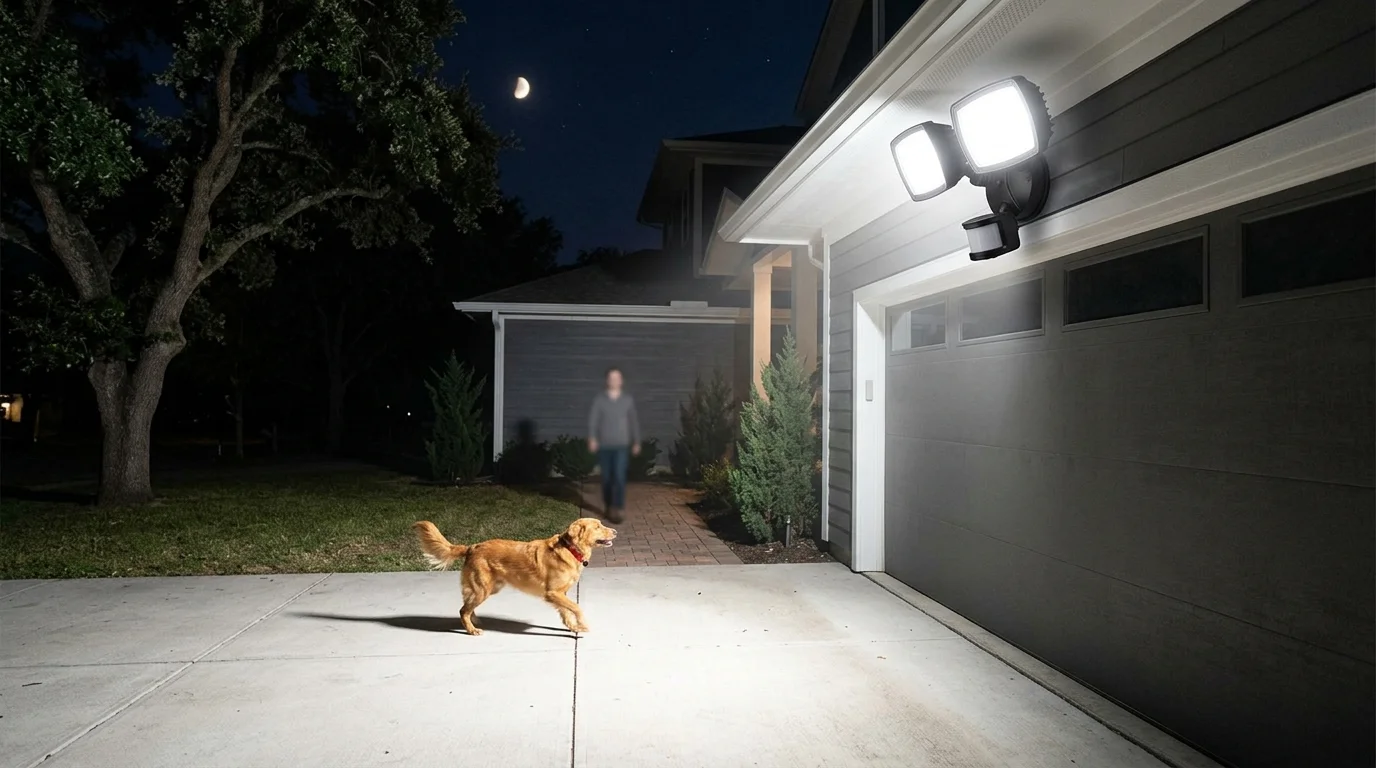
You walk out to your car at 11 PM. The driveway is pitch dark. Your hands are full of grocery bags, your keys are buried somewhere in your pocket, and somewhere in the shadows, something moves.
That exact moment is why motion lights outdoor exist — and why more homeowners are installing them than ever before.
But here’s the thing: most people either buy the wrong type, mount them in the wrong spot, or pick a model that gives up after one rainy season. This guide fixes all of that. Whether you’re a first-timer or someone replacing a fixture that finally gave out, you’re going to walk away knowing exactly what to get and where to put it.
What Are Motion Lights Outdoor, Exactly?
Simply put, they’re lights that turn on automatically when they detect movement nearby. No switch flipping. No leaving lights on all night. The light activates when something — a person, a car, sometimes an overly adventurous raccoon — enters the sensor’s detection zone.
The sensor does the smart work. It sits between the power source and the LED driver. The moment motion is detected, it triggers the light to turn on and holds it on for a set amount of time, usually anywhere from 15 seconds to 10 minutes. After that, it shuts itself off automatically.
This combination of security and energy efficiency is exactly why outdoor motion sensor lights have become one of the most popular home upgrades of the past decade.
The Three Sensor Types (And Why It Matters)
Not all sensors are built the same. Knowing the difference will save you from buying a light that triggers every time a leaf blows past.
1. Passive Infrared (PIR)
This is the most common type. PIR sensors detect changes in heat — specifically, the body heat of a human or animal moving through the detection zone. They’re reliable, affordable, and widely used.
The catch? They can miss slow-moving targets and struggle in very hot environments where ambient air temperature is close to body temperature.
2. Microwave Sensors (5.8 GHz)
These emit microwave pulses and measure the reflection. If something is moving, the reflected signal changes and the light activates. They work through walls and cover larger areas than PIR sensors.
Downside: they can trigger on movement inside the house or from passing cars on the street, which gets annoying fast.
3. Dual-Technology Sensors
This is the gold standard. Dual-tech sensors require both PIR and microwave detection to trigger simultaneously. That drastically reduces false alarms. If you’re tired of lights going off every time a car drives past at midnight, dual-tech is your answer.
Many modern outdoor motion sensor lights also include pet-immune modes — they mask the lower third of the detection zone so animals under about 40 pounds get ignored while human-height movement still triggers the light. Great feature if you have a dog or live near wildlife.
Power Sources: Wired, Solar, or Battery?
This is probably the first real decision you’ll make, and it changes everything about installation and long-term performance.
Hardwired Motion Lights
These connect directly to your home’s electrical system. They’re the brightest, most reliable option. Once installed, you never think about power again — they just work.
Best for: driveways, garage walls, main entryways, anywhere you need consistent, powerful light.
The tradeoff is installation complexity. You either need to run wiring or connect to an existing outdoor outlet. Some homeowners do it themselves; others call an electrician.
Solar-Powered Motion Lights
Solar has come a long way. Modern solar motion sensor lights charge during the day and store enough energy to power the light reliably through the night, even in partial sunlight. No wiring required. You just mount them and walk away.
One Amazon shopper summed it up well: installation was simply a matter of mounting the light where they wanted it, with no wires to run and no battery replacements to worry about.
Best for: garden paths, back fences, sheds, anywhere running a wire would be a headache.
Watch out for cheap solar models, though. Some lose capacity after one winter. Look for units with lithium batteries and at least 6–8 hours of stored charge.
Battery-Powered Motion Lights
The most flexible option. You can put them literally anywhere — under a patio overhang, inside a shed, on a tree. No sun required, no wiring.
The downside is obvious: you’ll be changing batteries. The good ones, though, are surprisingly efficient. Some users report going years between battery changes because the motion-activation keeps energy use so low.
Brightness: How Many Lumens Do You Actually Need?
Lumens measure light output. More lumens = brighter light. But brighter isn’t always better — it depends on where you’re putting the light.
Here’s a practical breakdown:
- Entryway or porch: 500–700 lumens is plenty. You want enough light to see who’s at the door, not to blind them.
- Driveway: 1,500–2,000 lumens. You need to see the full length of the driveway clearly.
- Backyard or large area: 2,000–3,000 lumens. This is floodlight territory.
- Path lighting: 100–200 lumens per fixture, spaced regularly.
The LeonLite dual-head security light, for example, produces up to 1,800 lumens — roughly equivalent to a car’s headlights — and detects motion from 70 feet away with a 180-degree sensing angle. That’s the kind of output that genuinely startles an intruder and lights up a full driveway.
On the budget end, something like the Mr. Beams wireless spotlight puts out 200–400 lumens, which is great for a side path or back porch but won’t cover a large yard.
The 5 Best Spots to Install Motion Lights Outdoor
Placement matters more than most people realize. A great light in the wrong spot is almost useless.
1. Above the Garage Door
This is the highest-impact location on most properties. It covers the driveway approach, lights up the garage entrance, and is visible from the street — which is a deterrent in itself.
Mount the light 6 to 10 feet high for the best detection angle. Too low and the sensor misses approaching vehicles. Too high and it may not catch someone crouching near the door.
2. At the Front Door
The entryway needs reliable, consistent lighting. This is where a wired or hardwired fixture makes the most sense — something that also has dusk-to-dawn capability so it provides ambient light all night and goes to full brightness when motion is detected.
3. Along the Side of the House
Side yards are a classic blind spot. Burglars know this. A motion-activated security light along the side path removes that shadow entirely.
4. At the Back Door or Deck
Anyone stepping out at night — whether it’s you taking the dog out or an uninvited guest — triggers the light immediately. This is one of the most practical places you can install motion lights outdoor for everyday use.
5. Along Pathways and Steps
This is more about safety than security. Illuminated steps and garden paths prevent falls. Solar stake lights work perfectly here and require zero installation beyond pushing them into the ground.
Weatherproofing: What the IP Rating Actually Means
You’re putting this light outside. Rain, snow, humidity, freezing temperatures — it needs to handle all of it.
The IP (Ingress Protection) rating tells you exactly how weather-resistant a fixture is.
- IP44: Splash-resistant. Fine for covered porches or protected eaves. Not great for open exposure.
- IP65: Dust-tight and protected against low-pressure water jets. This is the minimum you should buy for any outdoor application.
- IP66: Stronger water protection, including powerful jets. Good for exposed areas in rainy climates.
Stick with IP65 at minimum for any outdoor motion sensor light. Coastal areas or places with heavy rain should go IP66 or higher.
One thing worth noting: some budget lights claim waterproofing but develop internal corrosion after a wet season. Reading actual customer reviews — especially from people in humid or rainy climates — is the most reliable way to verify real-world weather performance.
Smart Motion Lights: Are They Worth It?
Smart outdoor motion lights connect to your phone, work with voice assistants, and can communicate with other smart home devices. Ring makes some of the most popular options — their motion-activated lights can trigger notifications on your phone, coordinate with Ring doorbells and cameras, and even let you watch a live feed when the light activates.
Philips Hue’s outdoor motion sensor works with Alexa, Apple HomeKit, and Google Assistant for fully integrated smart home control.
Are they worth the premium price? For most people, a solid non-smart motion light does 90% of the job at a fraction of the cost. But if you already have a smart home ecosystem — Ring, Hue, Google Home — adding compatible outdoor motion lights creates a genuinely useful security layer where your lights and cameras work together automatically.
Installation Tips That Most Guides Skip
Here are a few things that make a real difference once you’re actually mounting the fixture:
Test the detection zone before committing to a position. Most lights have a test mode that lets the sensor work during daytime so you can walk through the area and confirm the detection angle covers what you need.
Avoid pointing the sensor at heat sources. A/C units, vents, and even sun-warmed walls can trigger PIR sensors unexpectedly. Point the sensor toward the open area you want to monitor, not toward other structures.
Clean the sensor lens once or twice a year. Dust, spiderwebs, and grime reduce sensitivity over time. A quick wipe with a damp cloth keeps performance consistent.
Set the duration timer thoughtfully. A 1-minute timer is plenty for a pathway light. For a driveway or back door, 5 minutes gives you enough time to walk in comfortably without the light cutting out.
How Much Energy Do Motion Lights Actually Save?
Here’s the number that often surprises people: a properly specified motion-activated LED fixture cuts security lighting energy use by 90 to 95 percent compared to an always-on incandescent light.
That’s not a small difference. That’s leaving your front porch light on 24 hours a day versus having it activate for a cumulative 20–30 minutes per night. Over a year, across multiple fixtures, the savings on your electricity bill are real and meaningful.
LED motion sensor lights also last significantly longer than traditional bulbs — well-made fixtures are rated for 10 to 15 years of service life. That means you’re not replacing bulbs every season.
Common Mistakes to Avoid
Even good motion lights fail when they’re set up wrong. Here’s what trips most people up:
Mounting too high. Yes, you want the light up high enough to illuminate a wide area. But if the sensor is more than 10 feet up, it may miss low-level movement entirely. The sweet spot is 6 to 10 feet.
Buying a light rated for lumens it can’t sustain. Some cheap fixtures advertise peak lumens that drop significantly after a few months. Look for lights with real customer reviews confirming long-term brightness, not just the spec sheet number.
Ignoring the detection angle. A 90-degree sensor covers one specific area. A 180-degree sensor covers a much wider zone. For driveways and backyards, wider coverage usually wins. For a narrow walkway, a tighter angle reduces false triggers.
Not accounting for winter. Solar lights that work great in summer can underperform significantly in winter when daylight hours shrink. If you live somewhere with short winter days, hardwired or battery-powered options are more reliable from November through February.
Motion Lights Outdoor: Quick Buying Checklist
Before you buy, run through this list:
- [ ] What power source makes sense for this location? (Wired / Solar / Battery)
- [ ] How many lumens do I need for this specific area?
- [ ] What detection range and angle covers the zone I care about?
- [ ] Is the IP rating suitable for my climate?
- [ ] Do I want smart home integration?
- [ ] What’s a realistic budget, including installation if wired?
Final Thoughts
Motion lights outdoor aren’t a luxury — they’re one of the most practical upgrades you can make to your home. They pay for themselves in energy savings, they genuinely deter opportunistic crime, and they make daily life easier in ways you notice every single night.
The key is matching the right type of light to the right location. A solar stake light on your garden path. A hardwired dual-head floodlight over your garage. A battery-powered spotlight on your back fence. Each one doing exactly the job it was designed for.
Start with your highest-risk or most-used area, get that right, and then expand from there. You don’t need to light up the entire property at once — one well-placed motion light makes an immediate difference.
Frequently Asked Questions (FAQ)
Q1: How far away can motion lights outdoor detect movement?
It depends on the fixture, but most residential-grade motion sensor lights detect movement at 20 to 70 feet. Models with 180-degree sensing angles and ranges of 70 feet — like the LeonLite series — are well-suited for driveways and large backyards. Smaller path lights typically detect at 15 to 20 feet, which is appropriate for their use case.
Q2: Will motion lights outdoor work in heavy rain?
Yes, if the fixture has an adequate IP rating. Look for IP65 or higher for any light that will be exposed to rain. Fixtures rated below IP44 are only suitable for covered, protected locations. If you’re in a particularly wet or coastal climate, IP66 provides an extra margin of protection.
Q3: Can I install outdoor motion sensor lights myself?
Solar and battery-powered options are almost always DIY-friendly — most install with a few screws and take under 30 minutes. Hardwired lights require connecting to your home’s electrical system. If you’re comfortable working with residential wiring and your local code allows it, this can be a DIY project. Otherwise, hiring a licensed electrician for the wiring portion is the safer choice.
Q4: Why does my motion light keep turning on by itself?
The most common causes are wind-blown vegetation, passing cars, animals, or the sensor picking up heat from nearby objects like A/C vents or sun-warmed surfaces. First, try adjusting the sensitivity setting down. If that doesn’t help, reposition the sensor so it’s not aimed at heat sources or high-traffic areas like a busy road. Upgrading to a dual-technology sensor also dramatically reduces false triggers.
Q5: How long do outdoor motion sensor lights last?
Quality LED motion sensor fixtures are rated for 10 to 15 years of service life under normal use conditions. The LED component itself lasts longer than any other part of the fixture — it’s usually the sensor electronics or housing that eventually need replacement. Budget fixtures often fail within 1 to 2 years, especially if exposed to harsh weather. Investing in a reputable brand with a solid IP rating pays off significantly over time.