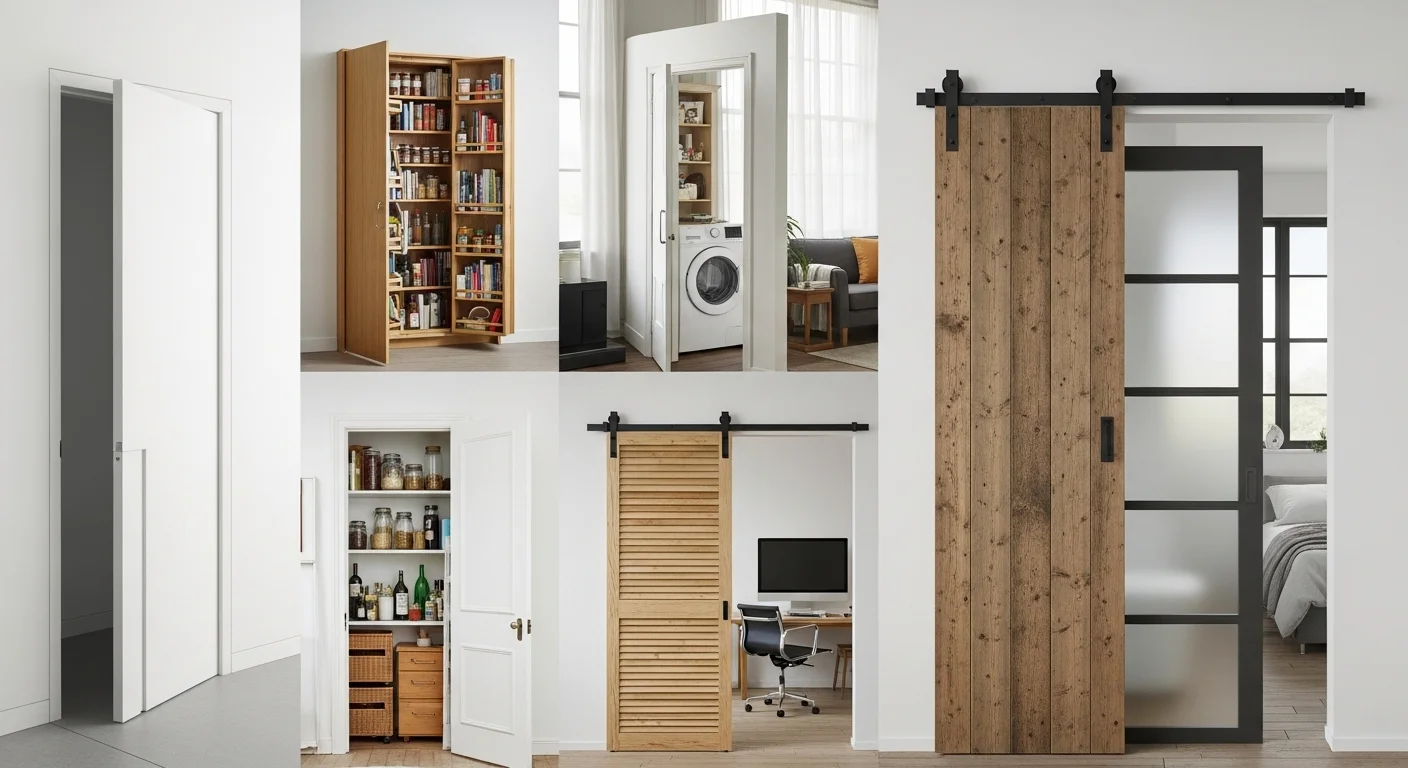
Picture this. You open your bathroom door and it smacks right into the toilet. Or you swing your bedroom door open and — boom — it blocks the dresser. Sound familiar? Yeah, regular hinged doors are basically the sneaky space thieves of your home. Nobody talks about them, but they steal anywhere from 9 to 12 square feet of usable floor space every single time they swing open.
Here’s the thing — that’s not a small deal when you’re living in a 500-square-foot apartment, a tiny house, or even just a cozy room that needs to breathe.
The good news? There are so many clever space saving door ideas out there that architects and interior designers have been quietly using for years. And honestly, once you see them, you’ll wonder why you ever put up with a regular door in the first place.
Let’s dig in. No fluff, just real ideas you can actually use.
Why Your Regular Door Is the Problem (And Not the Room Size)
Most people think their room is too small. But in reality, the door placement and swing direction is eating up precious square footage that could hold a chair, a bookshelf, or just… breathing room.
A standard interior door needs a 3×3 foot clearance arc just to open fully. That’s 9 square feet of floor space doing absolutely nothing productive. In a small apartment, that’s almost the size of a closet you’re wasting.
Switching to a space-efficient door style doesn’t just look cool. It fundamentally changes how a room feels and functions. Let’s look at what your options are.
1. Pocket Doors — The Classic Disappearing Act
If you’ve never heard of a pocket door, get ready for your mind to be blown.
A pocket door slides into the wall. Like, literally disappears inside it. When you don’t need it, it’s gone. No swing. No arc. No wasted space. Just a completely open doorway.
Best for: Bathrooms, small bedrooms, laundry rooms, home offices, between kitchen and dining areas.
The catch? You need wall space to “pocket” into. And the installation is more involved than a regular door — you’ll need a contractor if you’re retrofitting. But for new construction or a major renovation? This is the gold standard of space saving door ideas.
Pro tip: Pair a pocket door with a frosted glass panel and you’ll also get borrowed light into a windowless bathroom. Two problems solved at once.
2. Barn Doors — Rustic Charm Meets Smart Design
Barn doors have exploded in popularity over the last decade, and for good reason. They slide along a track mounted above the doorframe, completely eliminating the need for any floor swing clearance.
They’re also incredibly easy to retrofit. No wall surgery needed. You mount a track, hang the door, and done.
Best for: Bedroom closets, pantries, bathrooms (with proper privacy planning), living room dividers.
The one thing people miss? A barn door doesn’t seal as tightly as a pocket door. There’s usually a small gap on the latch side. For bedrooms, that’s totally fine. For bathrooms where privacy matters, you’ll want a good sliding latch installed.
Style-wise, barn doors are incredibly versatile. You can go:
- Classic reclaimed wood for a farmhouse vibe
- Painted MDF for a clean modern look
- Mirror-front to double as a full-length mirror and make the room feel larger
- Glass panel for an airy, open feel
That mirrored barn door idea? That’s a double win right there. Space saving and space-illusion creating.
3. Bifold Doors — The Accordion Option
Bifold doors are those accordion-style doors that fold in half when you open them. You’ve probably seen them on closets a million times, but they work great for other spaces too.
They only need about half the clearance of a standard swinging door. So instead of a 3-foot arc, you’re looking at maybe a 1.5-foot intrusion into the room.
Best for: Closets (obviously), laundry areas, pantries, small bathrooms.
One thing to know: bifold doors have a reputation for jumping off their tracks. The hardware matters a lot here. Invest in a good quality bifold system — cheap ones will drive you crazy within a year.
4. Sliding Glass Doors (Interior Style)
We’re not talking about the patio slider here. Interior sliding glass doors are a completely different animal — elegant, modern, and fantastic for creating a sense of openness while still dividing spaces.
Imagine a home office with a sliding glass door. You can see through to the living room, the space feels connected, but you still have a soundproof barrier when you need to focus.
Best for: Home offices, studios, open-plan separators, kitchen pass-throughs.
The glass doesn’t have to be fully transparent either. Frosted, ribbed, or textured glass panels give you privacy while still bouncing light around. That translucent quality is genuinely one of the best tricks for making small spaces feel bigger.
5. Dutch Doors — Quirky and Surprisingly Practical
A Dutch door splits horizontally in the middle. The top half opens independently from the bottom. Yes, like a barn for horses. But hear me out — this is actually genius for certain situations.
Best for: Kitchens, nurseries, home offices, rooms with pets or small children.
In a kitchen, you can open the top half for ventilation and light while the bottom stays closed to keep kids or pets out. In a nursery, you can check on a baby without fully entering the room.
Does it save swing space? Not dramatically, since each half still has a small arc. But the functionality is unmatched in specific scenarios, and it adds a ton of character.
6. Curtain Doors — Soft, Fast, and Zero Hardware
Sometimes the best door isn’t a door at all. A heavy curtain or a panel curtain set can replace a door entirely in the right situation.
Heavy velvet, linen, or even industrial felt curtains can serve as room dividers and “doorways” with zero swing clearance, minimal installation, and a surprisingly effective noise-reduction effect (especially with thick fabric).
Best for: Walk-in closets, studio apartments, rental spaces (no drilling needed!), temporary room dividers.
The limitation is obvious — curtains don’t lock and they don’t provide hard privacy. But for a closet or a studio partition? This is fast, affordable, and genuinely effective.
7. Accordion Folding Doors (Room Dividers)
Accordion doors are the bigger sibling of bifolds — multiple panels that fold together like a fan. They can span really wide openings and still compress down to almost nothing when fully open.
Best for: Large openings, dining rooms, living rooms that need to occasionally be divided, garage conversions.
These are great for open-plan homes where you sometimes want to define spaces — like creating a “bedroom zone” in a studio apartment at night.
8. Pivot Doors — The Architectural Statement
A pivot door doesn’t hinge at the edge — it rotates on a central (or offset) pivot point. This means it swings both ways and the visual footprint is very different from a traditional door.
Now, a pivot door doesn’t automatically save space. But here’s where it gets interesting: because they’re balanced differently, pivot doors can be dramatically taller and wider than standard doors without the structural issues. This means you can have a massive, impressive door in a small space without the same swing clearance penalty.
Best for: Main entrances, dramatic interior focal points, high-end renovations.
They’re expensive and architecturally bold. But if you want your small space to feel like a design magazine feature, a pivot door is the move.
9. Hidden/Secret Doors — Walls That Are Actually Doors
This one sounds insane, but hidden doors are a real, practical space-saving solution — not just a spy movie trick.
A hidden door is built to look like part of the wall — matching paneling, a bookshelf, or even a seamless painted surface. When the space around a doorway is all visual clutter, you lose a lot of the room’s flow. A hidden door eliminates that visual interruption completely.
Best for: Home libraries, basement stairs, guest rooms that need to “disappear,” reading nooks.
A bookcase door is especially popular — the bookshelf functions normally and swings open to reveal a room beyond. You get storage and a door in the same footprint. That’s a double win in small space design.
10. Stacked Sliding Doors (Bypass Doors)
Bypass doors are those double-panel setups where one panel slides behind the other. They’re very common for closets, but they’re underused for room applications.
With bypass doors, you can never open the full width of the doorway at once — one panel always overlaps the other. But you eliminate all swing clearance entirely, and for a closet or wardrobe, you get access to either half at any time.
Best for: Large closets, built-in wardrobes, pantry walls, laundry rooms.
Space hack: Install bypass doors on a built-in shelving unit and you’ve created a hidden storage wall that looks sleek and modern rather than like a cluttered shelving disaster.
11. Shoji Screen Doors — Japanese Minimalism at Its Best
Shoji screens are traditional Japanese sliding panels made of a translucent material (originally paper, but now often frosted acrylic or fabric) in a wooden or aluminum frame. They slide on a track and create a beautiful, diffused light effect.
Best for: Studio apartments, meditation rooms, dressing areas, Japanese or minimalist-style interiors.
They’re incredibly lightweight, easy to install, and they let light pass through in the most beautiful way. In a very small apartment, replacing one or two standard doors with shoji screens can make the whole place feel calmer and more open.
12. Murphy Door — The Fold-Away Everything
Named after the Murphy bed concept (the bed that folds into the wall), Murphy doors are designed to integrate with furniture and fold away when not needed.
A Murphy door might be:
- A full-length mirror that pivots to reveal a closet
- A wardrobe panel that swings open to become a door
- A section of wall shelving that hinges out as an entryway
Best for: Studio apartments, tiny homes, small bedrooms, dressing rooms.
This is where space-saving really becomes art. You’re not just saving door swing space — you’re combining the door’s footprint with furniture function.
13. Pocket Sliding Partitions — For Open Plans
In an open-plan home, maybe you don’t need a full door — you just need the option of dividing space sometimes. Pocket sliding partitions are a series of panels that tuck into a wall cavity and slide out to divide a room when needed.
Think of it like a wall you can deploy and then make disappear.
Best for: Living/dining separators, home offices in shared spaces, flexible studio apartments.
This is a bigger renovation project, but for anyone building or doing a major reno, it’s worth the investment if your lifestyle involves shifting between open and divided layouts.
14. Louvered Doors — Ventilation + Privacy
Louvered doors have angled slats that allow airflow even when closed. They’re especially useful in spaces that need ventilation — like a laundry room, a utility closet, or a bedroom wardrobe.
They don’t save swing space on their own (they’re typically hinged), but pair them with a bifold configuration and you get excellent ventilation with minimal space requirements.
Best for: Laundry rooms, wardrobe closets, utility spaces, basement storage.
15. Frameless Glass Doors — The Invisible Door
Frameless glass doors are exactly what they sound like — panels of thick glass with minimal or no visible frame. They open and close on slim pivot or hinge hardware that’s almost invisible.
The effect? You barely notice the door is there. The space flows visually right through it, making rooms feel larger and more connected.
Best for: Showers (the most common use), home offices, libraries, luxury apartments.
For a shower, a frameless glass door is practically the industry standard now in premium homes. But the same principle applies to any interior space where you want separation without visual interruption.
How to Choose the Right Space Saving Door for Your Home
Okay, now you’ve seen the options. How do you actually pick?
Ask yourself these four questions:
1. What’s the primary goal?
- Maximum space savings → Pocket door or barn door
- Style statement → Pivot or frameless glass
- Flexibility → Accordion or sliding partition
- Budget-friendly → Curtain or bifold
2. Is this a rental or do you own?
- Renters: curtains, freestanding screens, surface-mounted barn door tracks
- Owners: pocket doors, frameless glass, hidden doors
3. What’s the privacy requirement?
- High privacy (bathroom): pocket door with solid panel
- Medium (bedroom): barn door with quality latch
- Low (closet/pantry): bifold, louvered, or curtain
4. What’s your renovation tolerance?
- Zero: curtains, barn door surface mount
- Medium: bifold swap, bypass closet doors
- Full reno: pocket doors, frameless glass, hidden doors
Real Talk: What Actually Works in Tiny Apartments
From firsthand experience in small-space design consulting — the single biggest impact you can make in a small apartment is replacing the bathroom door.
A bathroom door swings into or out of a tiny bathroom and creates absolute chaos with the layout. Switching to a pocket door instantly gives you a few extra inches of actual usable bathroom space AND eliminates the awkward choreography of squeezing past the door.
Second biggest win? Replacing a standard bedroom closet door with a mirror-front bypass door. You free up the swing clearance AND gain a full-length mirror without using any extra floor space for it.
Those two swaps alone will make your apartment feel noticeably bigger without moving a single piece of furniture.
Space Saving Door Ideas: Quick Comparison Table
| Door Type | Space Saved | Cost Range | DIY Friendly? | Best Room |
|---|---|---|---|---|
| Pocket Door | Maximum | $$$ | No | Bathroom |
| Barn Door | High | $$ | Yes | Bedroom/Closet |
| Bifold | Medium | $ | Yes | Closet |
| Sliding Glass | High | $$$ | Partial | Office |
| Curtain | Maximum | $ | Yes | Studio/Closet |
| Bypass/Stacked | High | $$ | Yes | Wardrobe |
| Hidden/Bookcase | Maximum | $$$$ | No | Library |
| Shoji Screen | High | $$ | Yes | Studio |
| Accordion | Medium | $$ | Partial | Divider |
A Few Things Nobody Tells You Before Buying
Hardware quality matters more than door quality. A cheap track will derail your barn door every month. Cheap bifold hardware will jump its track. Spend the extra money on the hardware. The door panel itself matters less.
Sound matters. Sliding doors don’t seal as tightly as hinged doors. If sound privacy is critical (home office during calls, nursery), factor this into your choice. Pocket doors seal better than barn doors.
Think about the latch. A beautiful sliding door with no good latch is useless for a bathroom. Always solve the privacy latch question before you commit.
Check your walls. Pocket doors require a “pocket” — meaning the adjacent wall must be free of electrical outlets, light switches, and plumbing. This is the most common pocket door headache people encounter too late.
A Final Word: Start Small, Start Smart
You don’t need to renovate your whole house tomorrow. Pick one door — the one that’s been annoying you the most — and fix that one first. Usually it’s the bathroom or the bedroom closet.
Do that swap, live with it for a few months, and notice how much better the flow of your space feels. Then you’ll know exactly which door to tackle next.
Space saving door ideas aren’t just for tiny houses or micro-apartments. Even a big home benefits from doors that work smarter. Less wasted space means more room for life.
FAQ: Space Saving Door Ideas
Q1: Which type of door saves the most space in a small bathroom?
A pocket door saves the most space in a bathroom because it slides entirely into the wall cavity — there’s zero swing clearance needed. This is especially valuable in small bathrooms where a standard swinging door might hit the toilet or vanity. A barn door is a good second option if you don’t want in-wall installation.
Q2: Can I install a barn door in a rental apartment without damaging walls?
Yes, with surface-mounted barn door hardware, you only need to drill into wall studs for the track bracket — similar to mounting a curtain rod or shelf bracket. Many renters do this successfully. Always check your lease and use the original screw holes when removing the track, as the holes are small and easily patched.
Q3: Are pocket doors more expensive than barn doors?
Generally yes. Pocket doors require in-wall framing (a “pocket frame kit”) and more complex installation — especially for retrofit projects in existing walls. Barn doors use surface-mounted hardware and are much easier to install. Pocket doors typically cost $300–$800+ installed; barn doors can be done for $150–$500 depending on the door style and hardware quality.
Q4: Do bifold doors work for a bathroom?
Bifold doors can work for a bathroom, but they have limitations. They don’t seal as tightly as pocket doors and require a small clearance arc. They’re better suited for closets and pantries. If you need to replace a bathroom door, a pocket door or a small swing-in barn door with a solid latch is usually a better choice.
Q5: What’s the best space saving door idea for an open-plan studio apartment?
For a studio, the best option depends on what you’re trying to divide. For creating a sleeping zone, a ceiling-mounted curtain track (with full-length curtains) is the most flexible and affordable. For a more permanent separation with light flow, shoji-style sliding panels or a barn door are excellent. Both can be installed without major renovation and dramatically change how the space feels.
Have a specific door situation you’re struggling with? Drop your room dimensions and door problem in the comments — sometimes the best solution is one creative swap away.