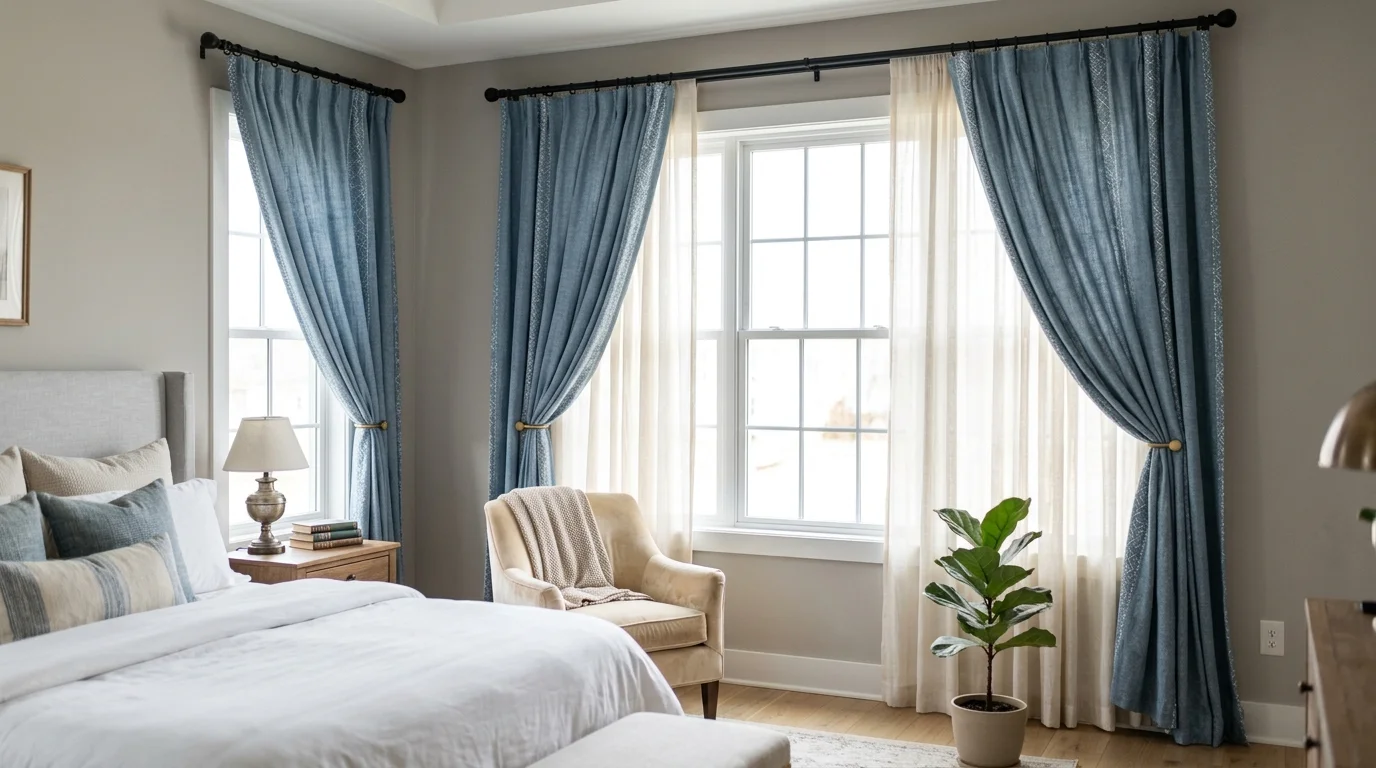
You walk into your bedroom after a long, exhausting day.
The room looks… fine. But something’s off. It feels flat. Lifeless. Like a hotel room nobody cares about.
Nine times out of ten? It’s the curtains. Or the complete lack of a good curtain setup.
Curtains are one of those things we ignore until we can’t anymore — either because the sun is blasting into our eyes at 6 AM, or because the neighbors can literally see us changing. Not great.
Here’s the thing though: the right curtain ideas for bedroom can completely flip the vibe of your entire space. We’re talking about going from “meh” to “wow” without repainting a single wall or buying new furniture.
So let’s get into it.
Why Bedroom Curtains Matter More Than You Think
Most people treat curtains like an afterthought. They grab whatever’s cheapest at the store, hang it up, and call it a day.
Big mistake.
Your bedroom curtains do way more than just block light. They control the mood, affect how big (or small) the room feels, set the privacy level, and honestly — they’re one of the first things guests notice when they peek in.
Think about it this way: curtains are basically clothing for your windows. You wouldn’t wear the same outfit to a beach party and a job interview, right? Same logic applies here.
The Big Question: What Do You Actually Need?
Before we dive into the fun stuff, ask yourself these three things:
- How much light do you want blocked? Do you sleep in on weekends? Do you have street lights shining in at night?
- What’s your room’s vibe? Cozy and rustic? Sleek and modern? Romantic and dreamy?
- What’s your budget? You can make a bedroom look incredible with ₹1,500 curtains OR ₹15,000 curtains — it’s all about knowing what to pick.
Got your answers? Cool. Let’s look at the actual ideas.
1. Blackout Curtains — The Sleep Lover’s Best Friend
If you’re a deep sleeper, a shift worker, or just someone who hates morning light with a burning passion — blackout curtains are non-negotiable.
These thick, dense curtains block out almost 100% of light. No more squinting at 5 AM because the sun decided to show up early.
What works best:
- Deep navy, charcoal, or forest green for a dramatic, cozy bedroom
- Linen-textured blackout curtains if you want a softer look
- Pair with a white sheer underneath for that layered, professional look
Pro tip: Don’t just get blackout curtains in boring beige. Go bold — a deep burgundy or slate grey set can make your entire room look like it belongs in an interior design magazine.
2. Sheer Curtains — Light, Airy, and Effortlessly Pretty
Sheer curtains are the opposite of blackout, and they’re honestly magical in the right bedroom.
They let in soft, diffused light that makes the whole room glow. Morning in a room with sheer white curtains? It feels like waking up inside a cloud. Very romantic, very Pinterest-worthy.
Best use cases:
- Rooms that face a garden or a nice view you want to enjoy
- Guest bedrooms where privacy isn’t a huge concern
- Pairing with heavier curtains for a layered look (more on this below)
Best colors for sheers: White, ivory, pale blush pink, light grey. Keep it soft and neutral — that’s the whole point.
3. Layered Curtains — The “I Know What I’m Doing” Move
Want to look like you hired an interior designer without actually paying for one? Layer your curtains.
Here’s how it works: you hang a sheer curtain closest to the window, then hang a heavier drape panel over it. During the day, you can push the heavy curtains aside and let the sheers filter the light. At night, close everything for full privacy.
This combo does three things:
- Looks incredibly luxurious and intentional
- Gives you flexible light control throughout the day
- Adds depth and dimension to the window area
The trick is to choose curtain colors that actually complement each other. White sheers with grey linen drapes. Ivory sheers with warm terracotta panels. The contrast is what makes it pop.
4. Floor-to-Ceiling Curtains — The “My Room Is Huge” Illusion
Here’s a design secret that interior decorators don’t advertise enough: hang your curtain rod high and wide.
Don’t hang it just above the window frame. Mount the rod as close to the ceiling as possible, and extend it at least 15–20 inches on each side of the window.
Why? Because it makes your windows look massive. It makes your ceilings look taller. It makes your entire room feel bigger and grander.
Even in a tiny bedroom, this trick can transform the space completely. The curtain panels sweep dramatically from ceiling to floor, and suddenly your room feels like it belongs to someone important.
Curtain ideas for bedroom using this technique:
- Velvet drapes in deep teal or emerald for a rich, dramatic effect
- Light linen curtains in natural beige for a calm, Scandinavian aesthetic
- White with subtle texture for a clean, hotel-suite feel
5. Velvet Curtains — Pure, Unapologetic Luxury
If you’ve ever walked into a room with velvet curtains and thought “wow, this feels expensive” — you’re not alone.
Velvet curtains are thick, heavy, and incredibly beautiful. They catch light in a way that no other fabric does. And they scream sophistication.
Colors that work amazingly in velvet:
- Burnt orange — warm, cozy, and surprisingly versatile
- Deep burgundy — romantic and bold
- Forest green — earthy and grounding
- Navy blue — classic and timeless
- Dusty rose — soft, feminine, and very trending
The only caution: velvet is heavy. Make sure your curtain rod and wall brackets can handle the weight.
6. Bohemian (Boho) Curtains — Relaxed, Earthy, and Totally Unique
Boho bedrooms have their own energy — and the curtains should match.
Think natural fabrics like cotton, linen, or jute. Loose, flowing textures. Earthy tones and natural patterns. Sometimes even macramé panels or tassel trim.
Boho curtain ideas that look stunning:
- White cotton curtains with hand-block printed patterns (florals, geometric, or tribal)
- Linen curtains with fringe or tassel hemline
- Macramé panels hung alongside simple white sheers
- Woven textured curtains in rust, sand, or terracotta
This style works especially well if your bedroom has plants, rattan furniture, or wooden accents. Everything ties together naturally.
7. Minimalist Curtains — Less Is More (and It’s Beautiful)
Some people don’t want drama. They want calm. Clean lines. A bedroom that feels like a deep breath.
For minimalist bedrooms, the curtain choice is all about simplicity and intention.
What minimalism looks like in curtains:
- Simple, unadorned linen panels in white, off-white, or warm grey
- No patterns, no fringe, no unnecessary detailing
- Pinch pleat or eyelet header for a clean top line
- Just enough length to touch the floor without pooling
The magic here is in the quality and the fit. A perfectly tailored, slightly textured linen curtain in warm white — hung correctly — is more beautiful than any elaborate, decorated curtain.
8. Patterned Curtains — Make Your Windows the Star
Ready to take a risk? Go patterned.
Patterned curtains can be the single most impactful design choice in your bedroom — when done right.
The rule: If your walls are neutral (white, grey, beige), you can go wild with patterns. If your walls are already bold or colorful, keep your curtains simpler.
Patterns that are killing it right now:
- Botanical prints — leaves, ferns, tropical motifs
- Geometric patterns — bold triangles, hexagons, abstract shapes
- Stripes — vertical stripes make the room feel taller
- Abstract watercolor prints — artistic and unique
- Traditional block prints — perfect for a warm, Indian-inspired aesthetic
9. Tie-Top Curtains — Casual, Cute, and Easy to DIY
Tie-top curtains have little fabric loops or ties at the top that you literally tie onto the rod. It’s a casual, relaxed look that works beautifully in a bedroom that leans cottagecore, farmhouse, or boho.
They’re also surprisingly easy to make yourself if you’re into DIY. A couple meters of your favorite fabric, some basic sewing, and you’ve got custom curtains that nobody else has.
Best fabrics for tie-top curtains:
- Muslin or cotton voile for a light, floaty effect
- Linen for a natural, textured look
- Printed cotton for a pop of personality
10. Roman Blinds + Curtain Combo — Functional and Stylish
Okay, this one’s a bit different. Instead of just regular hanging curtains, try combining Roman blinds (the kind that fold up in neat horizontal sections) with side drape panels.
The Roman blind handles your actual light control. The side panels are purely for decoration and framing.
This look is very popular in contemporary and transitional bedrooms. It’s neat, it’s modern, and it gives you that “designed by a professional” feel.
Color Psychology: Choosing the Right Curtain Color for Your Bedroom
Colors affect mood more than most people realize. Your bedroom curtain color isn’t just an aesthetic choice — it actively influences how you feel when you’re in the room.
Here’s a quick breakdown:
| Color | Mood It Creates |
|---|---|
| White / Ivory | Clean, fresh, airy, peaceful |
| Blue (any shade) | Calm, relaxing, great for sleep |
| Green | Natural, grounding, restful |
| Warm Grey | Sophisticated, neutral, modern |
| Terracotta / Rust | Warm, cozy, earthy |
| Deep Burgundy | Rich, romantic, dramatic |
| Blush Pink | Soft, feminine, gentle |
| Navy | Bold, classic, anchoring |
If your goal is a better night’s sleep, cool tones (blues and greens) are scientifically shown to promote relaxation. Warm tones (terracotta, rust, warm cream) make a space feel cozier and more inviting.
Curtain Length Guide — Get This Right or It Looks Wrong
This is where a lot of people mess up. The wrong curtain length can ruin an otherwise perfect setup.
Your options:
- Sill length — Curtains end at the windowsill. Best for kitchens or children’s rooms. Rarely used in bedrooms.
- Below sill (apron length) — Curtains end about 4–6 inches below the sill. Looks a bit awkward. Not recommended.
- Floor length — Curtains end just grazing the floor (about ½ inch above). This is the gold standard for bedrooms. Clean, elegant, and timeless.
- Puddle length — Curtains pool on the floor by 3–6 inches. Very dramatic and romantic. Works in formal or luxurious bedrooms.
The verdict: For most bedrooms, go with floor-length curtains that just graze the floor. It’s the safest and most stylish choice.
Budget-Friendly Curtain Ideas That Still Look Expensive
Good news: you don’t need to spend a fortune to get a bedroom that looks like it belongs in a magazine.
Smart budget tricks:
- Buy curtain panels in pairs and layer them — instead of buying one expensive thick curtain, buy two lighter, cheaper panels and layer them. More impact, less cost.
- Use a tension rod for lightweight sheers — no drilling needed, and they look just as good.
- DIY your curtains — plain canvas drop cloth from a hardware store makes surprisingly elegant, rustic curtains for almost nothing.
- Extend your existing curtains with fabric — if your curtains are too short, add a contrasting band of fabric at the bottom. It looks intentional and stylish.
- Shop secondhand — thrift stores and Facebook Marketplace often have quality curtain panels that just need a wash and an iron.
Curtain Hardware: The Detail Nobody Talks About (But Should)
Your curtain rod and rings matter more than you’d think.
A beautiful set of curtains hanging on a cheap, flimsy rod with ugly rings? It ruins the whole look.
Hardware that elevates the setup:
- Matte black rods — sleek, modern, very popular right now
- Antique brass / gold rods — warm, luxurious, pairs well with velvet or rich fabrics
- Natural wood rods — organic, boho, works with linen and cotton curtains
- Brushed nickel — clean, contemporary, understated
And please — use decorative finials (the end pieces on the rod). They’re a tiny detail that adds a finished, professional look to the whole setup.
A Real Story: How I Fixed My Bedroom With Just Curtains
A friend of mine — let’s call her Meghna — had a bedroom that she hated. Small, dark, and just depressing. She thought she needed to repaint everything or buy new furniture.
Instead, she replaced her old, short, beige curtains with floor-to-ceiling white linen panels, hung from a matte black rod close to the ceiling. She added a set of sheer white panels underneath.
Total cost: under ₹4,000.
The before and after were shocking. The room looked taller. Brighter. Bigger. More peaceful. All from curtains.
That’s the power of getting this right.
Trending Curtain Ideas for 2025
The curtain world (yes, it’s a world) moves with design trends. Here’s what’s hot right now:
- Earthy, muted tones — dusty pink, warm terracotta, sage green, clay beige
- Natural textures — linen, cotton, jute-blend fabrics in their natural state
- Pleated curtains — pinch pleat and goblet pleat styles are having a major comeback
- Monochromatic layering — using two shades of the same color for depth
- Statement hardware — chunky oversized rods and rings as a design element themselves
- Curved curtain rods — used to wrap around four-poster beds or bay windows for a very elegant effect
How to Hang Curtains Correctly (Common Mistakes to Avoid)
Even the best curtains look bad when hung wrong. Here’s what to watch out for:
❌ Hanging the rod too low — makes ceilings look shorter, windows look smaller. Always go high.
❌ Curtains that don’t reach the floor — nothing looks more unfinished. Always measure carefully.
❌ Rod that’s too narrow — the rod should extend well past the window on both sides so curtains can be pushed fully to the side without blocking light.
❌ Too few curtain panels — for a full, luxurious look, you want each panel to be 2–2.5x the width of your window. Skimpy panels look sad.
❌ Ignoring the lining — unlined curtains can look cheap in photos and in person. A simple lining adds weight, structure, and a more professional finish.
Conclusion: Your Bedroom Deserves Better Windows
Here’s the truth: your bedroom is the one space in your home that’s entirely yours. It’s where you start and end every single day. It should feel like a sanctuary — not an afterthought.
And curtains? They’re the fastest, most affordable way to completely transform that feeling.
Whether you go with rich velvet drapes for drama, airy linen panels for calm, or bold patterned curtains for personality — the right curtain ideas for bedroom can turn a forgettable room into one you genuinely love being in.
Start with what feels true to your vibe. Don’t overthink it. And remember: hang them high, let them touch the floor, and choose a color that makes you feel something.
That’s really all it takes.
Frequently Asked Questions (FAQ)
Q1: What type of curtains are best for a small bedroom? Floor-to-ceiling curtains in light, neutral colors work best for small bedrooms. Hanging the rod close to the ceiling creates the illusion of height, and light fabrics like linen or sheer cotton keep the room from feeling cramped. Avoid very dark, heavy curtains unless you layer them with sheers.
Q2: How do I choose curtain color for my bedroom? Match your curtain color to the feeling you want. Blues and greens promote sleep and calm. Warm neutrals (beige, cream, terracotta) create coziness. Deep, rich tones (navy, burgundy, emerald) add drama. A safe rule: pick a color that already appears somewhere else in your room — in your bedding, rug, or an accent pillow. This ties everything together.
Q3: Should bedroom curtains touch the floor? Yes — for a polished, designed look, bedroom curtains should just graze the floor (about ½ inch above) or lightly pool on it for a dramatic effect. Curtains that hover above the floor look unfinished and awkward.
Q4: Are blackout curtains bad for health? No — blackout curtains are actually beneficial for sleep quality. Blocking light helps regulate your body’s melatonin production, leading to deeper, more restful sleep. They’re especially helpful for people who sleep during the day or live in areas with lots of artificial light at night.
Q5: How many curtain panels do I need for one window? For a full, luxurious look, each panel should be 1.5 to 2.5 times the width of your window. So for a standard 90 cm wide window, each panel should be at least 135–225 cm wide. Most people use 2 panels per window — one for each side. If your window is large, consider 3 or 4 panels for an extra-full, dramatic effect.